

A Dark Day for Civil Rights in Iowa: Transgender Protections Are Stripped Away
Iowa Becomes the First State to Repeal Gender Identity Protections, Sparking Outrage and Protests at the Capitol
Update: February 28, 2025 – Governor Kim Reynolds Signs SF 418 into Law
As expected, Governor Kim Reynolds signed Senate File 418 (SF418) into law today, officially making Iowa the first state in U.S. history to repeal gender identity protections from its civil rights legislation. This unprecedented law has already drawn widespread criticism from civil rights advocates and legal experts, sparking fears of its implications for transgender Iowans and the broader LGBTQ+ community across the nation. Courtney Reyes, Executive Director of One Iowa, condemned the law in a public statement: “This is a devastating step backward for our state. Stripping away protections for transgender Iowans sends a clear message that their rights and dignity don’t matter. We will not stop fighting until equality is restored. ”The ACLU of Iowa has also announced plans to challenge the law’s constitutionality, calling it “a blatant violation of equal protection under the law.” While legal battles are expected to follow, advocates warn of the immediate harm the law will cause, including increased discrimination in housing, employment, and public spaces. Although protests at the Capitol have subsided since yesterday’s record-breaking turnout of 2,500, grassroots organizing efforts continue to gain momentum. The signing of SF 418 marks a significant and troubling shift for Iowa, a state once celebrated for its leadership in civil rights. Now, the nation watches closely as the fight for equality continues.
Today, February 27, 2025, will be remembered as a day when civil liberties for some of Iowa’s most vulnerable residents were dealt a devastating blow. As hundreds of protesters gathered on the Capitol Grounds in Des Moines, Senate File 418 (SF418) advanced to the desk of Governor Kim Reynolds, who is widely expected to sign it into law. This legislation, which removes gender identity from the Iowa Civil Rights Act, marks a significant rollback of protections for transgender individuals—rights they’ve held for 18 years.
The passage of SF418 also marks a chilling milestone: Iowa is now the first state in U.S. history to repeal gender identity protections from its civil rights laws. While other states have introduced restrictive measures targeting transgender individuals, no state has gone as far as to reverse long-standing protections once enshrined in law. This shocking precedent sends ripples far beyond Iowa's borders, signaling a dangerous shift in how civil rights for marginalized groups may be contested and dismantled across the nation.
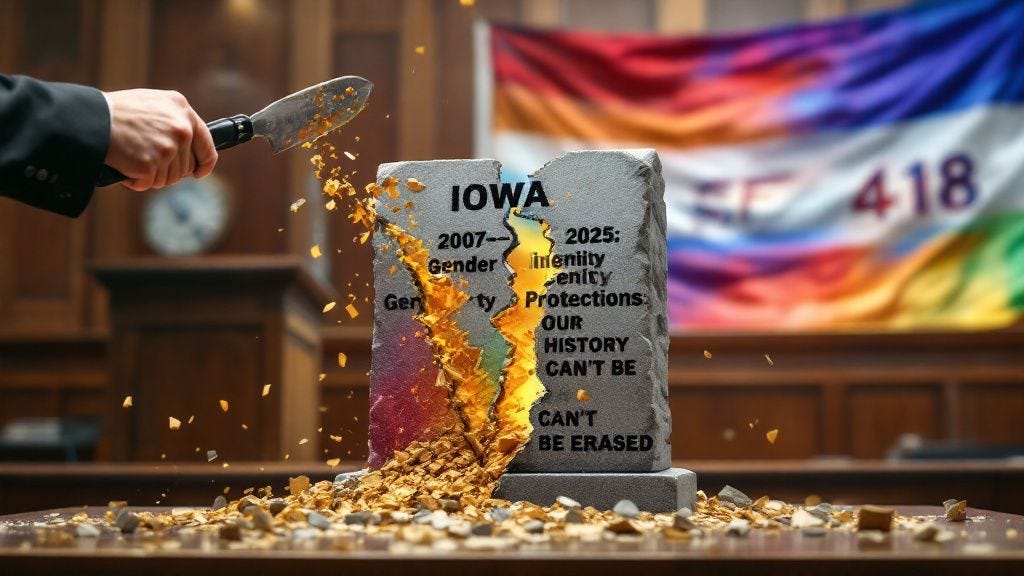
This cuts deeper than politics or policy debates—it's about our neighbors, friends, and family members who will wake up tomorrow facing more closed doors and fewer helping hands. I see the weight of this in their eyes: the dignity stripped away, the safety threatened, the message that somehow they don't fully belong. When we talk about marginalized communities, we're talking about real people with hopes and heartaches just like anyone else, people whose fundamental human need for respect and protection is being pushed further from reach.
What’s at Stake
SF418 goes beyond simply removing gender identity from the Iowa Civil Rights Act. It fundamentally redefines sex in state law as binary, ignoring the complexities of lived experiences. Under this redefinition:
Transgender individuals will no longer be protected against discrimination in employment, housing, education, or public accommodations.
Public spaces like restrooms, locker rooms, and women’s shelters will be legally closed off to transgender Iowans based on their gender identity.
Transgender Iowans will lose the ability to update the gender marker on their birth certificates, forcing them to carry documents that misrepresent their identities for life.
For transgender people in Iowa, this legislation isn’t theoretical—it’s deeply personal. It chips away at their ability to live openly and safely, stripping away protections they’ve relied on to navigate a world that is already challenging to exist in.
Protesters Speak Out: “This Is Dehumanizing
The outrage at the Capitol today was palpable. Protesters of all ages, backgrounds, and genders came together to send a clear message: this bill is wrong. Signs reading “Protect Trans Kids,” “Equality for All,” and “We Will Not Be Erased” dominated the crowd as chants echoed through Capitol Building.
One protester, a transgender high school student named Alex, spoke about how this bill affects their ability to feel safe in their own state. “This isn’t just a law—it’s my life. What happens when someone fires me just because I’m trans? What happens when I can’t find housing because of who I am? I don’t think lawmakers understand what they’re doing to us.”
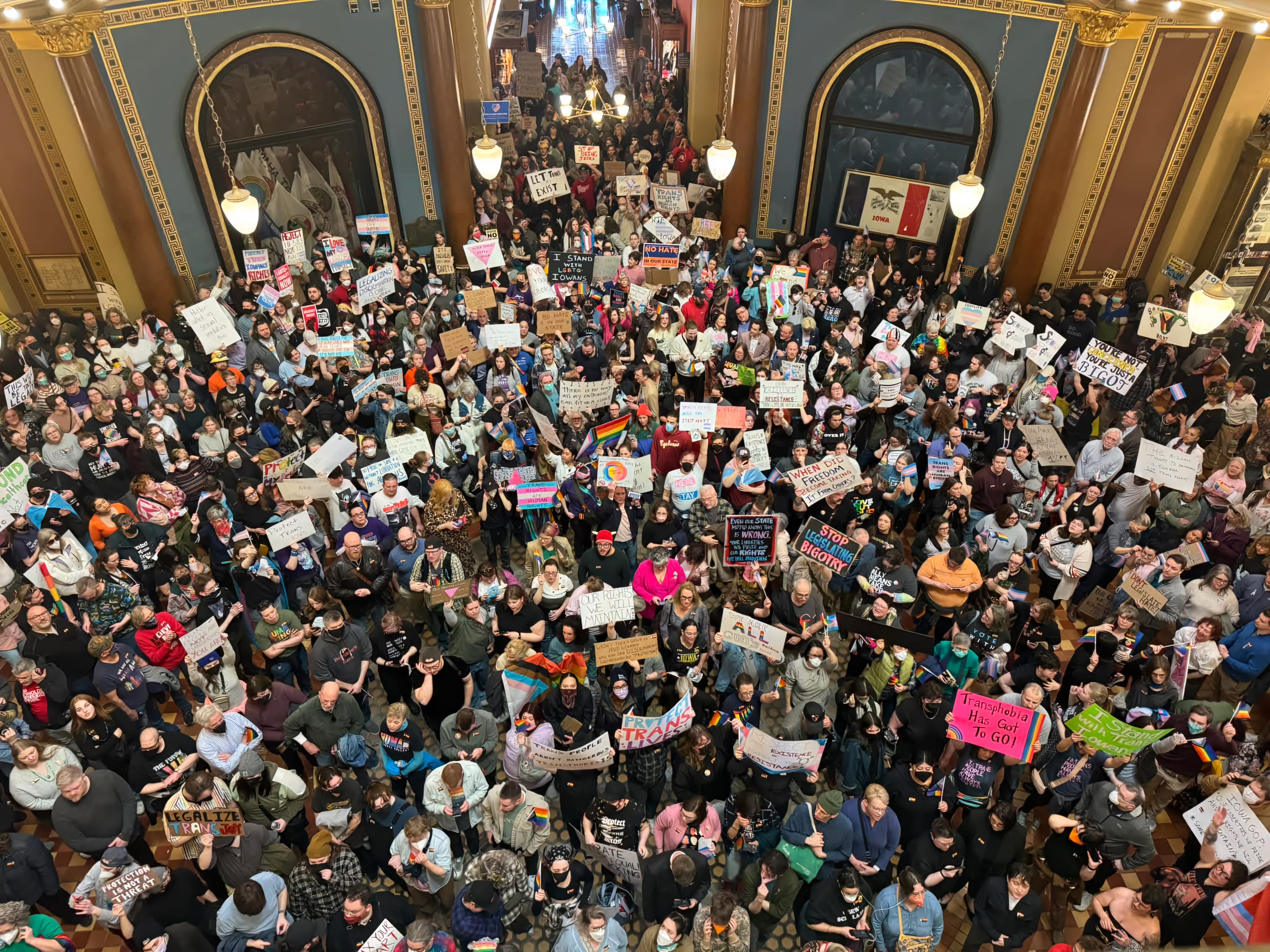
Parents of transgender children were also present, many expressing fear for their kids’ futures. “We’ve worked so hard to show our daughter that she’s loved and supported,” said one mother. “Now, the state is telling her she doesn’t matter. It’s heartbreaking.”
Advocacy organizations like the ACLU of Iowa and Iowa Safe Schools have been vocal in their opposition, calling this legislation one of the most dangerous actions taken against transgender people in recent history. However, despite their efforts and the protests today, SF418 passed with a 60-36 vote in the Iowa House and a 33-15 vote in the Senate.
A Chilling Precedent
The passage of SF418 makes Iowa the first state in the nation to repeal gender identity from its civil rights protections. This is not a distinction any state should aspire to hold. While many states have taken steps to limit transgender rights in recent years—through laws restricting access to healthcare, sports participation, or public facilities—Iowa’s decision to reverse protections already codified in law is unprecedented.
This sets a chilling precedent for other states considering similar legislation. It signals a broader push to roll back LGBTQ+ protections at a time when the community is already facing increased levels of violence, discrimination, and political hostility.
But the impact of this legislation goes far beyond legal definitions. It sends a loud and clear message to transgender individuals: that their rights, their identities, and their humanity are not valued. For a state that once prided itself on being a leader in civil rights—having legalized same-sex marriage in 2009—this moment feels like a cruel reversal.
When laws like this are written into existence, they etch something painful into the hearts of our transgender neighbors—something that whispers 'you don't belong here' in all the spaces they call home. I've seen the look that crosses someone's face when they realize their very identity is being debated like a theoretical concept rather than the core of who they are. How crushing it feels to watch a place you love—a state that once stood tall by embracing marriage equality before many others dared to try—now turn its back on marginalized people. There's something particularly heartbreaking about having hope extended and then withdrawn, like a hand reaching out only to pull away just as you reach for it.
While legal challenges are almost certain, they take time, and the damage done to the community’s sense of safety and inclusion is immediate. Transgender Iowans are now left wondering: What happens next? Will this embolden further attacks on LGBTQ+ rights? Will my state ever fully welcome me again?
The Fight Isn’t Over
Although today feels like a loss, the fight for equality is far from over. The protests at the Capitol are a testament to the resilience of the LGBTQ+ community and its allies. In every chant, every sign, and every story shared, there was a refusal to back down—a refusal to accept this as the end of the road.
Transgender rights advocates are already mobilizing for the next steps, whether through court challenges, grassroots organizing, or simply showing up to support those most affected. The ACLU of Iowa has pledged to explore legal avenues to challenge this legislation, while community organizations are calling on allies to step up and stand in solidarity.
For those watching this unfold from outside Iowa, it’s a reminder of how fragile civil rights can be. Progress is never guaranteed, and it can be undone in the blink of an eye. But it’s also a reminder of the power of collective action. The hundreds of voices that rose up today in Des Moines are part of a much larger movement—one that will continue to push for equality, even in the face of setbacks.
A Personal Reflection
As I reflect on the events of this day, I can’t help but think about the young transgender Iowans who are watching this unfold. What message are we sending them when we strip away their protections? When we tell them that their identities are invalid? When we take away their safety net and leave them to navigate a world that is often unkind to those who are different?
Today isn't just about bills or debate chambers—it's about the breath catching in someone's throat when they realize a new law means they'll have to look over their shoulder more often. It's about the parent losing sleep tonight, wondering how to explain to their child that the world feels less safe now because of decisions made by people who'll never know their names. Yes, headlines will tally political wins and losses, but history asks us to see the stories behind the statistics: the hands trembling as they fill out forms that suddenly matter more, the friends lowering their voices in public spaces, the quiet erasure of belonging. Let the policymaking jargon fade—what remains is the sound of hearts beating faster in rooms where safety used to feel guaranteed.
To those affected by this bill: You are seen, you are valued, and you are not alone. The fight for equality is far from over, and there are countless people standing with you, ready to push back against this injustice.
Let today serve as a wake-up call: Rights are not permanent unless we fight to protect them. And for the transgender community in Iowa and beyond, the fight continues.
If you want to support the fight for transgender rights, consider donating to advocacy organizations like Iowa Safe Schools, ACLU of Iowa, and One Iowa. Together, we can ensure that this dark moment becomes a turning point for justice and equality.