

A Resignation Is Not an Audit: Why Iowa Still Owes its Public Employees Answers
Iowa officials have framed the IPERS leadership departures as a personnel matter. The investment-governance questions already on file in court have not been publicly answered.

Iowa’s largest public pension system spent the spring of 2026 answering one question — who would lead it next.
They have not answered the governance question: whether Iowa reviewed the investment-risk, benchmarking, fee, and bonus-related allegations already pending in court.
On April 7, Governor Kim Reynolds said the public process was still underway and that “once that is completed, there will be a review of what next steps look like.”
By May 18, after former IPERS CEO Greg Samorajski had resigned and Chief Benefits Officer Steve Herbert had been removed, that promise had narrowed.
Asked by The Gazette whether Iowans would eventually receive more information about the investigation, Reynolds replied: “No, no.” She again framed the matter as personnel, saying she was “not going to share a lot,” while adding that the investigation had “no impact whatsoever on the IPERS fund” and involved no criminal charges.
That answer does not close the governance question. It sharpens it.
The public is now being asked to accept three things at once: that personnel concerns serious enough to produce departures at the top of IPERS existed; that the matter did not threaten the fund or involve criminal conduct; and that no additional details will be released that would let public employees, retirees, lawmakers, or the Investment Board determine whether the inquiry touched the separate investment-governance allegations already pending in court.
A personnel explanation may account for who left. It still does not answer what was reviewed.
From “Next Steps” to “No, No”
On April 7, 2026, asked whether the public would eventually learn details of the state investigation, Reynolds said (lightly condensed for clarity):
“Everybody deserves the right to go through the process … once that is completed, there will be a review of what next steps look like. It has no impact on the solvency of the trust fund and all the beneficiaries will continue to receive their payment. This is a personnel issue, so I’m not going to be able to comment on that … but it has absolutely no impact on solvency or the ability to allocate payments.”
Two things matter about that statement. The solvency reassurance was accurate as stated. Benefits are not at risk. The fund is not in crisis. And — separately — the review of next steps that Reynolds promised once the process completed has, in the public record reviewed for this article, produced personnel actions and a CEO search, but no announced independent review of the investment-governance allegations already on the public record.
That distinction matters because the Governor’s own public language shifted as the process moved from investigation to closure.
But the reason the personnel explanation is incomplete is already sitting in the public court record.
What the Court Filing Already Says
A month before the administrative leaves, a court filing in Polk County had already put detailed allegations into the public record.
On January 30, 2026, former IPERS Investment Risk and Operations Officer Rich Wiggins filed an amended petition in Wiggins v. State of Iowa, LACL163118, Polk County District Court.
The petition alleges flawed risk reporting; a benchmarking structure that, if accurate, made underperformance essentially impossible across large portions of the portfolio; management fees structured so they could not be itemized; and false bonus‑related information submitted to a state board after Wiggins was terminated in February 2023.
RDP’s April 6, 2026 article, Newly Obtained Amended IPERS Lawsuit Expands Allegations on Risk, Fees, and Benchmarking, lays out the petition in detail and remains the technical source.
These are allegations in a court filing, not findings. The State of Iowa contested them through a motion to dismiss. On April 19, 2026 — twelve days after Reynolds characterized the matter as a personnel issue — Judge Jason Walke denied that motion.
A denial of a motion to dismiss is a procedural ruling. It means the case survives and proceeds unless resolved. It does not prove the allegations, but it means the case survived the State’s attempt to end it at the pleading stage.
That distinction matters because Iowa already has audit reports in the public record. Those reports answer financial-statement and compliance questions within their stated scope. They do not, by that same stated scope, answer whether anyone reviewed the investment-governance allegations raised in the Wiggins petition.
Whether the two are related is precisely what officials have not publicly said.
The petition’s allegations remain allegations. But they are the specific allegations Iowa officials have not publicly said were reviewed, audited, or resolved.
What the State Audits Did — and Did Not — Cover
The Iowa State Auditor issued a Government Auditing Standards companion report on IPERS dated December 18, 2025, as part of the FY2025 financial-statement audit. Within its scope — the financial statements as of June 30, 2025, internal control over financial reporting, and limited compliance testing — the report found no material weaknesses and no instances of noncompliance required to be reported. A separate GASB 68 accounting audit released on March 24, 2026 also reported no findings, but addressed only employer-allocation schedules.
The December 18 report itself states that its purpose “is solely to describe the scope of our testing of internal control and compliance and the results of that testing, and not to provide an opinion on the effectiveness of IPERS’ internal control or on compliance.”
Those findings are meaningful within their scope. They are not the same thing as an investment-governance review, and they should not be read as evidence that the Auditor’s Office could simply expand the assignment at will. Since 2023, Iowa law has narrowed the State Auditor’s access to some categories of information and moved certain records disputes involving state agencies and the Auditor out of ordinary court enforcement and into an arbitration process instead.
Neither report, by its stated scope, appears designed to examine the questions raised in the Wiggins petition: investment-governance methodology, benchmarking structure, management-fee disclosure practices, fiduciary conduct, ethics compliance, or conflicts of interest. The point is not that the audits failed. The point is that they were never designed to answer the questions the petition raises.
An outside voice with experience in public-pension governance reached the same structural reading.
Public pension expert Chris Tobe, a former trustee of the Kentucky Retirement Systems and author of several books on pension governance, said the personnel explanation does not answer the governance question.
“When a public pension system removes senior officials after an internal investigation with no transparency, it tells you nothing except that IPERS is secretive,” Tobe said. “As far as we know, it is totally unrelated to investment governance issues.”
In a sharper assessment, Tobe added, “Everything I have seen indicates that IPERS is committed to covering up the investment governance issues in the Wiggins litigation.”
Tobe’s warning goes to the heart of the issue: a personnel explanation is not an investment-governance review.
That is why provenance matters. RDP was not reverse-engineering a governance question after the resignations. It was already asking one.
RDP Was Already Asking
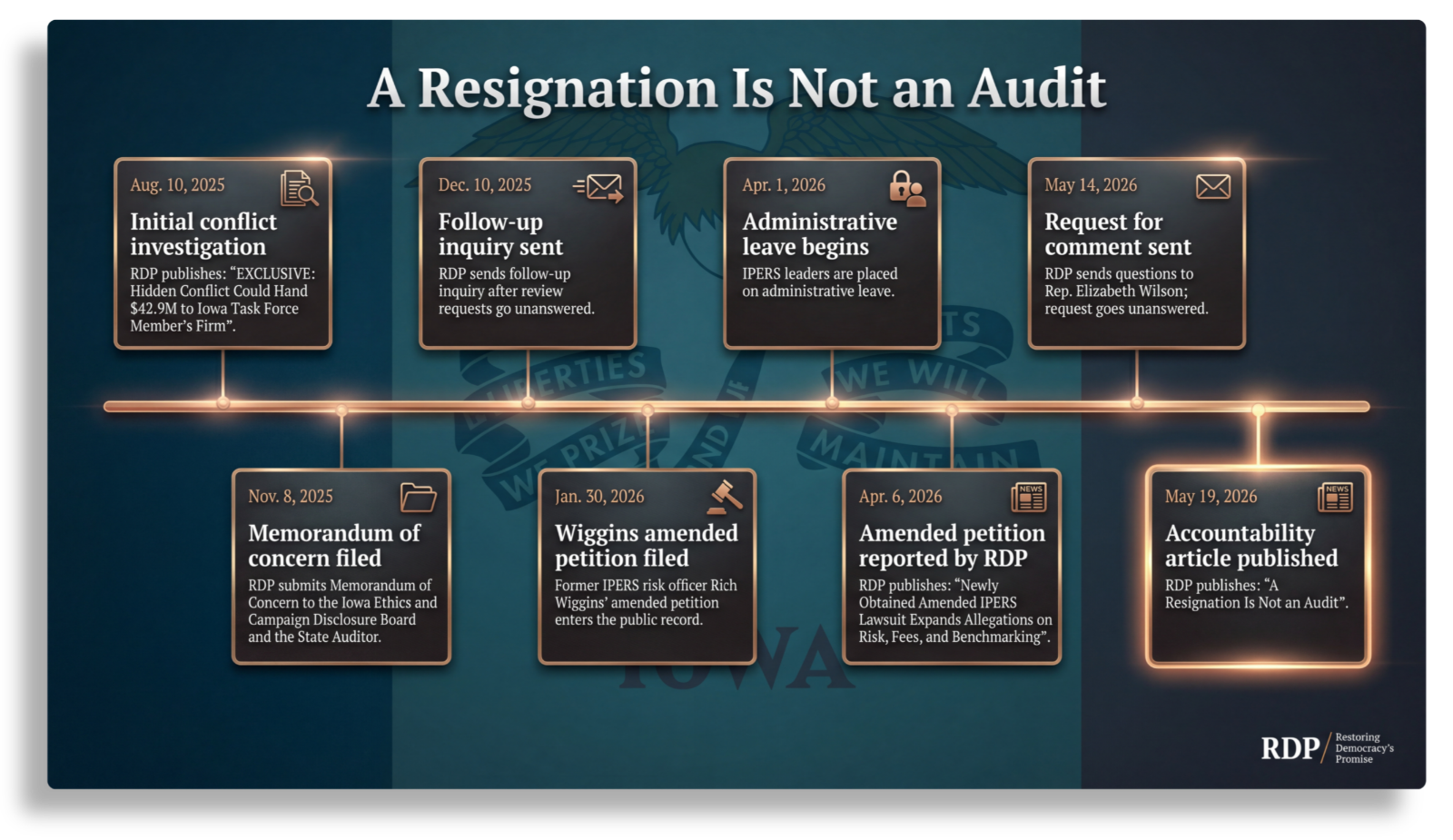
Restoring Democracy’s Promise did not arrive at the governance question after the headlines.
In August 2025, RDP published a conflict-of-interest investigation related to IPERS and an executive appointed by Governor Reynolds to the Iowa DOGE Task Force. In November 2025, RDP submitted a Memorandum of Concern to the Iowa Ethics and Campaign Disclosure Board, citing fiduciary concerns and requesting an independent review under Iowa Code §§ 68B.2A and 68B.25.
One specific governance question RDP already had on the record involved IPERS private-equity oversight. The relationship between IPERS’ general investment consultant, Wilshire Associates, and Pathway Capital Management — a private-equity fund-of-funds manager founded by former Wilshire partners and used in IPERS’ private-equity program — raises a basic independence question. The concern was not that the relationship, by itself, proved misconduct. The concern was that the public record left unanswered whether the consultant charged with providing independent advice was sufficiently independent from the private-equity structure it was helping oversee. Nine months later, that question still has not been publicly answered.
That is exactly why a personnel resolution is not a governance audit.
In May 2026, RDP notified IPERS leadership of the governance questions already on file and sent written questions to Rep. Elizabeth Wilson, who had been quoted in press coverage of the investigation. No response was received before publication.
That sequence does not prove the Wiggins allegations. It establishes only that governance questions about IPERS were on the public record — in court filings, in a formal ethics submission, and in newsroom inquiries — before officials framed the outcome as a personnel matter.
Support Independent Journalism with a free or paid subscription.
What Iowa Has Not Publicly Answered
These are not technical quibbles. They are the minimum questions needed to know what the public process actually examined.
The reviewed public record identifies no official response to any of the following:
Who conducted the investigation of Samorajski and Herbert?
What was its written scope?
Did it examine risk-reporting methodology?
Did it examine benchmarking structure?
Did it examine management-fee and transaction-cost disclosure?
Did it examine the bonus-related information alleged to have been submitted to the IPERS Investment Board?
Were findings provided to the IPERS Investment Board?
Will any findings be released publicly?
Until those questions are answered by someone with clear authority and independence, Iowans are being asked to treat “trust us” as a substitute for an audit.
No statement by the Governor’s Office, the IPERS Investment Board, or any other public official identified in the materials reviewed for this article directly answers those questions.
What Iowans Were Told, and What They Were Not
IPERS, Iowa’s largest public pension system, had 423,989 members in FY2025 — teachers, corrections officers, state workers, firefighters, and retirees. One in ten Iowans is an IPERS member. In FY2025, the fund paid $2.759B in benefits, including $2.442B to members living in Iowa. The net investment portfolio at FY2025 close stood at $46.682B. The funded ratio was 92.2 percent.
Those figures are why accountability matters. They are also why solvency was never the question.
Benefits being safe is not the same as governance having been reviewed. Clean financial reporting is not the same as an audit of investment methodology. A personnel action is not fiduciary accountability.
Those questions were raised in a court filing that survived a motion to dismiss. They were raised in a formal memorandum to state ethics officials. They were raised in newsroom inquiries that went unanswered. No reviewed public document shows that any independent body examined those investment-governance questions or released findings about them.
The question is not whether the checks will clear.
The question is whether Iowa reviewed the system behind them.
Iowa officials resolved the personnel question in public. They have not resolved the governance question in public. Until they do, the most important issue raised by the Wiggins record remains unanswered.
In a forthcoming article, RDP will examine how IPERS’ private-equity structure — including its consultant and fund-of-funds relationships — fits into those unanswered governance questions.
About this article: The allegations described above are drawn from the amended petition in Wiggins v. State of Iowa, LACL163118, Polk County District Court, and are allegations in a court filing — not adjudicated findings of fact. Governor Reynolds’ quote is from her April 7, 2026 press availability and has been lightly condensed for clarity; the unedited statement is preserved in the source record.
Reference List
Barton, T. (2026, May 18). Reynolds: No details will be released on IPERS misconduct investigation. The Gazette.
Iowa Judicial Branch. (2026). Iowa Courts Online — Case docket, Case 05771 LACL163118 (Wiggins v. State of Iowa) [Docket record].
Iowa Public Employees’ Retirement System. (2025). Annual comprehensive financial report, fiscal year 2025. Iowa Public Employees’ Retirement System.
Iowa Public Employees’ Retirement System. (2025). Performance report, fiscal year 2025. Iowa Public Employees’ Retirement System.
Iowa State Auditor’s Office. (2025, December 18). Iowa Public Employees’ Retirement System — Independent auditor’s report on internal control over financial reporting and on compliance and other matters (Government Auditing Standards companion report) [Audit report]. Office of the Auditor of State.
Iowa State Auditor’s Office. (2026, March 24). Iowa Public Employees’ Retirement System — Schedule of employer allocations and pension amounts by employer (GASB Statement No. 68) [Audit report]. Office of the Auditor of State.
Office of the Governor of Iowa. (2026, May 7). Gov. Reynolds announces resignation of IPERS CEO [Press release].
Restoring Democracy’s Promise. (2025, November 8). Memorandum of concern regarding IPERS governance and possible violations of Iowa Code §§ 68B.2A and 68B.25 [Formal memorandum submitted to the Iowa Ethics and Campaign Disclosure Board and copied to State Auditor Rob Sand].
Reynolds, K. (2026, April 7). Press availability [Audio recording and transcript]. Office of the Governor of Iowa.
Tucker, T. C. (2025, August 10). EXCLUSIVE: Hidden conflict could hand $42.9M to Iowa Task Force member’s firm. Restoring Democracy’s Promise.
Tucker, T. C. (2026, April 6). Newly obtained amended IPERS lawsuit expands allegations on risk, fees, and benchmarking. Restoring Democracy’s Promise.
Wiggins v. State of Iowa, No. LACL163118 (Polk Cnty. Dist. Ct. Iowa) (amended petition filed January 30, 2026; State’s motion to dismiss denied April 19, 2026, Walke, J.).
This is outrageous. Excellent reporting.