

EXCLUSIVE: Hidden Conflict Could Hand $42.9M to Iowa Task Force Member’s Firm
RDP investigation uncovers how a state pension overhaul could turn policy into profit.

1. Executive Summary
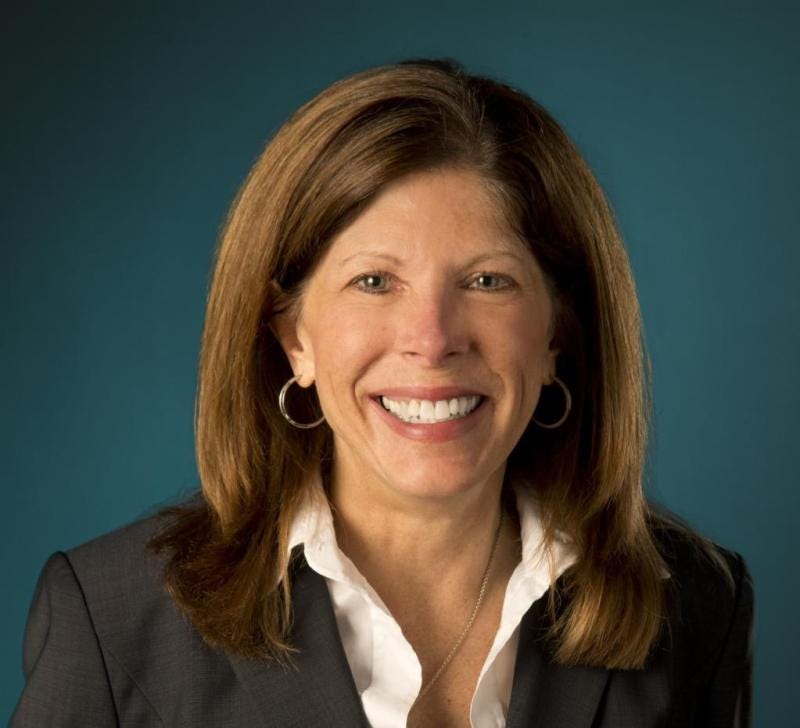
In Iowa, the fox is guarding the henhouse—and the prize is a $143 million market for private financial firms. Kathy Kay, a top executive at Principal Financial Group, helped craft a state task force plan to scrap the public pension system for new hires and replace it with 401(k)-style accounts—the very product her company profits from.
Our analysis shows this change would create a $143 million market for private financial firms over the next decade, with Principal Financial positioned to capture $42.9 million of that total. These projections are validated against industry benchmarks and confirmed through rigorous sensitivity analysis.
This isn’t a homegrown solution. Iowa’s proposal mirrors the American Legislative Exchange Council’s (ALEC) Defined-Contribution Pension Reform Act—a national blueprint for dismantling public pensions. The political sensitivity is so high that some officials have tried to distance themselves from the plan after initially backing it.
Iowa is being used as a test case—part of a coordinated national agenda, fueled by corporate-sector interests, to privatize public retirement security across America.
💡 Help Expose the Truth
Join thousands who rely on Restoring Democracy’s Promise for fearless, fact-driven investigations.
Subscribe Free or become a supporter to power more reporting like this.📢 Share This Investigation:
🌌 Bluesky
One share can put this investigation in front of thousands more Iowans.
Our live interactive chart (Figure 1) shows how much Principal could make under three scenarios—baseline, optimistic, and conservative.

2. The Principal Conflict: A Showstopper of Corporate Graft
The Player: A Top Executive at a 401(k) Giant
Governor Kim Reynolds appointed Kathy Kay, Executive Vice President and Chief Information Officer of Principal Financial Group, to Iowa’s DOGE Task Force — the body tasked with reimagining the state’s public pension system. Principal, one of the largest 401(k) and defined-contribution retirement plan providers in the U.S., now had a top executive sitting at the table where the future of Iowa’s IPERS would be decided.
Key Finding: The DOGE plan would funnel $2.85 billion into private accounts within a decade, stacking $143 million in Wall Street fees. Principal Financial — where task force member Kathy Kay is an executive — could rake in $42.9 million of that haul.
The task force didn’t stop there. Its 45 recommendations also align with corporate interests in manufacturing and engineering, blurring the line between public policy and private profit. These overlaps come not from speculation, but directly from the task force’s own report and public records.
Figure 2 exposes the play: when a task force stacked with industry insiders makes the rules, Wall Street walks away with billions.
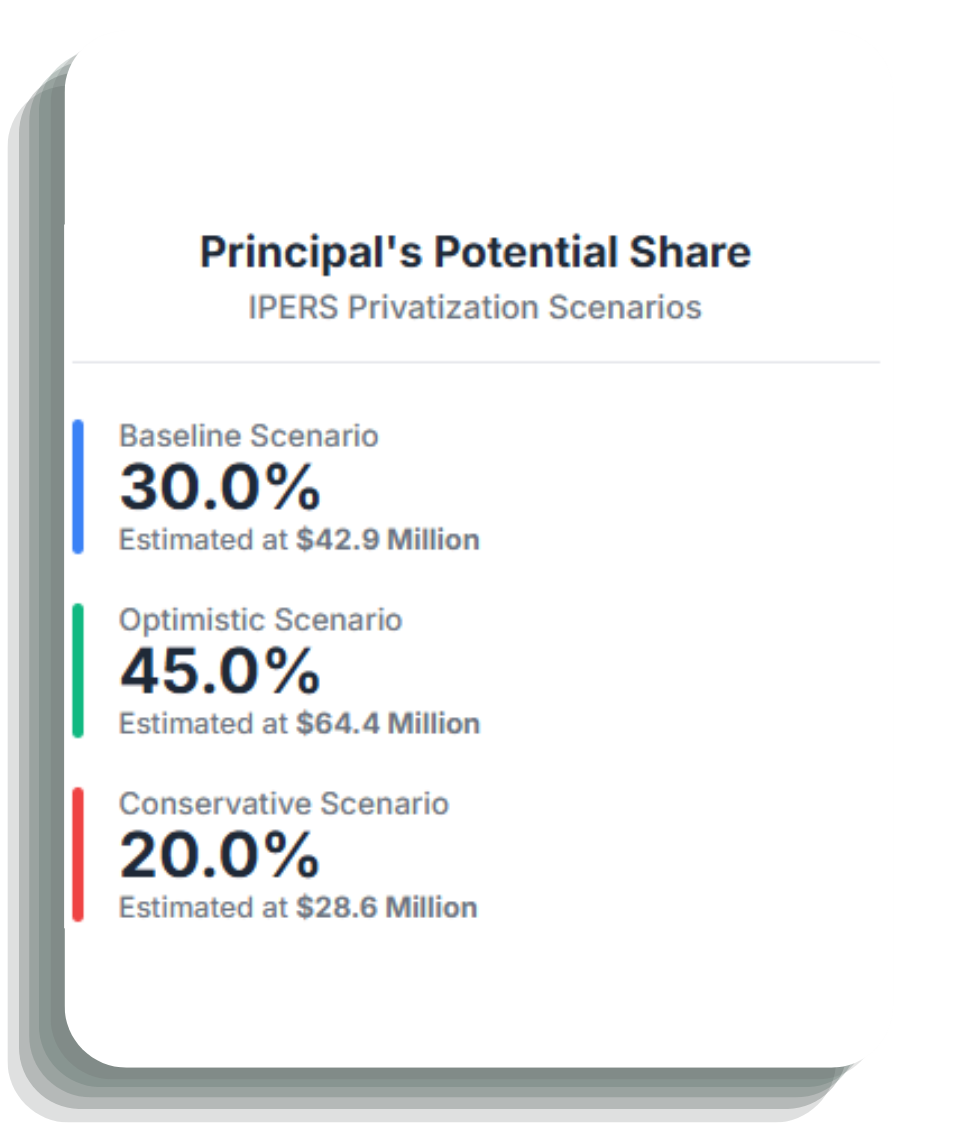
If adopted, the DOGE plan would redirect tens of millions in public retirement funds to private firms—led by Principal Financial, where Task Force member Kathy Kay is an executive vice president. The public loses a stable pension; private finance gains a guaranteed revenue stream.
This isn’t just a potential conflict of interest — it’s a precision-engineered cash grab. With no public record of Kay’s role being disclosed, debated, or mitigated, Iowa’s pension overhaul is being steered through a pipeline built for private profit.
📂Explore the Full Evidence
The complete Primary Sourcing Dossier, Master Source List, and all primary source documents are available in the Evidence Locker for our paid subscribers.
3. Policy DNA: Iowa’s Proposal Traced to a National Template
To determine the policy's origin, an RDP computational analysis compared the Iowa proposal with the American Legislative Exchange Council (ALEC). ALEC's "Defined-Contribution Pension Reform Act.” The results show a clear pattern of conceptual adoption, not direct copying.
Policy Comparison: ALEC Model vs. Iowa DOGE Proposal
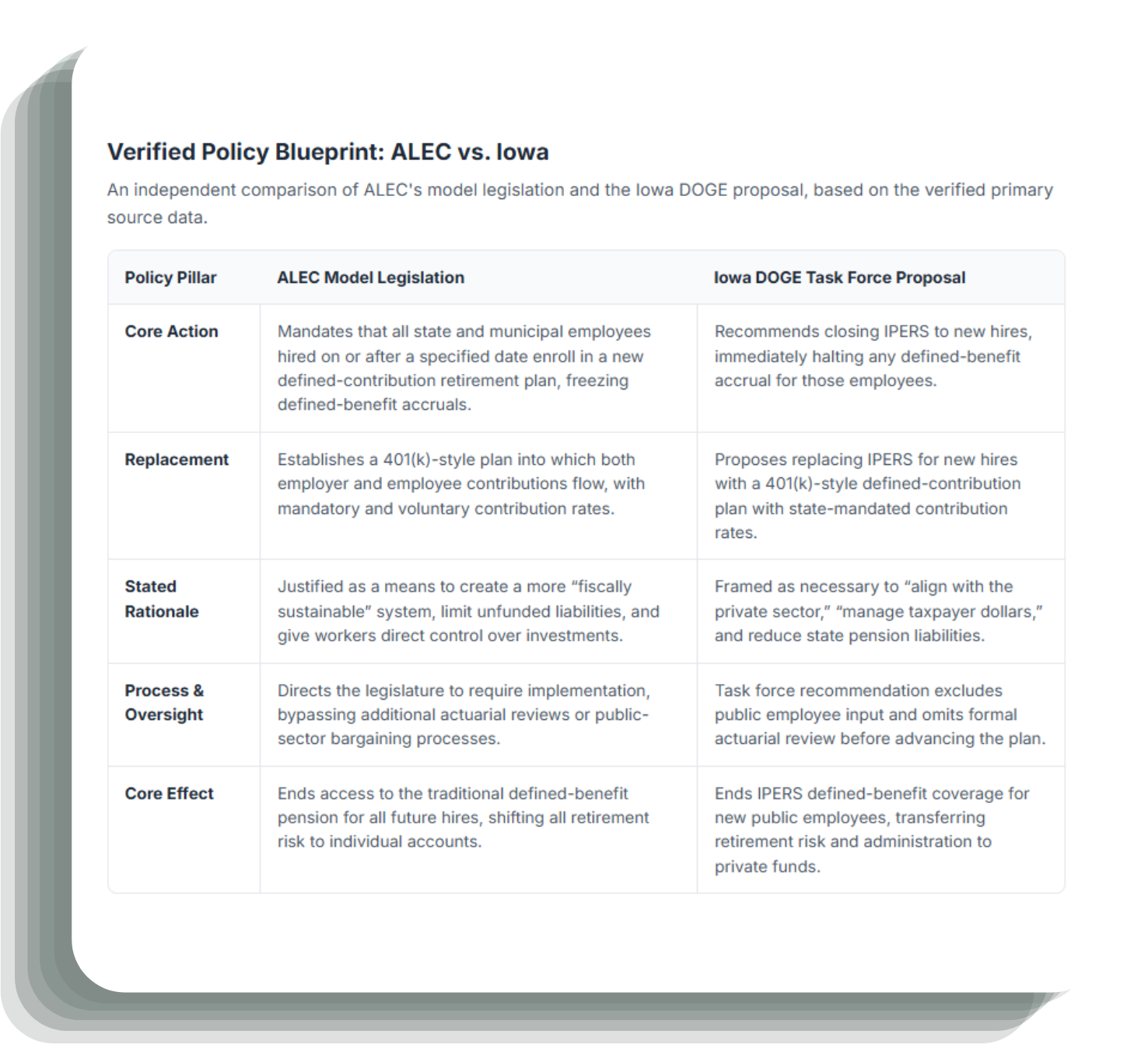
This side-by-side comparison demonstrates that the Iowa proposal is not a novel state innovation, but rather a state-specific iteration of ALEC’s pre-written policy script. By simply swapping “state and municipal employees” for “IPERS new hires” and adjusting dates and agency names, the Task Force reproduced ALEC’s entire policy architecture—complete with the same stakeholder-exclusion mechanism and 401(k) framework—under the veneer of local reform.
4. The Iowa Political Context
As the controversy deepens and appointees quietly distance themselves from the fallout, the outlines of a deliberate political strategy come into focus. This is no drift into chaos — it’s an engineered sequence.
A. The Governor’s Role
Governor Kim Reynolds has maintained a conspicuous public silence. She has not defended the task force’s proposal or directly addressed the growing backlash. But this absence is not neutrality — it’s the second phase of a calculated two-step: active enablement followed by strategic disengagement.
Phase 1: Active Enablement
Governor Reynolds was the architect of this process.
Personally established the DOGE Task Force by executive order in February 2025.
Hand-picked its members, creating a body dominated by corporate executives (80%) while explicitly excluding representatives from public labor, teachers, or IPERS beneficiaries.
Gave the task force its mandate to "run the state like a business," which framed the public pension system as an "outlier" to be eliminated.
Before the backlash, lent her administration's credibility to the process, publicly praising the members and their work.
Phase 2: Strategic Silence
Once the policy outcome was set in motion, Reynolds stepped back, leaving the committee to carry her blueprint forward. This creates an accountability vacuum, allowing high-profile members like Reynolds Cramer, CEO of Fareway Stores and DOGE Task Force member, to disavow the most controversial elements without challenge from the executive branch.
This distance shields her from political damage while keeping the policy trajectory aligned with national conservative agendas. Her silence is not retreat — it is the final stage in a strategy to advance a deeply unpopular overhaul while minimizing her personal political cost.
The DOGE Task Force's final report is scheduled for delivery to Governor Reynolds on September 29, 2025.
B. A Captured Committee
The DOGE Task Force was never a neutral policy body. From its first meeting, its composition guaranteed a predetermined outcome: public pension dollars flowing into private hands.
Of its members, a supermajority came from corporate leadership — including industries positioned to profit directly from the recommended changes. Public-sector voices were tokenized, not empowered; labor and retiree representatives were absent altogether. The result was a committee that looked like oversight but functioned like an investment prospectus.
Every recommendation and subcommittee assignment reflected the same bias: privatization framed as modernization, technology upgrades framed as efficiency, and exclusion of dissent framed as focus. The pipeline of influence ran one way — from corporate boardrooms into the official state record.
The “public input” process, meanwhile, was cosmetic. Key hearings were poorly publicized, scheduled during working hours, and structured to limit substantive challenge. Critics weren’t just ignored; their absence was designed.
By the time the final report lands on the Governor’s desk, the work will be done: the capture complete, the profit streams mapped, the political risk minimized — all under the cover of a task force that claimed to represent Iowa’s best interests.
By every observable measure, this is a textbook case of a “captured” committee — its membership, methods, and recommendations tracking neatly with private interests over the public good.
C. The Accountability Crisis
The political toxicity of the IPERS recommendation is so high that key figures on the task force have actively tried to evade responsibility for it.
I have known Reynolds Cramer since our days growing up in Boone, when we both played drums in the high school band. That history doesn’t change the fact that his email statement now stands in sharp contrast to the task force’s own records. (As CEO of Fareway Stores and chair of the DOGE Task Force’s workforce subgroup, Cramer held a direct role over the recommendations.) In response to my interview request, Cramer emphasized that he “is not involved with the committee making recommendations on IPERS” and has had “no discussions” on the subject — a claim directly at odds with his documented role as chair of the workforce subgroup on a unified task force that adopted all 45 recommendations, including the IPERS elimination plan.
His email is now part of the public record, providing a clear example of the accountability crisis surrounding the DOGE proposal. As someone who has faced sustained political and personal pressure before — and refused to be silenced — I recognize these tactics for what they are: a warning shot meant to chill scrutiny. It won’t work.
6. Recommendations for Accountability
Protect the Promise: Keep IPERS a stable, defined benefit system — no cuts, no backdoor changes. Anything less is a broken contract with Iowa’s public servants.
Demand Accountability: Block any privatization unless every public employee’s pension is fully guaranteed in writing. No guarantee, no deal.
Expose the Process: Shine a light on closed-door deals and force every task force vote, meeting, and record into public view. If they won’t defend it in daylight, it shouldn’t happen in the dark.
7. Conclusion: A Betrayal of Trust, Not Just a Policy Debate
The evidence is unambiguous: the DOGE Task Force’s IPERS recommendation is not an isolated policy idea — it is a calculated step in a coordinated campaign to dismantle Iowa’s defined benefit system. The task force’s own records, its members’ public statements, and the rapid alignment with national privatization models all point to the same conclusion: this is a political project, not a fiscal necessity.
The Pincer Movement is already in motion. On one side, a corporate task force quietly advancing Wall Street’s agenda. On the other, political allies working to soften public resistance. In the middle? Iowa’s public workers — teachers, firefighters, state employees — trapped in a squeeze play they never saw coming.
The IPERS fight isn’t about fiscal responsibility. It’s about breaking the promise that keeps our public servants here. Once the pincer snaps shut, there’s no reopening it. The time to demand accountability is before that happens — because silence now will be the sound of the trap locking in place.
Iowans deserve leaders who protect public service—not corporations looking for a state-mandated windfall. The task force’s silence on its own conflicts must end, and the public must demand full disclosure before their future is sold off.
8. References & Source List
(This article meets the Receipts Standard — every factual claim can be traced to primary sources. A complete set of archival materials, extended transcripts, and unredacted quotes is available in the Subscriber Vault.)
Primary Sources
Iowa DOGE Task Force public meeting minutes and subgroup reports – Iowa Department of Management.
Direct email correspondence with Reynolds Cramer, August 2025.
Emily Schmitt statements to CBS2 Iowa, Aug 2025.
Iowa State Education Association testimony – Times-Republican, Aug 2025.
Rob Sand statement on IPERS – Campaign press release, Aug 2025.
Supporting Documentation & Archives
ALEC “Defined Contribution Pension Reform Act” model legislation.
National Institute on Retirement Security: Iowa Public Pension Data.
State of Iowa Legislative Services Agency: Chapter 97B IPERS Code.
Equable Institute: Pension Legal Protections – Iowa.
Iowa Public Radio coverage of Task Force recommendations, Aug 2025.
Internal Reddit AMA archives from current Iowa public employees (Aug 2025).
Digital Visual References
“Iowa’s Pension Privatization” — Restoring Democracy’s Promise
“Pincer Movement” Data Visualization – Restoring Democracy’s Promise, 2025
“Pincer Movement” Infographic – Restoring Democracy’s Promise, 2025
“The God Machine” Live interactive exclusive investigation, Restoring Democracy’s Promise, 2025