

From State of the Union to State Statute: How Iowa Is Wiring the SAVE America Act into Law
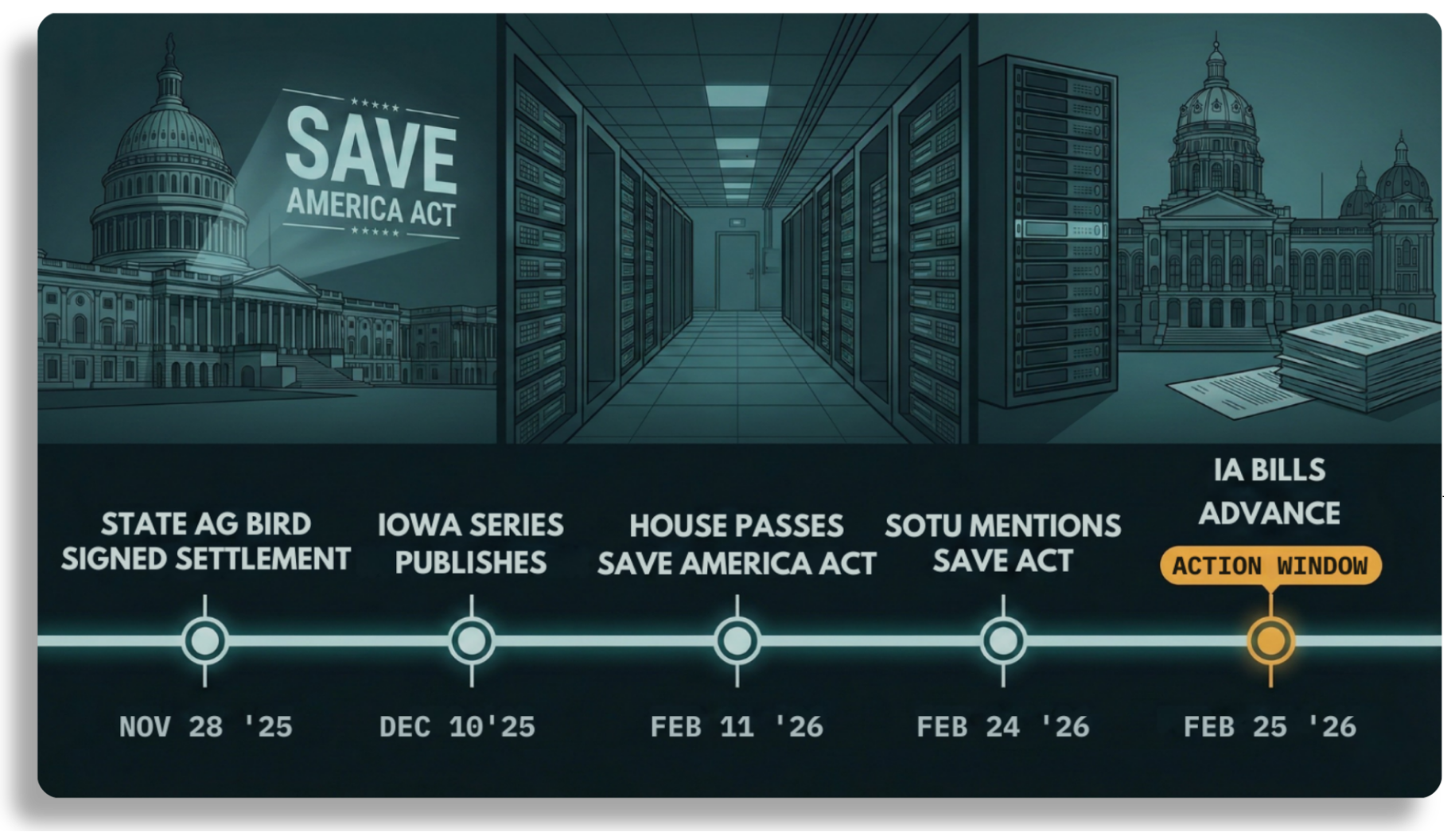
One day after the SAVE America Act was invoked on the national stage, Iowa moved to codify recurring federal citizenship checks into state statute.
LEVIATHAN SERIES — INVESTIGATION UPDATE

From Rhetoric to Infrastructure—Codifying the System Already Running
During the recent State of the Union address, President Trump repeatedly invoked the “SAVE America Act” — framing it as a necessary safeguard for election integrity through expanded citizenship verification.
The messaging was clear: verification must become routine, centralized, and federally integrated. Less than twenty-four hours later, Iowa lawmakers advanced legislation that mirrors that national push — embedding recurring federal SAVE verification system checks directly into state election administration.
This is not coincidence. It is architectural alignment.
In the only statewide test of this model, nearly nine in ten Iowans flagged as “potential non‑citizens” turned out to be U.S. citizens. Iowa is not simply debating voter policy. It is wiring federal verification infrastructure into state law.
In December, we documented how the DHS’s existing Systematic Alien Verification for Entitlements (SAVE) came to Iowa through executive action.
Through a combination of administrative procedures the system architecture is already running in Iowa.
On February 25th, Iowa lawmakers advanced SF 2203 in the Senate (34–13) and HF 2501 in the House, bills that would formalize those connections and make recurring SAVE checks a requirement rather than an option.
The bills are not companions nor have they been reconciled. They are on parallel tracks. In Iowa, a bill passed by one chamber must pass the other chamber in the same form (or be reconciled) before it can go to the governor.
That limbo makes the current moment critical for public input: the core system is already wired, and the legislation would make it permanent.
Though texts differ, both bills would move Iowa from executive order and court settlement use to statutory mandate.
Under SF 2203, county auditors would verify registrations against SAVE, mark voters as “unconfirmed” if the database fails to confirm citizenship, mail notices, and—if the voter fails to return proof within 90 days—cancel the registration.
HF 2501 establishes similar verification mechanisms and narrows same‑day registration options.
On its face, this is framed as a procedural safeguard. But structurally, it embeds a recurring federal query mechanism into Iowa’s voter maintenance system. Verification shifts from an event-based safeguard to an ongoing data relationship between Iowa election officials and federal databases.
The implication is subtle but significant: The state becomes dependent on federal status codes to maintain its voter rolls. In plain terms: instead of checking citizenship once, the state would check repeatedly. And when databases don’t match, the voter—not the state—must fix the error.
State Sen. Sarah Trone Garriott warned during floor debate that the legislation piles “more brokenness on our already broken immigration system” and risks punishing eligible voters: “We are not only punishing the people we’re trying to weed out — if they exist — we’re punishing people who are eligible to vote”.
Together these proposals would legislate an identity‑matching architecture rather than a one‑time purge. If SF 2203 builds the verification pipeline, HF 2501 adjusts how flagged records are processed.
This is not a single reform. It is a layered system. To understand the architecture, follow the data flow.
The Data Pipeline: From the DMV to SAVE to County Election Officials
Under expanded SAVE integration, state DMV identity data for all residents may be aggregated into the DHS’s SAVE system to cross-reference citizenship indicators through federal systems. Under SF 2203 county auditors would start a 90‑day removal clock as soon as SAVE fails to confirm a voter.
That coupling of automatic flags and short correction windows effectively shifts the burden of proof from the state onto each voter. In a system that relies on federal match codes the state does not control, friction is inevitable; the SAVE algorithm does not eliminate human error—it encodes it.
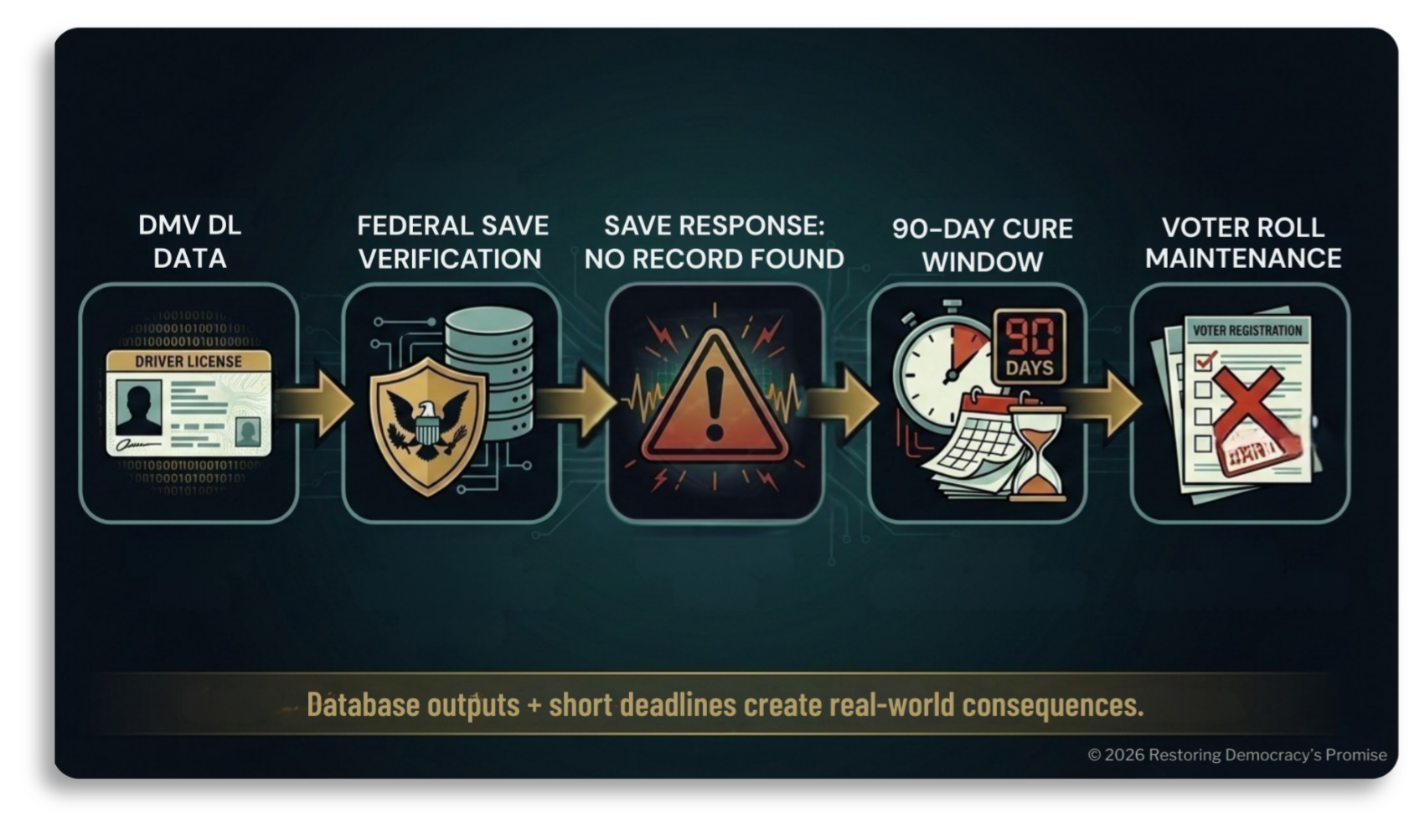
The debate often centers on fraud prevention. But the structural change is the creation of a recurring federal-state verification loop. And Iowa already knows what that loop produces. In the only statewide test of this architecture, the results were definitive — and damning.
SAVE System Errors and Voter Verification Flaws
The danger is not theoretical: it is visible in Iowa’s own pilot. In 2024, state officials compared voter lists against legacy DMV immigration codes and flagged 2,176 registrants as potential non‑citizens. Court filings later revealed that only 277 were actually non‑citizens; at least 88 percent of those flagged were U.S. citizens, many of them naturalized Americans whose lawful permanent‑resident records were never updated in older DMV databases.
Getting flagged does not equal removal. However, the volume of flags determines administrative burden — and the burden shifts to the voter to resolve discrepancies within the cure period.
When verification systems expand in scope and speed, error tolerance matters.
And documented federal database inaccuracies — including naturalization lag and missing citizenship indicators — remain part of the equation.
The ACLU of Iowa called the program an “unjustified, intimidating effort” to police naturalized citizens, and voting‑rights attorney Jonathan Topaz warned that it invites discrimination against people who sound or look “foreign”. National voting‑rights advocates have echoed those warnings: ACLU policy counsel Molly McGrath criticised federal SAVE legislation as “an expensive solution in search of a problem” that will “kick eligible voters off the rolls”. Those observations are borne out in the results: naturalized citizens received provisional ballots and had to prove their citizenship, while county auditors later learned that the list itself was “fatally flawed.”
South Carolina election officials, in a letter to the U.S. Attorney General, said the system would require “large‑scale manual override” to avoid wrongly removing naturalized citizens.
A federal judge presiding over current litigation of the SAVE overhaul wrote that she was “troubled by the recent changes to SAVE” and “doubts the lawfulness of the Government’s actions.”
These are engineering warnings, not ideological critiques: when a bulk‑matching system hinges on incomplete DMV or SSA records, false positives multiply.
When you scale a one to one lookup database to a nationwide bulk ingestion model, prior error rates matter.
DHS’s SAVE user guide explains that when the system returns a “no match” or “incomplete” response—situations that commonly occur for citizens whose records lack a citizenship indicator—the local agency cannot correct the underlying federal record.
Only USCIS or the Social Security Administration can update the data, and individuals must navigate federal bureaucracy to clear their names.
These are not hypothetical risks. They are the documented performance of the system Iowa's legislature now proposes to make permanent.
The Convergence: When Federal Rhetoric Becomes State Code
The SAVE America Act would expand federal verification authority nationwide; Iowa’s bills operationalize that framework at the state level. What is pitched as a federal safeguard becomes, in Iowa, an everyday administrative workflow. The rhetoric of “election integrity” becomes recurring code.
Iowa has always maintained voter rolls. What changes now is the frequency of federal verification and reliance on federal databases—essentially federalizing voter lists that have historically been state‑maintained and decentralized.
If passed, the state bills would also put timeline pressure on flagged voters to prove their citizenship. It normalizes bulk federal verification queries of citizens’ private data. This is not about a single flagged record.
It is about converting voter maintenance into a data synchronization exercise with federal systems. Once embedded in code, such systems rarely contract.
They scale.
The legislative proposals therefore raise practical questions that remain unanswered. Before these bills are signed, these critical issues are still unknown and as of yet undefined in the bill language:
What notice is guaranteed before cancellation?
What is the current accuracy rate of the verification system?
Will the verification system be audited, and by whom?
What documentation will satisfy county auditors?
How quickly can DHS or SSA correct underlying records?
How often will recurring checks run?
What audit thresholds will be applied?
What error safeguards will be published?
How will cure notifications be delivered and tracked?
Will the state publish transparency reports showing how many voters are flagged, how many are ultimately removed, and why?
Voters deserve clarity not just about intent — but about implementation. Because once verification becomes routine, it stops being exceptional. And routine systems define the landscape far more than speeches ever do.
Without guardrails, instituting recurring SAVE verification checks risks normalising federal system that disenfranchises eligible voters and treats citizenship as a database field rather than a constitutional status.
What is pitched federally becomes routine administratively in Iowa.
The SAVE America Act may be debated in Washington. But in Iowa, the wiring is already being installed.
The proposed state statute now reflects the existing state and national architecture:
A federal database.
A recurring query.
A defined purge window.
A state compliance clock.
The policy language sounds procedural. The design is infrastructural.
Voters should respond with proactive steps rather than panic. To stop the transfer of your personal DMV data to DHS federal systems, contact your state legislators and urge them to oppose these bills.
Periodically verify your registration— especially if you have recently naturalized or changed your name. Confirm that your federal records reflect your current status. If you receive a notice from your county auditor, respond promptly—these letters will arrive under the authority of a law that presumes non‑citizenship unless proven otherwise. The machinery is in motion; civic vigilance is the only defense.
If you are a naturalized citizen, or your name has changed, consider bringing a passport, birth certificate, or naturalization papers when you vote.
But individual vigilance cannot substitute for structural accountability.
Citizenship Is Not a Database Field
The bottom line is that election law debates often focus on ballots, but this debate is about databases. Iowa’s bills would transform voter eligibility into a question of cross‑agency identity matching. Infrastructure persists; error rates compound.
Before the Legislature codifies this new identity layer, it should confront the operational evidence: in the only statewide test, nearly nine in ten flagged voters were U.S. citizens. When automation scales, past error rates aren’t footnotes — they are forecasts.
The machine is built, but it is not yet fully legalized. The window to unplug it is closing.
References
Iowa General Assembly. (2026). Senate File 2203: A bill for an act relating to the verification of United States citizenship of voters [Bill text and legislative history]. Iowa Legislature.
Iowa General Assembly. (2026). House File 2501: A bill for an act relating to the conduct of elections and including effective date provisions [Bill text and legislative history]. Iowa Legislature.
U.S. Citizenship and Immigration Services. (2023). Systematic Alien Verification for Entitlements (SAVE) user guide [PDF]. U.S. Department of Homeland Security.
U.S. Department of Homeland Security. (n.d.). Systematic Alien Verification for Entitlements (SAVE): Program overview [Web page]. U.S. Department of Homeland Security.
American Civil Liberties Union of Iowa. (2026, February 11). Iowa Secretary of State agrees to settle lawsuit after wrongly targeting naturalized citizens as “potential non‑citizens” [Press release].
Texas Secretary of State. (2019). Memoranda regarding SAVE pilot processing failure rates [Internal memoranda]. Office of the Texas Secretary of State.
South Carolina Election Commission. (2020). Letter to the U.S. Attorney General regarding SAVE verification burdens [Letter].
State of Florida, State of Indiana, State of Iowa, & State of Ohio v. Department of Homeland Security, Case No. 3:24-cv-00509-TKW-HTC (N.D. Fla. Nov. 28, 2025) (Settlement Agreement).
U.S. Citizenship and Immigration Services & Iowa Secretary of State. (2025). Memorandum of agreement between the Department of Homeland Security, U.S. Citizenship and Immigration Services and the Iowa Secretary of State regarding participation in the SAVE program.
Office of the Iowa Attorney General. (2025, December 1). Attorney General Brenna Bird secures election integrity win for Iowa [Press release].
Reynolds, K. (2025, October 8). Executive Order 15. State of Iowa Executive Department [Press release].
4 Republican states will help Homeland Security obtain driver’s records to check voters’ citizenship. (2024/2025). Associated Press / News Reporting.
Social Security Administration, Office of the Inspector General. (2006, December 18). Congressional response report: Accuracy of the Social Security Administration’s Numident file (Report No. A-08-06-26100).
U.S. Department of Homeland Security. (2025, October 31). Privacy Act of 1974; System of Records (DHS/USCIS-004 Systematic Alien Verification for Entitlements). Federal Register, 90(209), 48948–48953.
U.S. Department of Homeland Security. (2025, October 31). Privacy impact assessment for the Systematic Alien Verification for Entitlements (SAVE) program (DHS/USCIS/PIA-006(d)).
Fair Elections Center. (2025, December 12). Comment of Fair Elections Center to the Social Security Administration on the System of Records Notice for SSA Master Files (Docket Number: SSA-2025-0225).
U.S. Citizenship and Immigration Services. (2025, May 22). Optimizing SAVE: New options to create cases with a Social Security Number and by bulk upload.
U.S. Citizenship and Immigration Services. (2025, July 16). SAVE user reference guide, 10.1 bulk upload file management.
Plaintiffs' Amended Complaint (April 2025)—Selcuk v. Pate, Case No. 4:24-cv-00390, Amended Complaint for Declaratory and Injunctive Relief (S.D. Iowa Apr. 4, 2025).
State Defendant's Supplemental Declaration (November 2024) Selcuk v. Pate, Case No. 4:24-cv-00390, Supplemental Declaration of Michael Ross (S.D. Iowa Nov. 1, 2024).
Final Settlement Agreement (February 2026) Settlement Agreement, Selcuk v. Pate, Case No. 4:24-cv-00390, Exhibit A (S.D. Iowa Feb. 9, 2026).
Iowa Secretary of State. (2025, March 20). Iowa Secretary of State’s audit of voter registration lists finds 277 confirmed noncitizens registered to vote [Press release].
Primary documents & prior SAVE evidence lockers (paid archive): Restoring Democracy’s Promise — Subscriber Vault.
It amazes me how so closely some of our focuses track. Just last night I starting getting into the fact that America is a multi-constitutional political entity and how the excessive focus on the Federal constitution comes at a cost to State constitutions.
Your essay and its State level focus immediately brought to mind Kansas where recent news reporting reveals efforts to ban Trans persons from self-identifying on the drivers licenses and requiring birth certificate sex identification be lifetime established.