

Iowa Handed Over the Voter Data — The Legal Blueprint Was Already There
Records show Iowa hesitated before turning over voter data — then consulted the Attorney General’s Office
This piece builds on Restoring Democracy’s Promise’s earlier reporting on Iowa’s SAVE architecture and the December settlement that helped wire state records into federal verification systems. What is new here is the paper trail: open-records responses showing how differently state offices answered basic questions about the legal authority behind the transfer.

Iowa media is now reporting that Iowa turned over voter-registration information to the federal government. That matters. But the data transfer is not where the story begins.
The latest reporting confirms the public-facing event. What it does not yet explain is the system behind it.
Months ago, Restoring Democracy’s Promise documented the deeper architecture taking shape beneath Iowa’s election and identity systems: voter records, DMV data, immigration verification systems, Nlets-linked data pathways, and agency-level agreements that can transform ordinary administrative records into a voter-screening infrastructure.
This week’s headlines focus on Secretary of State Paul Pate’s announced transfer of Iowa voter-registration data to the Department of Justice. That is the visible event. But the deeper architecture was already in motion.
To understand why this week’s announcement was predictable, start with December.
The Handoff Was the Output, Not the Origin
In December, Iowa officials announced a settlement giving the state access to DHS’s SAVE system (Systematic Alien Verification for Entitlements). SAVE is the federal verification system officials use to check immigration or citizenship-related status against federal records.
Iowa also shared driver’s license data with the federal government as part of that arrangement. That agreement was announced by Attorney General Brenna Bird and Secretary Pate.
The contradiction became sharper when Pate publicly acknowledged Iowa’s compliance with the federal demand while also distancing his office from the legal authority behind it.
According to the Des Moines Register, Pate said Iowa had “serious concerns” about the federal request, but ultimately complied after legal review and consultation with the Iowa Attorney General’s Office.
Less than three weeks later, Pate announced that Iowa had complied with DOJ’s voter-data demand. But even then, he again emphasized that “states are responsible for elections and voter list maintenance,” while saying Iowa complied only after legal review and consultation with the Iowa Attorney General’s Office.
That does not absolve Pate. His office transmitted the data. But it does sharpen the central question: if Iowa’s chief election official was publicly emphasizing state control, who supplied the legal theory that made federal access operational?
Pate Transmitted the Data, Bird Supplied the Legal Theory
Secretary of State Paul Pate is accountable for the transfer. But Attorney General Brenna Bird’s office was not a bystander. According to Pate’s own statement, his office consulted with the Attorney General’s Office before Iowa concluded it was legally obligated to surrender the data.
“We are legally obligated to comply with the request, but we do not take the obligation to turn this information over lightly,” Pate stated on May 5th, 2026.
That matters because “legal obligation” is not a neutral phrase. It is a theory — and in this case, Bird’s office helped supply it.
Pate was still speaking the language of state election control. Bird’s office quietly supplied the legal theory that made federal access operational.
That role becomes even clearer when you compare how each office responded to our open-records requests.
The Records Request Discrepancy
RDP submitted an open-records request to the Iowa Attorney General’s Office on Jan. 13 seeking records related to the SAVE settlement, implementation, and data-sharing architecture. After receiving no substantive production, RDP followed up on Mar. 5 with narrowed language.
The Attorney General’s Office responded by stating that responsive communications were protected as attorney-client privileged or attorney work product, that no such documents existed, and that no documents existed within the Attorney General’s Office related to the request.
But records produced by the Secretary of State’s Office tell a different institutional story. Those records show that Secretary of State staff told DOJ in December that they had sent a legal question to the Attorney General’s Office and were awaiting a response. Pate later told DOJ that, after consulting with and receiving advice from the Attorney General’s Office, Iowa concluded DOJ likely had authority to demand voter-registration data.
That does not prove the Attorney General’s Office lied. But it does raise a basic public-records question: if the AG’s office was asked for legal guidance and later supplied advice central to Iowa’s compliance decision, why did its records response not produce or clearly account for that role?
The answer points back to the Attorney General’s Office. Brenna Bird campaigns as a fighter against federal overreach. But on Iowa voter data, her office appears to have helped convert federal overreach into state compliance. That is the contradiction at the center of this story.
That discrepancy matters because Iowa’s compliance did not occur in a vacuum — it slotted neatly into an architecture already documented months earlier.
If this reporting helps clarify what Iowa officials did — and what they still have not explained — share it with someone following voting rights, privacy, or state government.
From Iowa Model to Federal Pipeline
This was never just an Iowa story. Nationally, the Brennan Center has tracked DOJ lawsuits against Washington, D.C. and 30 states that refused to provide complete voter-registration lists with driver’s-license and Social Security-number information.
Iowa’s decision to comply should therefore not be treated as automatic or inevitable. It was a choice made through a legal theory — and Pate’s own statement points back to the Attorney General’s Office.
In Part IV of this series, RDP documented the national expansion: DOJ demands for full, unredacted statewide voter rolls, driver’s license numbers, SSN4s, confidential MOUs, 45-day “clean” clocks, and SAVE as a de facto national eligibility gate. Iowa was not an outlier. Iowa looks increasingly like the proof of concept.
The danger is not simply that Iowa shared voter-registration data. The danger is that Iowa appears to be participating in a broader identity-verification pipeline where voter rolls, driver records, citizenship-status checks, and federal databases can be cross-referenced without ordinary voters understanding the rules, the retention policy, or the correction process.
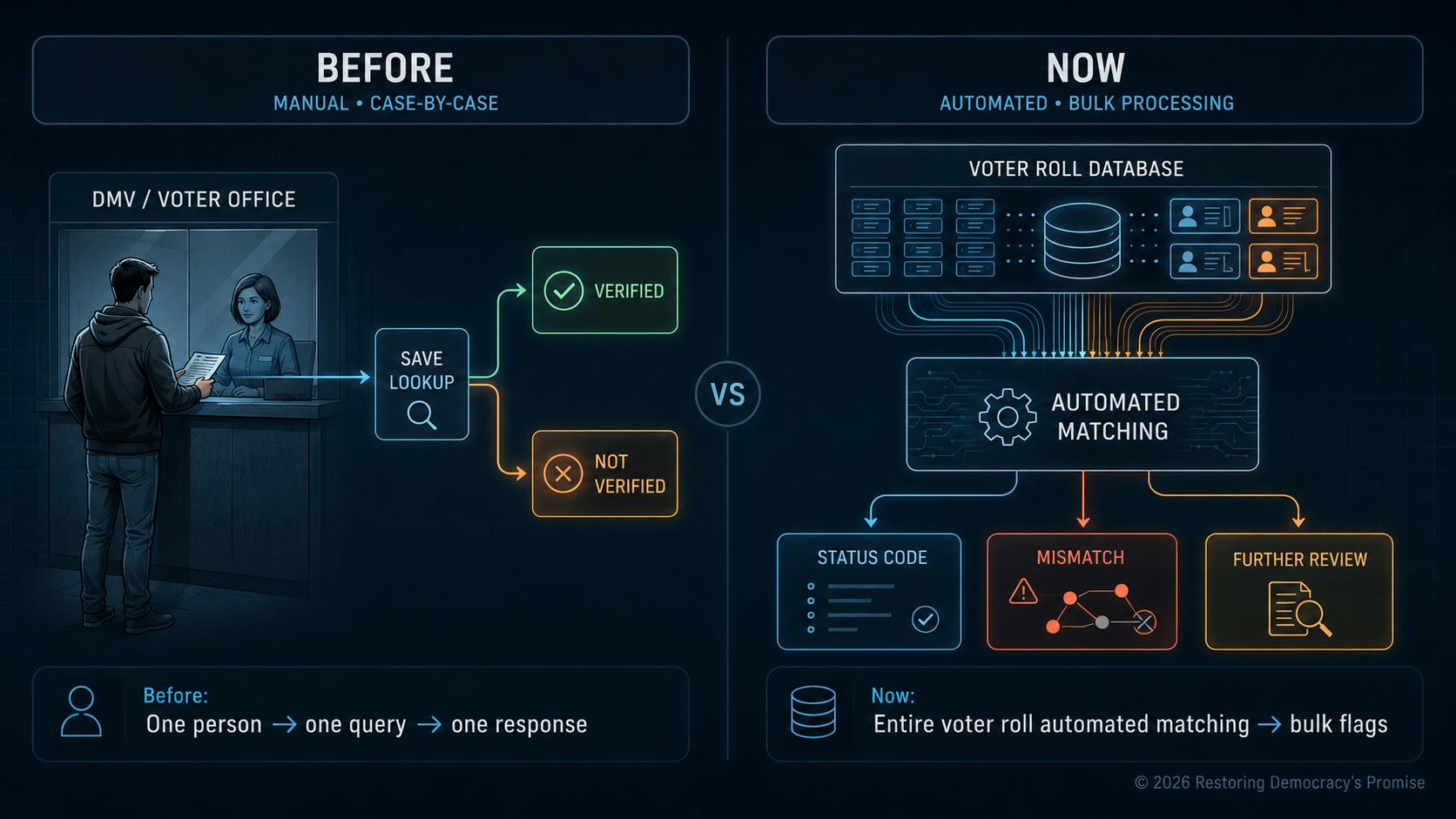
The issue is not just data sharing. It is what the data can be connected to.
That is why this week’s disclosure matters: it connects the public headline to the infrastructure RDP had already documented.
This week’s reporting did not reveal a new architecture. It revealed the next stage of the architecture already documented here. Which brings us to the blueprint: the architecture that predated this week’s data transfer.
The Transfer Was New—The Blueprint Was Not
The headline this week is that Iowa handed over the data.
What Iowa entered was not just a data-sharing agreement. It was a legal pathway for moving routine state records into a federal identity-screening system most Iowans have never seen, debated, or consented to.
Secretary Pate may want voters to hear that elections belong to the states. Attorney General Bird’s office appears to have helped build the argument that placed Iowa’s voter data within federal reach.
Independent journalism matters because the architecture is usually visible before the headline.
Subscribe to support the kind of reporting that follows the system before the press release catches up.