

Iowa’s New ALPR Bill Is a Start — But It Doesn’t Stop the Data
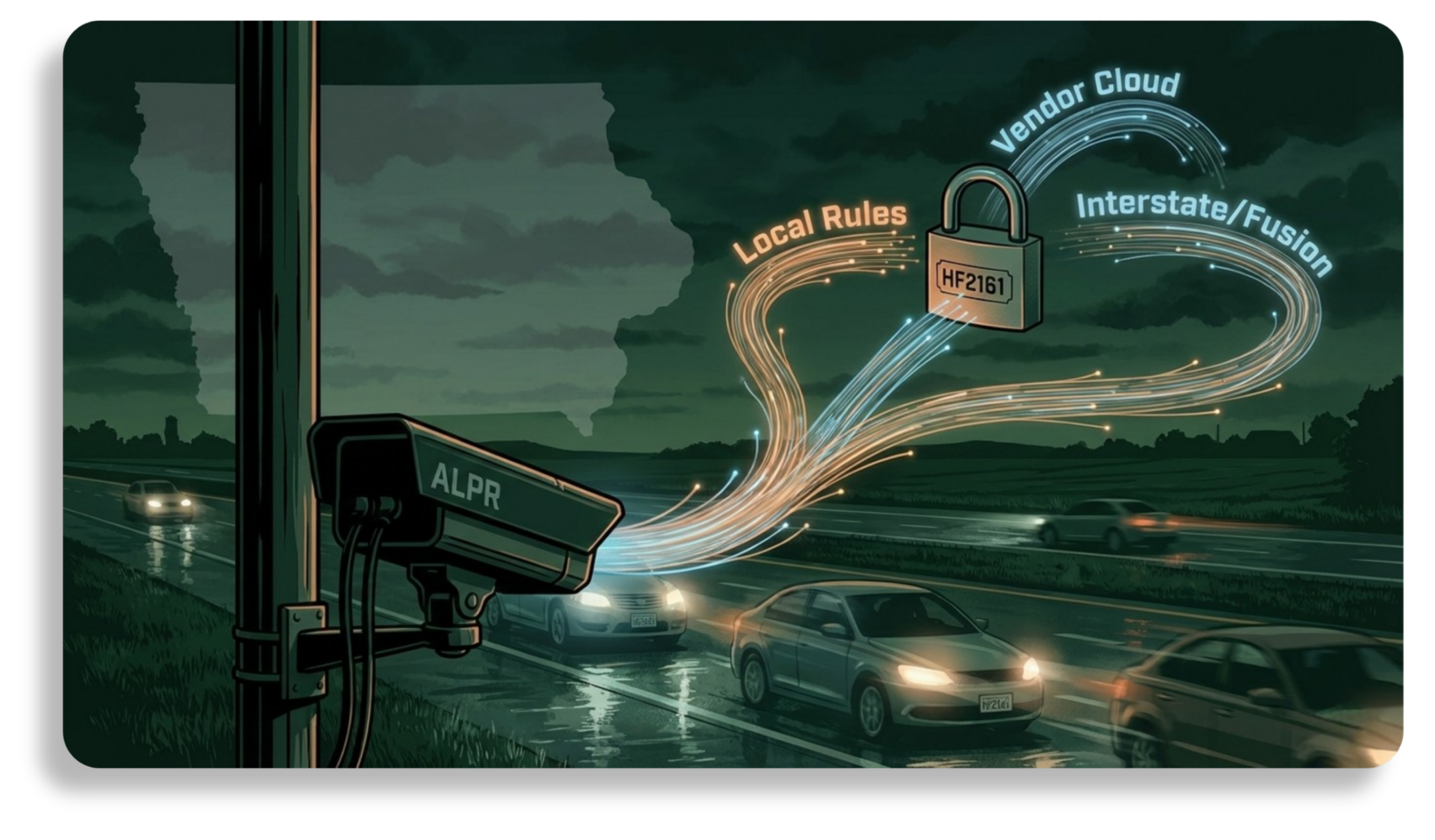
HF2161 adds real guardrails for license-plate readers. But it still doesn’t fully address how ALPR data moves, aggregates, and returns through upstream systems.
Analysis by Restoring Democracy’s Promise
Iowa lawmakers are considering HF2161, a bill intended to rein in Automated License Plate Readers (ALPRs). On its face, the bill is a step forward — and in a state that’s been moving fast on surveillance infrastructure, “a step forward” matters.
Iowa’s own ALPR transparency portals show at least 4,386,514 vehicle detections in a single month, averaging 10,177 detections per camera.
But here’s the core reality:
HF2161 mostly regulates local use. It does not fully regulate the system those cameras feed.
This analysis builds on our prior reporting on ALPR networks and upstream data flows in Iowa.
What HF2161 Gets Right
HF2161 does a few important things that should not be minimized:
Local authorization: A local authority must approve ALPR use through an ordinance — not a wink-and-nod purchase order.
Tighter access to stored data: Access beyond a short window requires a warrant or subpoena, with narrow exceptions.
Audit trail: It requires logging of access/queries — basic accountability Iowa has needed for a long time.
Some bright-line protections: It bars ALPR use for facial recognition and restricts placement in certain sensitive contexts.
These provisions reduce local misuse. That’s real progress.
Where the Gaps Remain
The biggest weaknesses aren’t philosophical — they’re structural.
Scope is still too narrow.
If the bill doesn’t clearly cover state-level actors and upstream routing layers, you can end up regulating the street-level “camera operator” while leaving the true power nodes untouched.
“Don’t share” isn’t the same as “can’t replicate.”
HF2161 includes language that restricts sharing, but the real problem is architectural:
The proposed bill bans providing copies of plate images/data to third parties (including out of state), but it doesn’t explicitly prevent vendor-network replication or remote cross-jurisdiction querying that can recreate the same outcome through a different pathway.
This is the difference between policy and system design.
Derivative use and parallel construction are still the elephant in the room.
Even if a local agency “follows the rules,” ALPR-driven intelligence can still generate leads that get laundered through other channels — and later show up as “normal policing,” with the original surveillance trigger never disclosed.
That’s not just a privacy issue. It’s a due-process issue.
The commercial/broker loophole remains wide open
If government can obtain equivalent location intelligence through vendors and commercial pathways, state restrictions can be bypassed without technically “breaking” state law — while producing functionally identical surveillance outcomes.
Policy Recommendations
If lawmakers want this bill to actually protect Iowans in practice, amendments should:
Expand scope to cover state-level agencies and upstream routing layers
Explicitly address vendor-network replication and remote cross-jurisdiction querying (not just “providing copies”)
Add enforceable data-sharing limits with meaningful audits and penalties
Close the commercial data loophole
Add due process protections around disclosure when ALPR-derived intelligence influences investigations
Lock the Door, Leave the Windows Open
HF2161's effort is a starting point. It signals that lawmakers recognize the privacy harms of indiscriminate plate scanning—and it adds guardrails that would meaningfully reduce local misuse.
But the bill, as written, still leaves key pathways unaddressed: upstream sharing, vendor-network federation, fusion-center laundering, derivative re-circulation, and commercial/broker bypasses.
In other words: it tightens the rules at the camera and the local database—while leaving too much of the broader data ecosystem structurally untouched.
That’s the conversation worth having now — before the architecture hardens and the gaps become permanent.
Sources / Key texts
HF2161 (bill text)
Iowa Code §321P.4 (current ALPR retention law)
ACLU of Iowa / UI Tech Law Clinic ALPR report (Dec 2025)