

SAVE: The Benefits Database Now Monitoring Every Licensed Iowan — and Every Driver
How a September Scandal, an October Executive Order, and a December settlement quietly built a statewide voter-screening machine.

Table of Contents
The Database They Won’t Name — what SAVE is and how it drifted
How Iowa Wired the Pipe — EO 15 mandates an identity clearinghouse
The Nlets Backdoor — How the state of Iowa DMV vault feeds the federal engine
What It Does to People and Cities — Mark, Des Moines, the human and municipal impact
What Iowa Really Built — What Comes Next. Systems, Oversight, and “Sunlight”
Part III of the Warrantless Surveillance Series By Restoring Democracy's Promise. Part II is here. Read Part IV here.
TL;DR – What Iowa Just Did
Iowa secretly reclassified your driver’s license and every state professional license as a “public benefit,” so it could run you through a federal immigrant-benefits database built in 1986.
In exchange for “voter checks,” the state agreed to give DHS full access to Iowa’s DMV vault—photos, signatures, addresses, biometric metadata—through the Nlets law-enforcement network for 20 years.
That creates a closed identity loop: your data flows upstream to DHS; opaque federal status codes flow back down to decide whether you can drive, work, or vote.
Newly naturalized citizens can already be auto-flagged and delayed because SAVE lags reality. The same mechanism could be repurposed to quietly sideline protesters, journalists, or whole neighborhoods.
This isn’t just about immigrants. Every licensed Iowan is inside a federal surveillance prototype—built by executive order and a lawsuit “settlement” no one voted on.
The System That Couldn’t be Named
On December 1st, Iowa Attorney General Brenna Bird announced a “major victory” for election integrity. She told reporters the state had secured access to a powerful “federal system” to verify voters. But she refused—repeatedly—to say its name.
She called the system “the database”, “federal verification tool”, “advanced federal screening technology,” and other vague terms. None of the publicly released statements from Bird or state officials mention SAVE by name, despite the settlement granting access to it. Not once. Not in the press release. Not in the Q&A. Nor was the system name mentioned in the triumphant victory lap she took afterward on conservative media.
And to most Iowans, that omission wouldn’t register — because “SAVE” sounds like nothing. A vague acronym. A bureaucratic footnote. Something that belongs on a dusty shelf in Washington. The kind of acronym reporters casually drop into paragraph four without ever realizing they’ve buried the entire story.
But to anyone who actually understands immigration systems — anyone who has lived inside them, fought against them, or worked through the bureaucratic machinery that governs them — that silence is deafening.
Because SAVE is not a “federal verification database.”
It is not a voter-identification tool.
It is not a law-enforcement system.
SAVE — the Systematic Alien Verification for Entitlements — is a federal benefits-eligibility database created in 1986 solely to help determine whether immigrants qualified for Medicaid, food stamps, or housing aid.
For decades, that narrow, public benefit-focused purpose is what made SAVE obscure and mostly uncontroversial. It sat in the background of the benefits bureaucracy, doing work almost no one outside that world ever thought about.
Until recently.
In the last several years, its mission has drifted. Under pressure from politicians and agencies looking for shortcuts, SAVE has been pulled away from its original role and repurposed for new targets and new kinds of checks it was never built—or democratically authorized—to handle.
Iowa just took that drift and turned it into a hard swerve. SAVE is the system the state has now plugged into the heart of its election machinery and licensing regime. Bird carefully and conspicuously avoided naming the very database her press conference was about.
Why? Because the moment you say “SAVE,” anyone who understands the law begins asking the questions she cannot answer:
“Why is Iowa using a benefits system to screen voters?”
“Who authorized this shift in purpose?”
“What data did the state have to trade to get access?”
“And why did the Attorney General avoid the word entirely?”
This article answers those questions.
In The ALPR Trap (Nov. 2025) I documented how Iowa quietly wired local plate data into the national Nlets network. This new settlement shows that same pipe has recently been extended into the DMV vault and the SAVE database.
What Bird celebrated on December 1st wasn’t a “victory” at all. It was the public ribbon-cutting for a data pipeline Iowa quietly built two months earlier, under the cover of a completely different scandal — a pipeline never meant for one superintendent with fake credentials, but for every licensed Iowan and every professional license whose data flows through the state.
To see how that machine was assembled, you have to go back to October 8th — to an executive order that was sold as a school-safety fix, but was actually something else entirely.
How a School Scandal Became a Statewide Monitoring Machine
Two months before Brenna Bird walked to the podium and announced her “major victory” for election integrity, Governor Kim Reynolds signed Executive Order 15.
On the surface, EO 15 looked like a fast, decisive response to a single, outrageous failure: the hiring of former Des Moines Public Schools superintendent Ian Roberts, later arrested by ICE and revealed to have fraudulent documents and an outstanding order of removal. The image was made for TV: federal agents at a school district office, the governor denouncing “bureaucratic breakdowns,” and promises of tougher screening to make sure it never happened again.
Reynolds framed the order as the fix. The problem, she said, was that Iowa didn’t have strong enough verification for school leaders and other licensed professionals. The solution, she claimed, was to require E-Verify and tighten background checks. Local and national outlets ran with that frame. The headlines were almost interchangeable: Governor mandates E-Verify after superintendent scandal. The public takeaway was simple—this was about cleaning up one hiring system that had failed spectacularly.
But that story only survives if nobody reads the actual order. Don’t take my word for it — here are the documents.
📂 Paid Subscriber Vault: Source Documents
Access the full Executive Order, DHS settlement pages, press release PDFs, and supporting materials.
🔗 Open the SAVE Source Vault
Once you move past the talking points, EO 15 stops looking like a targeted repair and starts reading like a blueprint. The bulk of its operative sections have almost nothing to do with school districts or superintendent searches. They are about something else entirely: building a new data pipeline that ties Iowa’s driver’s license system to a federal immigration benefits database.
In the text of the order, Reynolds directs the Iowa Department of Transportation to “take all steps necessary” to give the newly consolidated Iowa Department of Health and Human Services direct, electronic access to the SAVE program. That’s not a side note—it’s a core instruction. In the same breath, the state of Iowa DOT is told to open up its full driver’s license and ID database to HHS, not for a narrow, high-risk list of positions, but as an ongoing information feed.
State HHS is then instructed to expand its use of SAVE. The order pushes the agency to run federal eligibility checks on people receiving public benefits, including programs that had never required immigration-status verification before. In other words, a single employment scandal in one school district becomes the justification for a sweeping, statewide reconfiguration of how identity and eligibility are checked across multiple systems.
Put in plain language, EO 15 quietly does three things:
It puts the state HHS in the middle as a new “clearinghouse” for SAVE queries in Iowa.
It gives that clearinghouse a direct tap into the driver’s license and state ID database.
It normalizes using a federal immigration benefits determination system as a gatekeeper for licenses and services that were never designed to run through SAVE at all — and, as we later learned, voter verification as well.
None of that has anything to do with a superintendent in Des Moines.
Seen as code instead of spin, EO 15 is not a clean-up operation; it’s a construction project. The Roberts scandal is the scaffolding. The real build is a statewide identity-verification machine that can be pointed wherever the executive branch wants it pointed—teachers this month, benefits recipients next month, voters after that. Once you realize what that pipeline connects, the stakes shift.
Once you understand the three endpoints—DOT at the front, HHS in the middle, DHS/SAVE at the back—the structure of the machine snaps into view. Iowa didn’t repair a system after a scandal. It built a new one. The state quietly rewired the entire identity backbone so that everyday bureaucratic actions—license renewals, address updates, benefits applications—have started flowing through a federal verification system designed for immigrants, not citizens.
On paper, the order sounds like it’s aimed at one superintendent and a few “high-risk” positions. In practice, the language sweeps in almost everything the state touches. Medical licenses. Nursing licenses. Law licenses. Teaching certificates. Engineering, real-estate, insurance, cosmetology, commercial driving — if a board in Iowa can grant or renew it, EO 15 gives the executive branch a path to run it through the SAVE clearinghouse.
This is the part that was never said out loud. This is the part you weren’t supposed to notice.
To see the architecture as the state wired it, not as it was described publicly, it helps to trace the flow the way engineers would.
Figure 1 maps the actual pipeline created by EO 15.
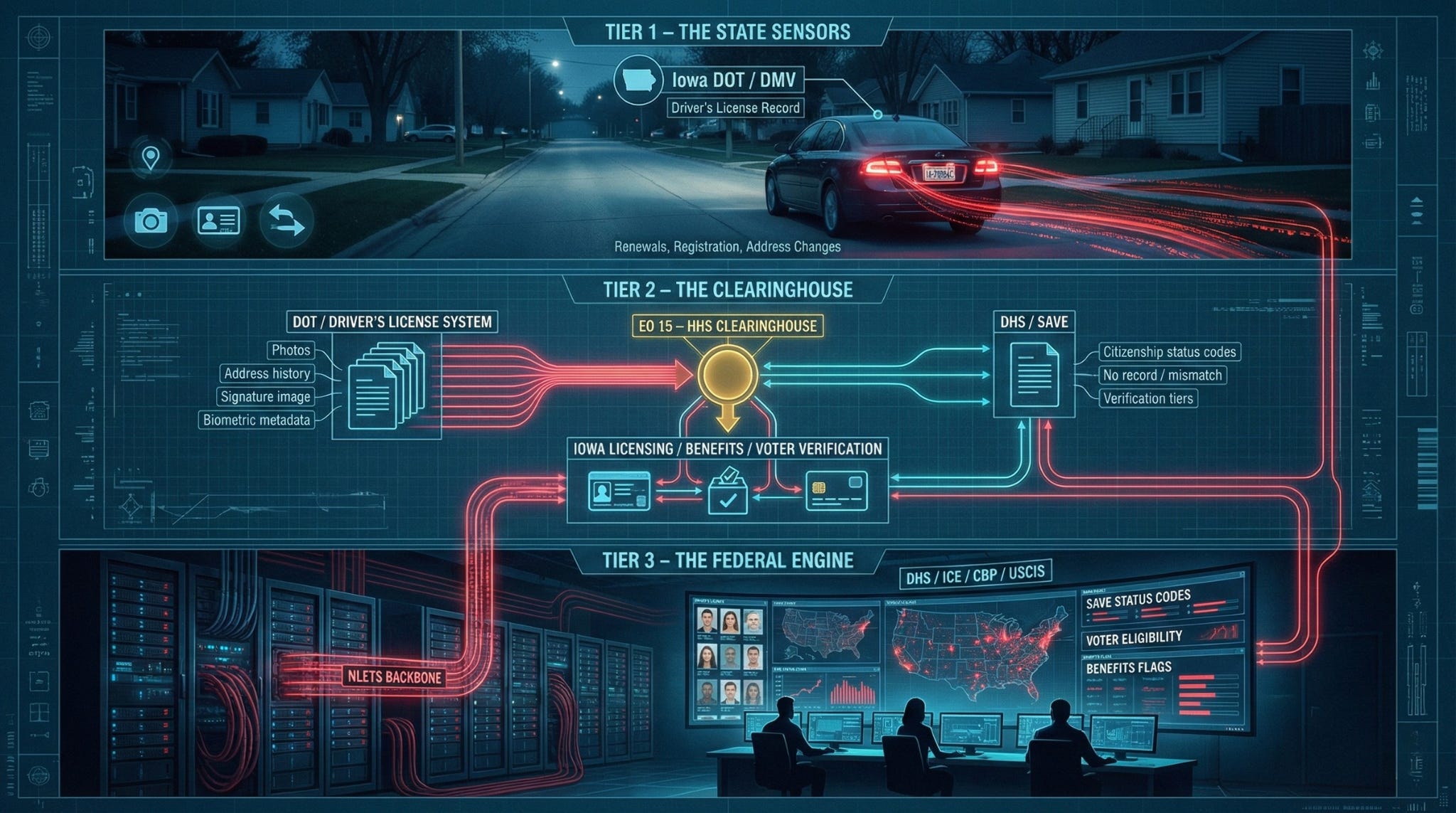
EO 15 didn’t act alone. It opened the door, but something else had to walk through it. And right on schedule, the fall news cycle delivered exactly what was needed: a public distraction that made the underlying data construction look like a response to chaos rather than what it truly was—a pre-planned systems build.
There’s another layer of damage that never made it into the press releases. What does this architecture do to local control?
In The ALPR Trap, we showed how city councils and police departments were sold camera networks with comforting assurances—short retention limits, “local” use, and no immigration enforcement. The fine print, and the contracts above their heads, told a different story. Once the data left the city and flowed into state and national networks, those local promises became mostly symbolic.
EO 15 repeats that pattern in a more sophisticated key.
This architecture destroys local control. A city council in Davenport or Iowa City can pass all the privacy ordinances it wants, promising residents that police cameras won’t feed federal dragnets. But those promises are now void. By wiring the state DOT and law enforcement networks directly to DHS, Governor Reynolds has effectively preempted every mayor and city council in Iowa.
Their residents’ data is still moving—just through pipes the locals do not control and cannot shut off.
That is the deeper meaning of EO 15. It does not just respond to one hiring failure. It preempts future limits. It ensures that, even if some city council down the road decides to draw a line—to reject Flock contracts, to limit data-sharing, to assert “home rule” over how its residents are monitored—the state has already committed their residents’ IDs and biometric records to a system that transmits them upstream anyway.
This is what “state preemption” looks like in the surveillance era. Not a bill that openly says “cities may not pass X,” but a set of data-sharing obligations and executive orders that make local policy irrelevant by design.
The superintendent scandal provided the noise. The executive order provided the wiring. And Then, in December, the settlement with DHS flipped the system on.
That sequence matters. The order is the tell. Which brings us to the timeline.
The Timing is not a coincidence.
By the time Brenna Bird strode into her December 1st press conference to announce her “federal verification database” deal, the wiring was already in the walls. The public was primed by the Roberts scandal and the E-Verify headlines. Most reporters had never heard of SAVE, much less read EO 15’s technical directives. The idea of a statewide benefits-and-ID clearinghouse had already been normalized in October.
All Bird had to do in December was flip the next switch and keep the name of the system off the microphone.
What happened between September and December wasn’t a coincidence—it was choreography. The public narrative moved one way while the data infrastructure moved another. What looked like disconnected events were, in fact, phases of a single build.
Figure 2 shows that choreography in motion.
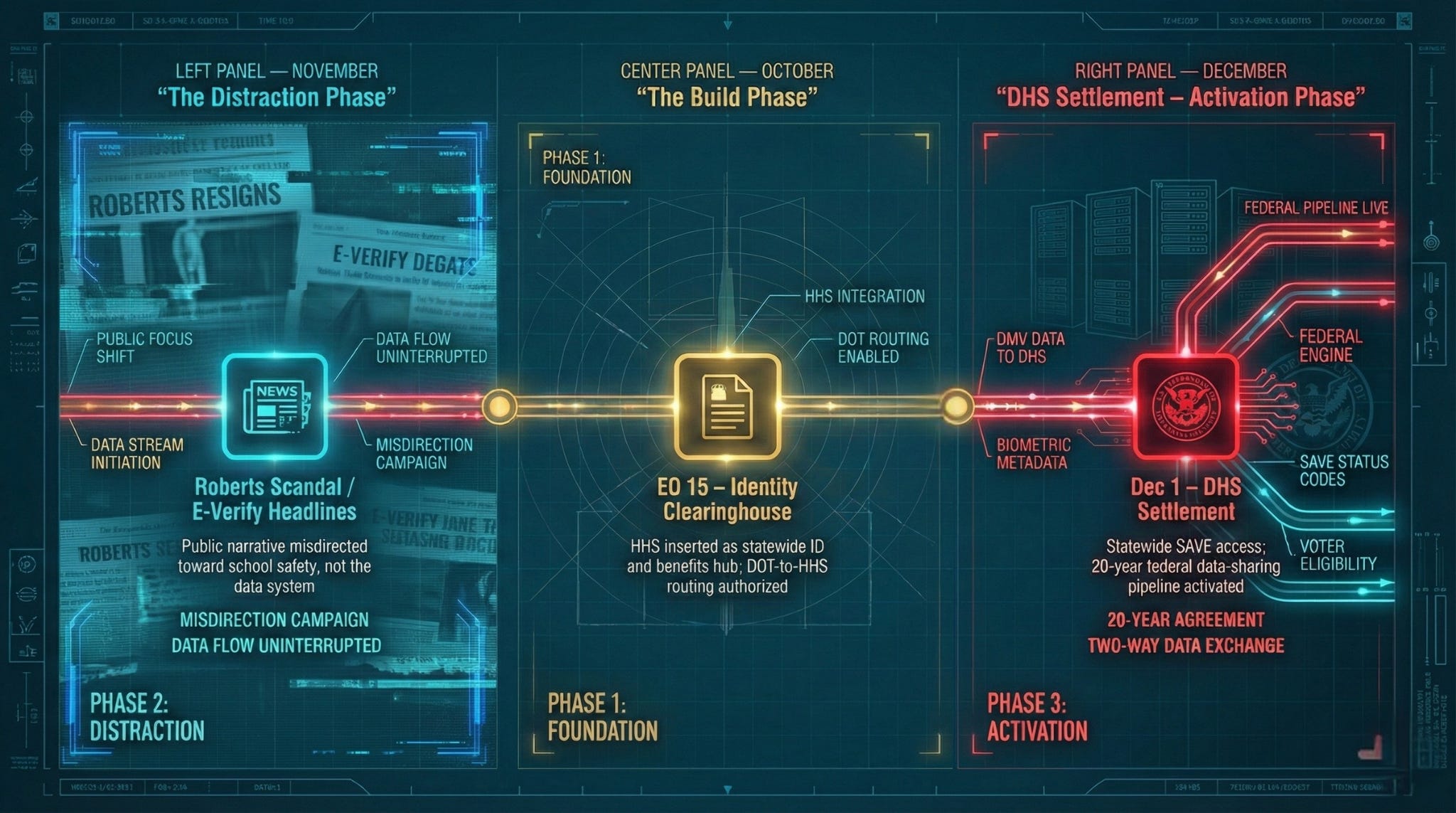
Once you see the sequence lined up—the distraction, the build, the activation—the December press conference plays very differently. Bird wasn’t announcing a new tool. She was announcing the final stage of a system that had already been installed.
The most important question becomes:
What exactly did Iowa activate?
That answer requires looking at the part almost no one outside law enforcement understands: the network that moves identity data across state lines without public debate, legislative oversight, or meaningful audit trails.
That network is the heart of the upstream flow into DHS.
They built the pipe in October.
They repurposed it in December.
And the only reason it worked is because every step of the build was wrapped in a different story—school safety on the front end, “election integrity” on the back—while the actual machinery was installed in the middle, in language only a handful of lawyers and database administrators were ever expected to read.
That is the quiet brilliance of the design: each stage looked harmless on its own. Only when stitched together does the full system come into view — a prototype for something much larger taking shape beyond Iowa’s borders.
And that raises the question the public never got to ask:
What exactly did Iowa just plug into?
From One Superintendent to Six Million Files
If Executive Order 15 laid the pipe, the next move was figuring out how to turn it on without anyone realizing what they were actually doing.
That required a workaround — because SAVE was never designed, intended, or authorized to verify voters.
Not in its inception in 1986.
Not during the public benefit reforms in IIRIRA in 1996.
And not in any Congressional amendment since.
SAVE was built for one narrow purpose: to check whether immigrants were eligible for public benefits.
It was never a citizenship database.
It was never an elections tool.
Congress never expanded it into one.
Governor Reynolds solved that obstacle by reclassifying your driver’s license as a form of public benefit. And once that reclassification was made, the entire system snapped into place.
The Trick: Using a 1996 Public Benefit Loophole to Unlock a Federal Immigration System
The key statutory language — buried inside 8 U.S.C. § 1621(c)(1) — reads:
“The term State or local public benefit…includes any grant, contract, loan, professional license, or commercial license provided by an agency of a State or local government.”
This clause was never meant to operate as a blanket identity-screening authority. When Congress wrote it, the concern was narrow: preventing a small number of fraudulent applications for specialized licenses.
But Iowa has stretched this language to an absurd extreme.
Under Governor Reynolds’s Executive Order 15, a driver’s license — the most routine credential in everyday life — has been reclassified as a “public benefit” under 8 U.S.C. § 1621. If you hold an Iowa-issued license of any kind — MD, JD, CDL, teaching certificate, cosmetology card — this system already has a hook into you.
This is the trick: change the label, and the entire system follows.
Once a driver’s license is treated as a public benefit, every person renewing their license becomes, in legal terms, a benefits applicant. And SAVE was built to screen benefits applicants.
A person renewing any Iowa license is a benefits applicant. Because Iowa ties voter registration to DMV records, voters are now treated as benefits applicants too.
Every adult Iowan is subject to SAVE screening.
You did not apply for Medicaid.
You did not seek food stamps.
You simply renewed your license.
And under this interpretation, that is enough to run you through a federal immigration-benefits database that was never supposed to contain your information in the first place.
Here’s the Part Few Realize. SAVE was never supposed to contain U.S. citizen data at all. Congress never authorized it. No law expands its scope to voters.
No statute gives DHS authority to load it with:
Social Security Number records
Citizenship markers from SSA
DMV identity data
Driver’s license photographs
Facial-recognition-compatible metadata
Yet today, SAVE contains all of that — because these feeds were quietly added through internal DHS-SSA agreements, not public legislation.
This means Iowa has started using a database that was never meant to hold U.S. citizen information but contains millions of U.S. citizen identities anyway. The database will be used to police the voter rolls even though no law was passed to authorize this use. The system Iowa uses to check whether you can vote was never legally authorized to know who you are in the first place.
This is the very definition of a structural overreach — and it didn’t happen by accident. It happened because SAVE was quietly turned into something Congress never intended — a federal identity warehouse.
And that identity warehouse is wired directly into Iowa’s voter system.
The Hidden Cost: Iowa Traded Your Driver’s License Data to DHS
When AG Brenna Bird held her December press conference celebrating a “major victory” for voter verification, the public heard only one side of the deal.
They heard that Iowa gained access to a powerful federal database.
They did not hear what Iowa had to give up to get it.
Because SAVE access is never free. There is always a trade.
And in this case, Iowa traded something that belongs to you:
the entire DMV identity vault.
Help support independent investigative journalism
Winter Signal Drop — 20% Off for One Year
Access all paid content and subscriber evidence vaults
The Part They Hid: Iowa Agreed to Give DHS Full Access to State Driver’s License Records
The settlement agreement is explicit: Iowa receives SAVE access in turn for granting the Department of Homeland Security full access to state driver’s license records. This is not a gift — it is a data trade.
To run voter checks through SAVE, Iowa must provide DHS with ongoing, continuous access to the state’s driver’s license system. And the DMV does not contain mere “addresses and renewal dates.”
It contains:
high-resolution driver’s license photographs
facial-recognition–ready image metadata
signature images
vehicle registration
home address history
renewal and ID issuance events
name changes and demographic data
Under the terms of this agreement, all of it becomes accessible to:
DHS, ICE, CBP, FBI, Secret Service, and other federal agencies.
In plain language:
Iowa sold the face of every licensed driver to the federal government.
Not because you broke a law. Not because you applied for a federal benefit. Not because a judge ordered it.
But because Iowa wanted to purge its voter rolls — and this was the price of admission.
How Federal Agencies Get The Data: The Nlets Backdoor
DHS does not connect directly to state DMVs. That would be politically radioactive. Instead, DHS plugs into a powerful nonprofit data broker most Iowans have never heard of:
Nlets — The International Justice & Public Safety Network.
Nlets is a 50-state identity exchange network originally built for law enforcement. This is the same Nlets network we exposed in the ALPR Trap—the law enforcement superhighway where your plate data flows with almost no public oversight. Iowa has opened that same pipe to carry driver's license photos, addresses, and biometric metadata flowing straight to DHS.
But over time, it became a national identity superhighway — a place where DMV records, driver’s license photos, vehicle registration, and identity metadata flow with almost no public oversight and no legislative guardrails.
Most states don’t even realize the full extent of what they’re sending — because Nlets is a legacy system that predates modern privacy law.
And Iowa just opened that pipe all the way. The moment Iowa signed the SAVE agreement, DHS gained continuous access to the state’s full ID vault through a law enforcement network using a voter-purge deal as the legal cover.
This is the “backdoor” in its purest form. Multiple federal agencies including ICE are now able to obtain state driver data without ever having to subpoena the state.
The Exchange: Voter Data Downstream, DMV Data Upstream
If the October order built the pipe and the December settlement turned it on, the Nlets network is the part that reveals what the machine actually does once it begins running. Iowa didn’t simply gain the ability to look into SAVE; it opened its entire DMV identity vault to a multi-agency federal backbone that operates without warrants, subpoenas, or public reporting of any kind.
The movement of information is straightforward. Data leaves the Iowa DOT and enters the Nlets network. From there, it is delivered to DHS, which feeds it into SAVE.
The results then return to Iowa as official verification codes. Driver records move outward. Federal status determinations come back in.
And the public never sees either transaction.
Figure 3 maps the vault and the federal engine it feeds.
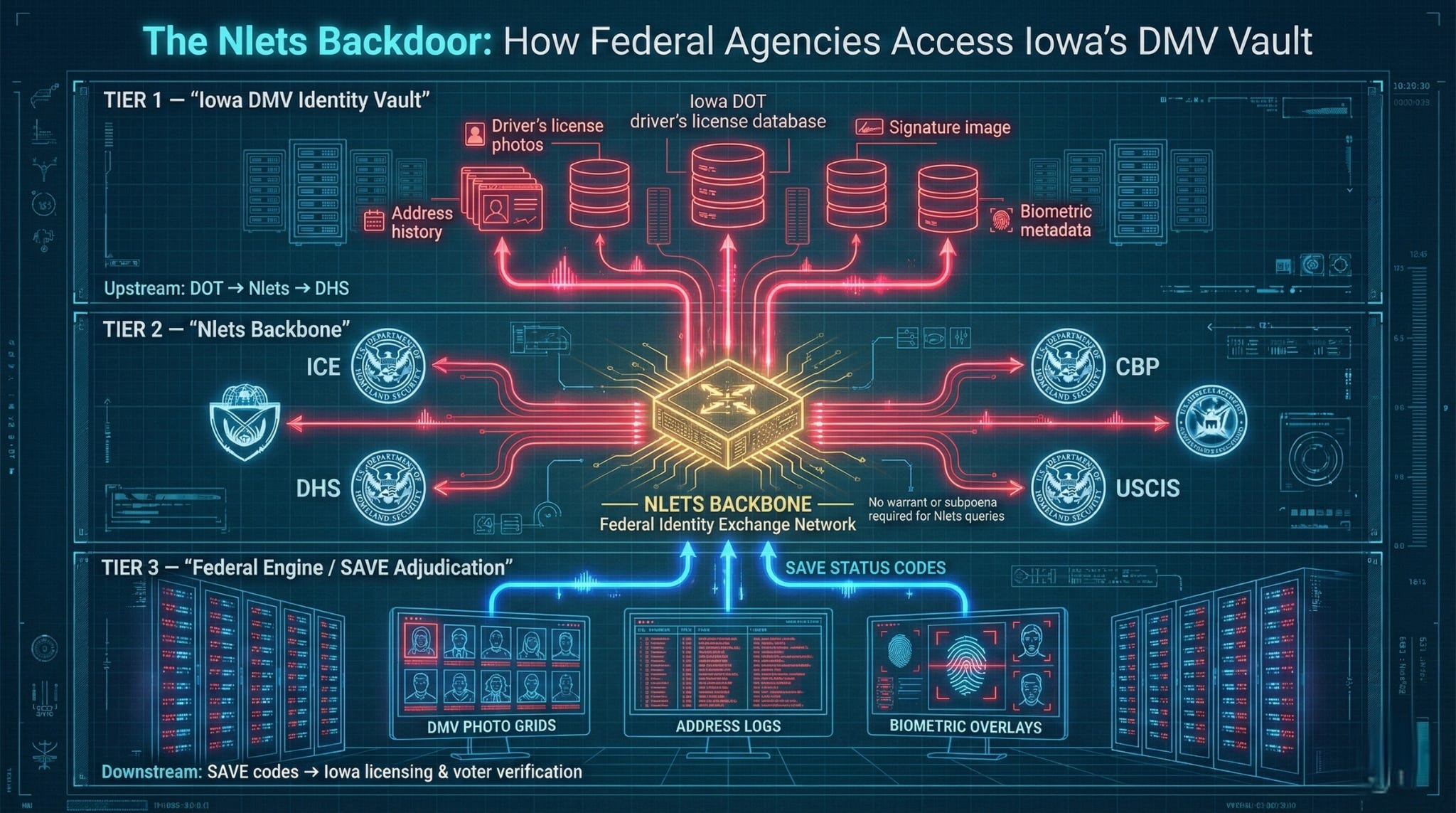
What the diagram makes plain is that Iowa’s identity system now runs on a bidirectional rail. Once information enters the federal engine, it is no longer just a background eligibility check; it becomes part of a larger verification architecture that Iowa cannot see and the public cannot audit. And that architecture rests on a distinction most people have never heard of: the difference between Nlets and SAVE — and what each one is built to do.
Nlets vs. SAVE: What Iowa Plugged Into — and Why It Matters
Nlets (State to Federal)
Nlets is the national law-enforcement data backbone that links all 50 state DMVs to federal agencies. Through Nlets, ICE and DHS have long been able to query DMV records — names, addresses, photos, driving histories, and vehicle data. It is a one-way street: states send identity data upward.
SAVE (Federal to State)
SAVE is different. SAVE sends federal identity determinations back downstream to states. When Iowa queries SAVE, DHS returns a status code — citizen, non-citizen, lawful permanent resident, no record, mismatch, or needs further verification.
It becomes a two-way exchange: states ask DHS to define a person’s identity.
Why It Matters
With Nlets alone, federal agencies could look into Iowa’s data.
With SAVE, Iowa is depending on federal data to decide who is eligible for a driver’s license. And because Iowa links driver’s licenses to voter registration, SAVE can influence who is treated as eligible to vote.
Nlets lets DHS see Iowa.
SAVE lets DHS judge Iowa.
Together, they form a closed identity loop: state data flows upstream to DHS, and federal identity codes flow back downstream into state eligibility decisions. This is the system Iowa just activated — and it means every adult Iowan is already subject to a federal benefits-verification database that was never designed to evaluate U.S. citizens or voters.
Iowa gave DHS everything.
DHS gave Iowa verdicts — verdicts that cannot be independently verified, that are generated in a system never authorized to hold U.S. citizen data, and that can be wrong with no legal recourse for the person flagged.
The Attorney General calls this a “victory.”
What the public heard in December was only the downstream half of this loop. The upstream half — the part that opened Iowa’s DMV vault to federal agencies — never made it into the press conference.
The Public Was Told Only One Side of the Contract
In her press conference, Brenna Bird spoke only of what Iowa “gained”: access to a “federal tool” and the ability to “verify voter citizenship.” But she never said that her “settlement” authorizes DHS access to every Iowan’s driver’s license file, that this data is fed into Nlets, or that Nlets already allows ICE to mine state DMV records nationwide.
SAVE was never supposed to hold U.S. citizen data to begin with. This agreement effectively nationalizes Iowa’s identity system. This is not voter integrity. This is identity forfeiture.
And it happened without a debate, without legislation, and without a single Iowan being told what the state traded away in their name.
This agreement doesn’t expire when the headlines fade. Bird's settlement bound Iowa — and every resident — to this data-sharing pipeline for 20 years. Twenty years of driver’s license photos, addresses, renewal histories, and biometric identifiers flowing through Nlets into DHS databases.
Twenty years of federal access to Iowa’s identity system without the legislature voting on it, without public debate, without informed consent. Citizen or not. Resident or not. Immigrants and non-immigrants alike. All of Iowa is in the surveillance grid created by state executive leadership.
At her press conference, Bird beamed as she announced the length of the deal — as if committing an entire state to a 20-year surveillance contract with DHS was an accomplishment.
What This Means for Every Iowan
For the average Iowan, the translation is simple. Your identity was traded away for two decades — and you were never told what Iowa got in return. Iowa did not just plug into SAVE. Iowa plugged SAVE into you.
The most disturbing finding of this investigation is not what Iowa got, but what it gave away. Access to the SAVE database is not a gift. It is a data trade. To “secure” this access, the Department of Homeland Security (DHS) demanded reciprocity. They did not just want to verify names; they wanted to ingest data. This investigation confirms that the mechanism for this trade is the International Justice & Public Safety Network (Nlets).
While participation is ostensibly voluntary, the terms of Iowa’s new settlement force the state to provide DHS with “full use” of its driver’s license records. This was not just a data trade; it was a biometric one. When Iowa agreed to provide DHS with “full access” to its driver’s license system, it handed over more than just addresses and renewal dates.
It handed over high-resolution driver’s license photographs and, critically, the underlying “facial recognition-ready image metadata.” In simple terms, the state of Iowa sold the face of every licensed driver to the federal government. It provided a biometric template of its citizenry to DHS, creating a facial recognition database-in-waiting for federal law enforcement.
This creates a dangerous, bidirectional surveillance pipe: Downstream (The Purge): Iowa pulls “citizenship markers” from SAVE to flag and purge voters. Upstream (The Dragnet): DHS pulls driver’s license photos, home addresses, and biometric data from the Iowa DOT to fuel its own tracking operations.
Together, they form a closed identity loop: state data flows upstream to DHS, and federal identity codes flow back downstream into state eligibility decisions.
Governor Reynolds and AG Bird did not just “sign a deal.” They effectively nationalized the Iowa DMV database. To catch a hypothetical handful of non-citizen voters, they handed the biometric keys to the state’s data vault to federal law enforcement.
If you have a driver’s license in Iowa, your photo, address history, and biometric template sit in a federal system that can decide whether you’re allowed to drive, work, or vote — even though you never applied for a federal benefit and never consented to be in that database.
The Leviathan: Iowa Isn’t an Outlier. It’s a Test Node
What happened in Iowa is not an isolated bureaucratic misfire.
It is not a paperwork mistake or a one-off overreach. It is structural. It is intentional. And it is part of a national blueprint that has been quietly forming for more than a decade. Iowa is simply one of the first states willing to implement the full stack.
What is being built in Iowa is not a simple "election integrity" measure. It is a state-level node of a national surveillance Leviathan. By merging the DMV database (State ID) with SAVE (Federal Status) and connecting them via Nlets (Law Enforcement Sharing), the state has consolidated your identity into a single, searchable track.
This is the "fusion" model in action. It takes data silos that were legally separated for your protection—benefits, driving records, voting rights—and breaks the walls down. Once those walls are gone, the data becomes fluid. A license plate scan from a "financial crime" investigation can be matched to a DMV photo from a "voter check," which can be cross-referenced with a "benefits status" from SAVE.
Iowa officials won’t say the word "SAVE" because they are afraid of what you will find if you Google it. They are afraid you will realize that a tool built to help immigrants has been weaponized into a dragnet that treats every citizen like a suspect.
Brenna Bird called it a victory. Governor Reynolds said it was for the security of our school children. But when the government builds a machine that can watch you from the DMV to the ballot box, using your own face as the tracking beacon, there is only one accurate word for it: Surveillance.
📣 If this investigation matters to you, share it.
This is how Americans learn what their government built — and how we hold power accountable.
This investigation is not over. The story continues with the federal architecture that enabled this, the corporate contracts that built it, and the full surveillance blueprint Iowa has linked itself to.
The federal contracts, the IBM-scale infrastructure, and the national fusion of benefits, driving, and voting will be the focus of future reporting. But this much is already clear: what Iowa built is not a voter tool. It is a system—and systems, once built, do not unbuild themselves.
In practice, this system routes identity in one direction and power in the other. The state DMV feeds into federal SAVE. State HHS files feed into the Social Security databases SAVE queries. DMV identity records travel through Nlets into DHS pipelines. Federal SAVE status codes flow back down into voter-eligibility decisions in county election offices.
That is not a policy tweak. It is an architecture.
Piece by piece, Iowa has agreed to wire together state records, federal immigration databases, benefits-eligibility files, employment-verification logs, and biometric feeds into a single, query-able profile of every resident. What used to be separate silos—protected by separate laws and norms—now sit behind one verification engine.
Iowa didn’t design this architecture. Iowa simply agreed to flip the switch.
The Pattern: States Like Iowa Are the “Pincer Points.” In our broader investigation, we’ve described The Pincer Movement — a political and technological strategy where the federal and state arms move toward the same surveillance goal from opposite directions.
Iowa is an ideal testbed because power is consolidated and largely unopposed. The governor signs the executive orders, the attorney general commits the state to a 20-year identity-sharing contract, and the legislature has already signed off on pervasive law-enforcement surveillance framed as immigration enforcement.
Even if Iowa officials insist they have no “intent” to misuse this machinery, the question that matters is not what they plan to do with it — but what the system is presently capable of doing.
A database that can automatically delay a newly naturalized citizen’s right to vote simply because SAVE has not updated yet is already a form of structural suppression.
The deeper danger is the data-pipeline architecture itself. With no new legislation—through administrative action alone—the SAVE database was quietly integrated into a state clearinghouse inside Iowa’s newly formed HHS, within the executive branch.
The system can flag a voter, generate a mismatch code, and quietly move that voter into “review” status. Nothing in the current structure prevents a future administration from using that same mechanism to target protesters, political opponents, demographic groups, specific neighborhoods, or entire communities that tend to vote the “wrong” way.
No accusation is needed. The capability exists. There is no independent oversight layer preventing such abuse. When a verification engine becomes powerful enough to invalidate a vote, the only real question is who controls the engine.
This is precisely the environment where a surveillance Leviathan can be built while the public still thinks it's just about “catching fraud.”
The Federal Half: A Quiet Fusion of Databases No One Voted On
While Iowa was building the state-level pipeline, the federal government has been building its mirror system.
SAVE is an immigrant-benefits checker by federal statute. E-Verify was originally an employment tool. SSA Citizenship Files have before this year been separate and protected identity documents. DMV identity data was always held at the state level. Law enforcement networks (Nlets) were originally built for warrants and stolen vehicles.
All of these are being quietly federated into a single, massive federal identity engine that was never authorized by Congress. Iowa’s Executive Order 15 didn’t invent this. It simply harmonized with it.
When you line up Iowa’s actions with the federal contracting documents, the pattern becomes undeniable. State DMVs are the organs. Nlets is the circulatory system. SAVE is the identity warehouse. The voter system is the test case.
And Iowa is the first state to plug in fully — because its leadership cooperated. What It Means for Iowans: You live in a surveillance prototype.
This is no longer hypothetical.
Iowa has a new state agency (HHS) explicitly empowered to run SAVE checks on residents. We have a DMV database wired into federal networks for 20 years by a “settlement” between Brenna Bird and the Trump DOJ. Voter eligibility decisions are being routed through a federal system never built for that purpose.
Iowa ALPR and local surveillance systems are already primed and state leadership openly celebrating the merger of state identity with federal enforcement tools.
Iowa has become a live demonstration of what a fully merged state–federal identity system looks like. Once that system exists, there is no limiting principle. If you can check voters, you can check renters. If you can check renters, you can check employees. If you can check employees, you can check parents, drivers, patients, customers, donors.
Once your identity lives inside a machine built to cross-link everything, the only question left is who gets to query it. This Is the Real Scandal — Not Just What They Did, But What They Made Possible. Nothing in Iowa’s new surveillance architecture is limited to elections. Elections were simply the public justification — the Trojan Horse.
What exists today is a permanent data pipeline between state identity systems and federal agencies using a licensing loophole.
This is enforced through a 20-year contract that no Iowa resident asked for, monitored through unregulated networks and driven by opaque federal status codes with no public oversight and no ability for individuals to contest errors.
This isn’t “election integrity.”
This is governance by database and algorithmic surveillance — a form of identity policing where the machinery is already built — and the people inside it never voted for its creation.
The Stakes: What a System Like This Can Do
To this point, we’ve walked through the mechanics — the executive order, the federal trade, the data flows, the 20-year lock-in. But the real stakes aren’t in the paperwork. They’re in the capability of the system Iowa has wired itself into.
Once a state plugs its identity infrastructure — DMV, voter rolls, HHS records — into a federal verification engine built without legislative oversight, the most important question stops being “What will they do with it today?” and instead becomes, “What could this system be used to do — and who gets to decide?” A system designed for one purpose rarely stays that way.
Start with the most obvious consequence.
Newly naturalized citizens can be disenfranchised instantly and automatically.
SAVE does not update quickly. The “naturalization lag” is a known failure mode. When a resident becomes a citizen, they get a naturalization certificate — but their Social Security record, which SAVE has ingested, often remains outdated for months or even years. The result is a perfectly legal voter flagged as a non-citizen by a database that is technically “correct” about their old status but factually wrong about their right to vote.
Picture a new U.S. citizen in Cedar Rapids who has done everything right: studied for the civics exam, taken the oath, proudly registered to vote. If SAVE still lists their old status, the system quietly tags them as ineligible. Their registration is delayed or challenged. Maybe they are forced onto a provisional ballot. Their first attempt to participate in democracy is denied — not by a poll worker who misread a form, but by a federal code Iowa cannot see, cannot audit, and cannot appeal.
That is not hypothetical. That is how SAVE works today in states already using similar setups. But that’s just the visible edge of the blade.
The deeper danger is structural: Iowa has built a system that can exclude any category of person with a single code.
Once the state funnels eligibility decisions through SAVE status codes, it gains a remarkable power. It can quietly shape who participates in public life — not by accusation, arrest, or criminal penalty, but through “verification.” The voter roll is simply the first place this becomes visible. The verification engine itself doesn’t know it’s looking at voters; it just sees identities. Which leads to the question no one in state government wants to answer: if the system can delay a voter based on a code, what stops a future administration from using it to delay anyone who becomes politically inconvenient?
Nothing in Iowa law stops this. Nothing in federal law stops this. No independent board oversees the system. No audit trail is required. No resident has the right to contest an error inside SAVE or Nlets. No judge signs off before someone is flagged.
So this is not really about what today’s officials say they intend. It is about what the system allows. Once the machinery exists, whoever inherits power inherits the machine.
A system with centralized identity, federal status codes, cross-linked databases, 20 years of state-to-federal data sharing, no public oversight, and automated eligibility decisions is a system that can be repurposed silently. Not in ways that make headlines, but in ways that shave the edges of participation — the quiet tools authoritarian regimes always reach for first.
Could this grid be used to slow down protesters? To quietly frustrate communities that vote the “wrong” way? To label certain neighborhoods as “high-risk” in a future algorithm and make every application from that ZIP code just a little harder? To mark journalists or political dissidents for extra scrutiny, without ever writing their names into a law?
We don’t have to claim that anyone is doing this today. We only have to show that the system is capable of it — and no one is watching it.
Once a system like this is built, once the pipes are laid and the data begins to flow, future officials of any party inherit it as a turnkey tool: already humming, already normalized, already hidden behind bureaucratic language like “verification” and “integrity.”
That is why this matters. That is why Iowa’s case is not just a local story. Iowa has just demonstrated the template. You don’t need to change the law to change who participates in democracy — you only need to change the database.
That’s what this system can do to one person standing alone at a polling place. But the same machinery doesn’t just act on individuals — it can sideline entire communities at once.
Because once the state hard-wires its databases into a federal grid, local promises about privacy and restraint stop mattering. A city can vote to limit surveillance, set retention rules, or keep cameras “local only.” On paper, those protections still exist. In practice, the state has already routed around them.
To see how that works on the ground, you don’t have to imagine a dystopia. You just have to look at what happens the moment an ordinary Iowan walks into the DMV after the state signs a 20-year deal.
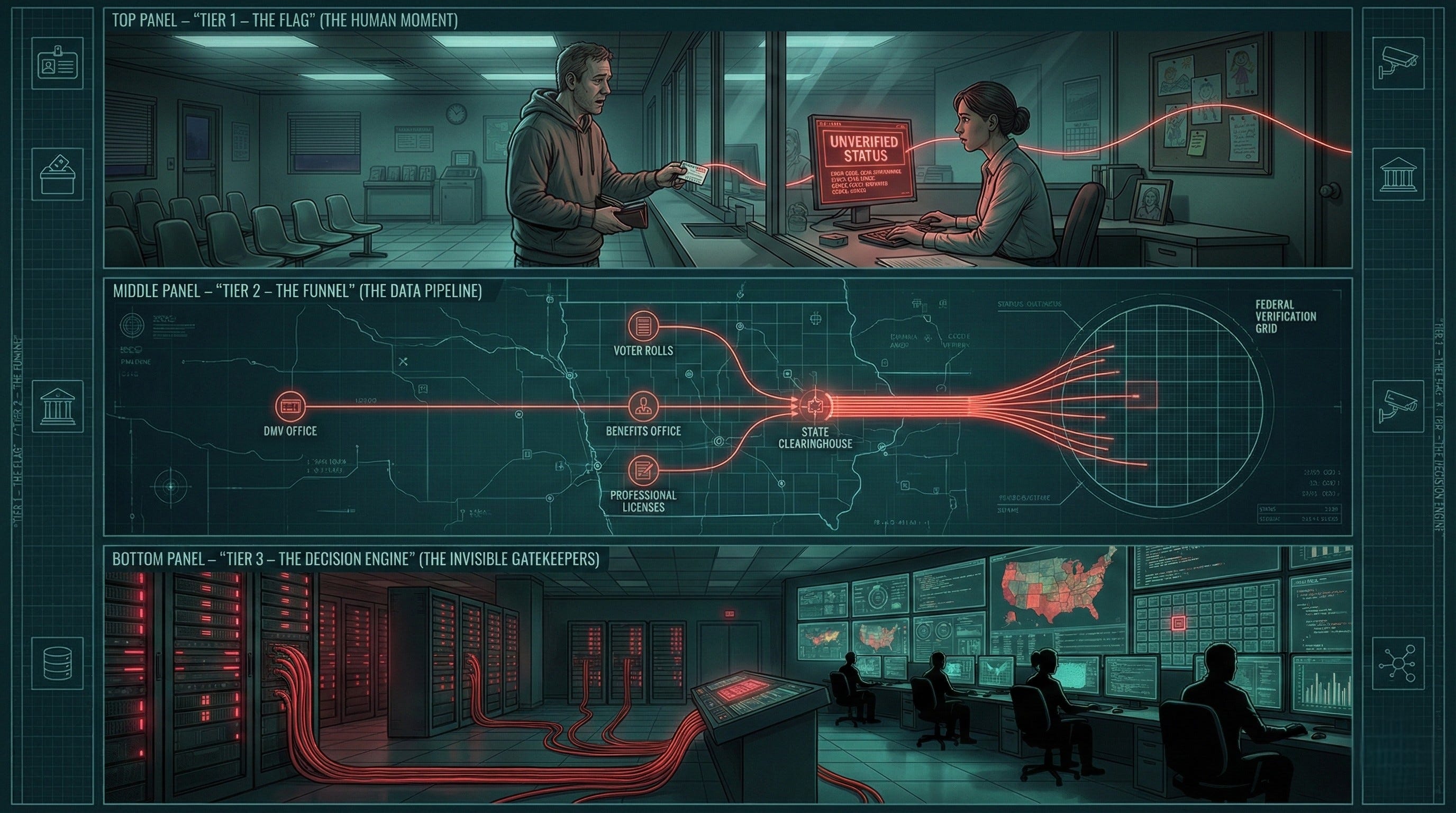
What It Feels Like When the Database Decides You Don’t Count
Imagine Mark, a 52-year-old warehouse supervisor in Ankeny. He’s never missed a day of work, never been arrested, never thought twice about politics beyond grumbling about “those damn politicians” over coffee.
One morning he goes to renew his license like he always has. Same office, same line, same laminated form. Only this time, the clerk frowns at the screen.
“I’m sorry, sir. The system can’t verify your status. You’ll need to call this number.”
No one in that office wrote the code that flagged him. No one can see the SAVE record that tripped. No one can tell him whether it was a typo, an old data breach, or a status code that got flipped when Iowa fused its DMV and benefits records into a federal “verification” engine.
All Mark knows is: his renewal is on hold. His CDL is in question. His job is suddenly at risk — not because a judge ruled anything, but because a database Iowa can’t audit whispered that something about him doesn’t match.
Mark just happens to drive a truck. Swap him out for an ER doctor in Iowa City whose hospital can’t get her license renewed on time, a teacher in Cedar Rapids whose background check suddenly “needs review,” or a solo attorney in Council Bluffs whose bar renewal hits the same red code. The job title changes. The machine doesn’t. Once the state treats every license a public benefit, everyone with letters after their name is standing in the same line.
Mark isn’t an immigrant. He isn’t a criminal. He isn’t on any watchlist. He’s just inside the machine now. And once you’re in, every mistake the system makes is your problem to fix — if you’re ever even told it happened in the first place.
Multiply Mark by a thousand quiet errors a year, and you start to see what this really is: not a tool aimed at “them,” but a permanent filter over all of us — one that can be tuned at any moment without a single vote being cast.
And if this is what it can do to one ordinary person trying to renew a license, the next question writes itself.
When the State Pulls Rank on Your City
In last week’s investigation, The ALPR Trap, we showed how local governments and police departments were the key “pressure points” in the surveillance network. City councils could, at least in theory, decide whether their police joined Flock’s network, how long plate data was retained, and whether it was shared upstream with federal partners.
That was true — until the deal Governor Reynolds and Attorney General Bird just signed. By wiring Iowa’s driver’s license system into SAVE and routing that relationship through Nlets, the state has quietly preempted local control over much of this surveillance data. Once the data flows into state-level pipes, it can be queried over Nlets by federal partners, no matter what a city council in Cedar Falls, Des Moines, or Iowa City told its residents.
A city can promise its voters, “We only use these cameras for local crime. We don’t share with ICE.” But when the same state that runs those plates is also feeding its driver’s license records into a repurposed immigrant benefits verification system, and doing it through a law-enforcement network that cities don’t control, those promises are on borrowed time.
In practical terms, that means if the cameras stay up and keep feeding state-reachable systems, the state’s deal with DHS ensures that data will be available to federal agencies, one way or another.
Local leaders can still vote to remove cameras or refuse new contracts — but in Iowa and perhaps other states, once data enters a pipeline governed by the state’s agreements, their authority stops at the city limits.
This is not just about immigration, or voting, or one benefits database. It is part of a broader pattern in Iowa politics: pulling decision-making up from cities and school boards and instead centralizing authoritarian power at the State executive level.
Whether it is DEI, university governance, or now the fate of every driver’s record in the state, the center of gravity keeps moving upward.
With Reynolds’ EO 15 and the SAVE settlement that Brenna Bird announced last week, surveillance followed the same path. The question of “who controls the cameras” is no longer just a local policy debate. It is a question of what the state has promised, and to whom.
Iowa Deserves to Know What Was Built in it's Name
When Governor Reynolds signed Executive Order 15 on October 8th, few Iowans noticed. It was announced in the shadow of a high-profile school scandal, framed as a procedural “E-Verify fix,” and reported as a minor administrative cleanup.
When Attorney General Brenna Bird held her press conference on December 1st, most people walked away believing the state had simply “won access” to a federal tool for election integrity.
No one told them that Iowa had opened a permanent federal pipeline into the state’s identity vault, tied its voter rolls to a benefits database never meant to contain U.S. citizens, locked itself into 20 years of DHS visibility into DMV records and constructed a system whose capabilities far exceed the issue it was sold to address.
No one explained to the public what this architecture actually does. No one explained what it could do. No one explained what it means for the future of democratic participation in this state.
Why this story matters
Iowa did not just acquire a new verification tool. It became a proof-of-concept for a much broader, national identity apparatus — one that merges state DMV data, federal immigration-benefits databases, law enforcement networks, Social Security identity markers, and voter eligibility systems into a single, cross-referenced profile of every resident.
This shift did not go through the legislature, include public debate or require democratic consent. It happened through an executive order, a settlement agreement, and a 20-year contract — stitched together behind a public narrative that never mentioned the true scope of what was being built.
Now the data pipe is running. Not because Iowans asked for it or voted for it—because the state constructed it quietly, assuming no one would read the fine print, trace the pipelines, or understand the federal architecture humming beneath the surface.
But someone did. Thus the question that matters most is not, “Do you trust the current administration?” but instead, “Do you trust every future administration — of either party — with a system this powerful and no oversight?”
Once an identity system is wired into federal databases and state election infrastructure, once it becomes the arbiter of who qualifies and who does not, once it is normalized as the invisible referee of citizenship, employment, benefits, and voting, it never unwires itself.
This is not about fear. It’s about clarity. And clarity is the one thing surveillance systems cannot survive. Iowans—and all Americans—deserve to understand the system built in their name. They deserve transparency. They deserve consent. They deserve democratic control over their own identity infrastructure.
At the very least, they deserve the truth.
A database designed for immigrant benefits has been repurposed into a statewide eligibility engine.
A “voter verification” deal traded away 20 years of driver’s license data. A federal identity warehouse now sits behind Iowa’s elections. Iowa hasn’t just plugged voters into this machine; it has plugged in every licensed profession it can reach—from the DMV counter to the operating room, the classroom, the salon chair, and the courtroom. And no one asked your permission.
As a deliberate policy choice, this is one more step in a long march toward centralized control—away from home rule and toward a surveillance system ordinary Iowans never voted on and were never told about.
The deeper federal architecture behind this deal, and the corporate vendors building it, will be the subject of future reporting. For now, Iowans deserve to know this much: in the span of a few weeks, their governor and attorney general turned a benefits database into a voter-screening tool, turned a “school safety” scandal into a data pipeline, and quietly pulled surveillance power up and away from every city in the state.
But this much is already clear: what Iowa built is not a voter tool. It is a system. And systems, once built, are not easily unbuilt.
The only antidote is sunlight. This is where the sunlight begins.
References
For source documents, legal citations, and the interactive exhibit, see the Evidence Locker for this investigation.
American Immigration Council. (2012). The Systematic Alien Verification for Entitlements (SAVE) program: A fact sheet.
https://www.americanimmigrationcouncil.org
American Immigration Council. (2012). Using SAVE to verify voter eligibility comes with unexplored risks.
https://www.americanimmigrationcouncil.org
Bipartisan Policy Center. (2024). What adding motor vehicle data to USCIS’s SAVE system means for election administration. Bipartisan Policy Center.
Brennan Center for Justice. (2012). Homeland Security’s “SAVE” program exacerbates risks to voters. Brennan Center for Justice.
Fair Elections Center. (2025). Eligible voters at risk: Examining changes to USCIS’s SAVE system. Fair Elections Center.
Iowa Attorney General’s Office. (2025, December 1). Attorney General Brenna Bird secures election integrity win for Iowa [Press release].
Office of the Governor of Iowa. (2025, October 8). Executive Order 15. State of Iowa, Office of the Governor.
National Immigration Law Center. (2020). Nlets: Questions and answers. National Immigration Law Center.
Nlets. (2025). Who we are: Mission and vision. Nlets – The International Justice and Public Safety Network. Nlets
U.S. Citizenship and Immigration Services. (n.d.). Systematic Alien Verification for Entitlements (SAVE) program. U.S. Department of Homeland Security. (Original fact sheet and program description pages.)
U.S. Government Accountability Office. (2017). Verification for benefits: Actions needed to improve evidence for eligibility decisions (GAO-17-204). U.S. Government Accountability Office.
Sunlight is the only antidote to systems built in the dark.