

Starlink Diplomacy: Elon Musk’s Hidden Handshake with Power
When the White House Peddles Influence for Profit
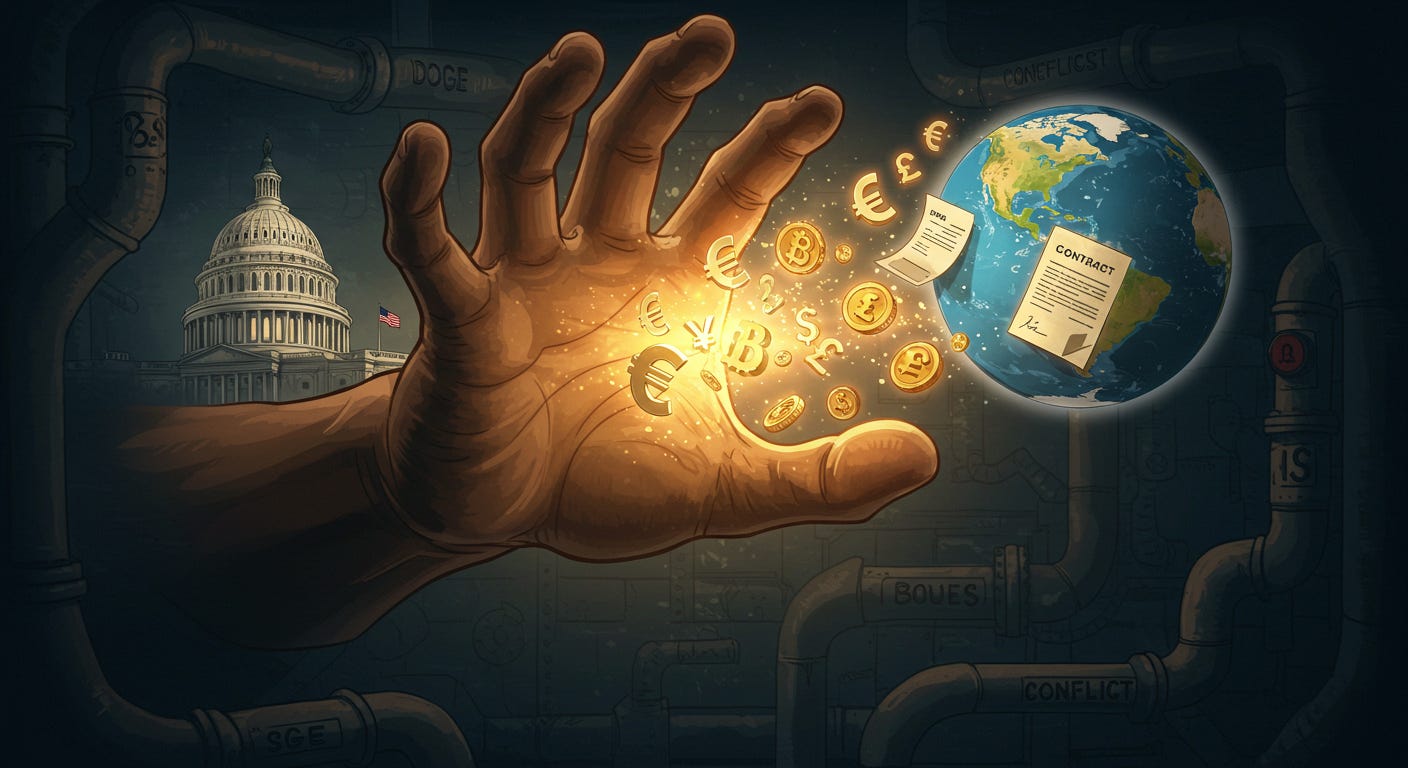
Meta-Journalism / Investigative Feature
"I write regarding recent reporting that the Department of State is advocating for foreign countries to approve licenses for Elon Musk’s Starlink satellite internet platform to the potential detriment of other American companies..." — Rep. Gerald E. Connolly, May 13, 20251
When the White House Peddles Influence for Private Gain
Picture a world where foreign policy doesn’t serve national interest, but instead chases the ambitions of a billionaire—hidden behind layers of secrecy—wielded behind the facade of government advice. That world, it seems, has arrived. As your neighbor and fellow Iowan raising children in uncertain times, I recognize that these behind-the-scenes dealings impact more than just distant politics—they shape the very future our families will inherit.
If you once believed disruption could be patriotic, you're not alone. Many did. But when power concentrates in the hands of the few, scrutiny—not loyalty—is the real civic duty.
Emerging evidence suggests U.S. diplomatic infrastructure may be quietly shifting roles—no longer serving only national interests, but increasingly advancing private enterprise2.
On May 13, 2025, U.S. Representative Gerald E. Connolly dropped a political bombshell, demanding an investigation into reports that the Trump White House is promoting Elon Musk’s private satellite company, Starlink, in exchange for diplomatic concessions. This allegation points to a disturbing truth: Elon Musk has become a quiet power broker, working the levers of influence out of sight, using his influence to push U.S. foreign policy in ways that benefit his private empire, blurring the lines between public service and private greed.
Connolly's letter alleges that foreign governments are being pressured to approve Starlink licenses as a way to gain favorable treatment in trade negotiations—a move he says creates a blatant conflict of interest.
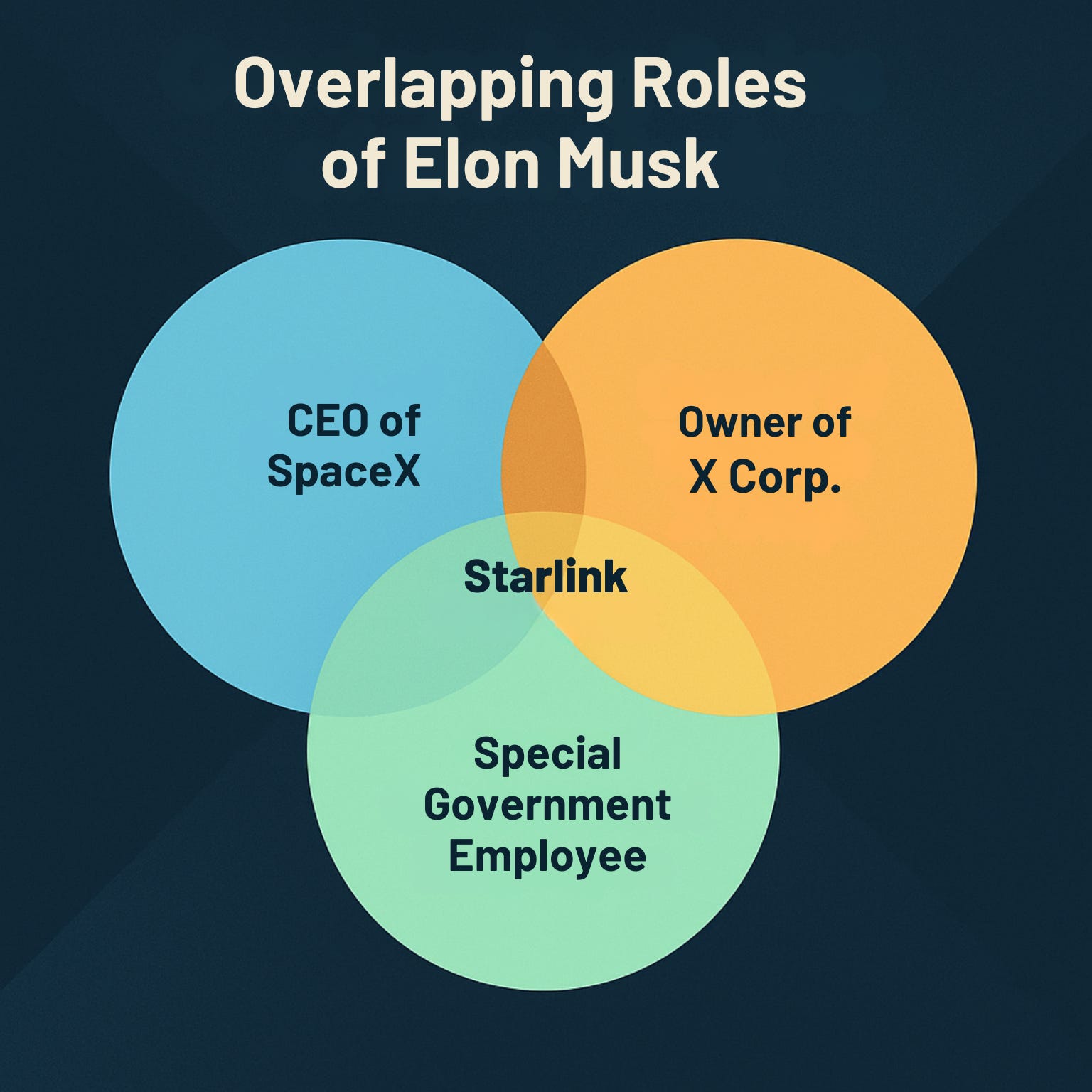
Musk, after all, isn’t just an entrepreneur. Still officially listed as a Special Government Employee (SGE), he also serves as CEO of SpaceX (Starlink’s parent company) and leads DOGE, the Department of Government Efficiency. This trifecta places him in an unprecedented position: laying the groundwork for policy that funnels public leverage into his private enterprise. What was once a safeguard against private overreach—the machinery of government—is now being reshaped into a profit engine. And in this dangerous feedback loop, accountability becomes the first casualty.
A Special Government Employee — and a Special Conflict of Interest
It’s Musk’s double role—Trump adviser and tech CEO—that’s sparking Connolly’s alarm: a single figure blurring the line between public duty and private gain, shaping U.S. foreign policy in ways that advance his private empire.
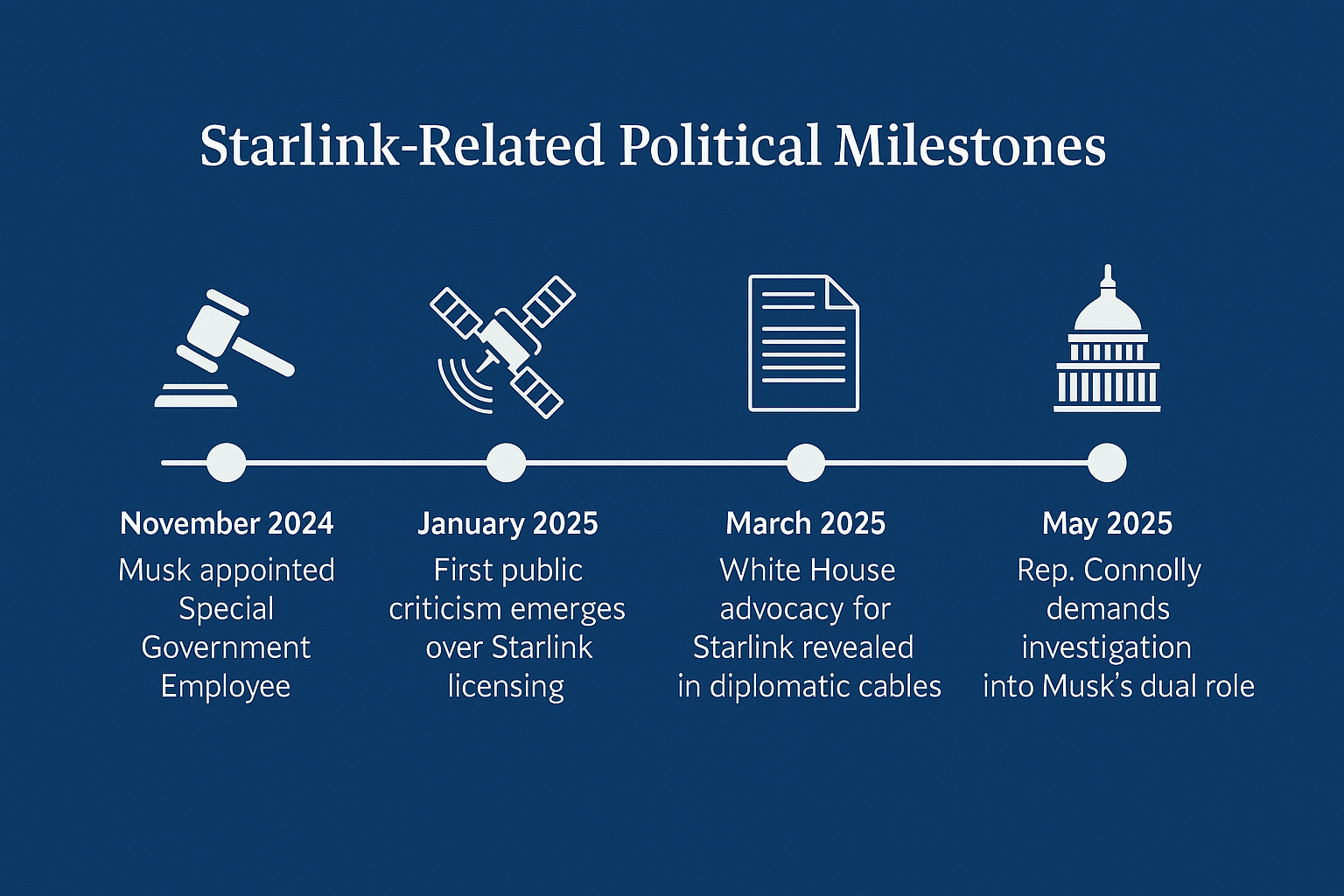
This timeline traces a troubling evolution: from Musk’s quiet appointment as a Special Government Employee, to mounting global backlash over Starlink’s aggressive licensing push. As diplomatic pressure tactics came to light, the White House’s role in promoting Starlink sparked alarm—culminating in Rep. Connolly’s explosive call for a federal investigation.
It’s not just the timeline of events that’s alarming—it’s the structure behind it. The same ambiguity that let Starlink diplomacy unfold has allowed Musk to operate in a legal gray zone, using a public role to quietly build a private empire.
This ambiguity has allowed Musk to wield enormous influence over federal spending, policy implementation, and now, apparently, international diplomacy—without the legal or ethical constraints that should come with that power. Musk has refused to publicly disclose the full extent of his financial interests, despite his empire’s reliance on government contracts. According to Connolly, Musk’s position allows him to profit directly from the very policies he helps shape3.
Scaling Back—or Scaling Influence?
In late April 2025, under mounting pressure—including a sharp Tesla stock decline and calls from his board to refocus—Musk announced he would reduce his DOGE involvement to "a day or two per week." He also began working remotely. By May 13, a City Journal report declared Musk would "step down" by the end of the month. Yet that same day, Connolly still referred to him as an active SGE underscoring the persistent ambiguity of his official status.
The contradiction was telling. Just days earlier, DOGE had unveiled a software revamp—designed in part by SpaceX-linked engineers—to accelerate federal job cuts, an initiative unmistakably aligned with Musk’s ethos of disruptive efficiency. Former officials at USAID and the State Department noted that even if Musk fades from view, his policies continue to roll forward like a self-perpetuating machine. The software project was interpreted as a post-departure power play, solidifying Musk’s legacy in code.
Musk might not be the public face of DOGE anymore, but his hand still pulls the levers. This evolution—from public appointee to shadow architect—lets the administration harness his clout while dodging accountability.
Starlink: Diplomacy’s New Bargaining Chip
Starlink, SpaceX’s satellite internet division, operates the world’s largest LEO broadband constellation. With over 6,750 satellites beaming connectivity across the globe, Starlink is strategically poised to become the backbone of digital infrastructure in emerging markets and conflict zones.
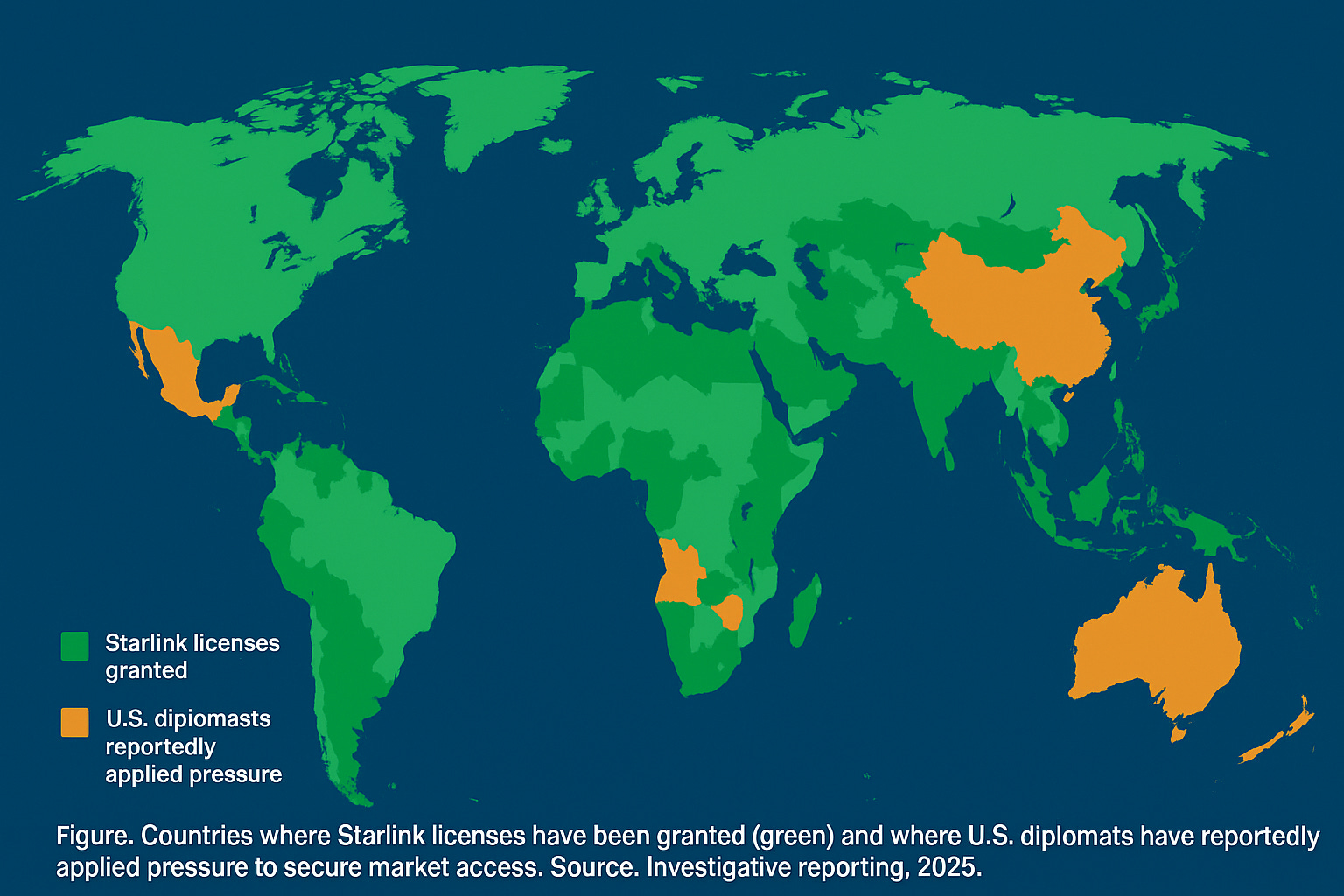
But Starlink can’t operate in a country without that country’s approval—landing rights, spectrum access, and local licenses are required. That’s where U.S. foreign policy enters the equation. Connolly’s letter suggests that in several cases, U.S. diplomats have encouraged—or pressured—foreign governments to grant Starlink licenses as part of ongoing trade or tariff negotiations.
Lesotho, for example, explicitly stated that it hoped licensing Starlink would help it gain traction in trade talks. In India, concessions to facilitate Starlink’s entry could yield $1 billion annually for Musk’s company—just from a 1% market share4.
What makes this so troubling is that Musk stands on both sides of the table: he is the beneficiary of the deal and a quasi-governmental force shaping it. This isn’t just promoting American business. It’s weaponizing diplomacy to enrich a presidential adviser.
This isn’t just about backing American business—it twists diplomacy into a tool for someone’s private gain. This could become the new normal: a kind of shadow diplomacy where elite interests, not national priorities, steer the course.
Diplomatic pressure once used to open humanitarian corridors or broker peace deals is now deployed to secure broadband licenses for a private billionaire. It’s an inversion of priorities—a hijacking of our foreign policy institutions.
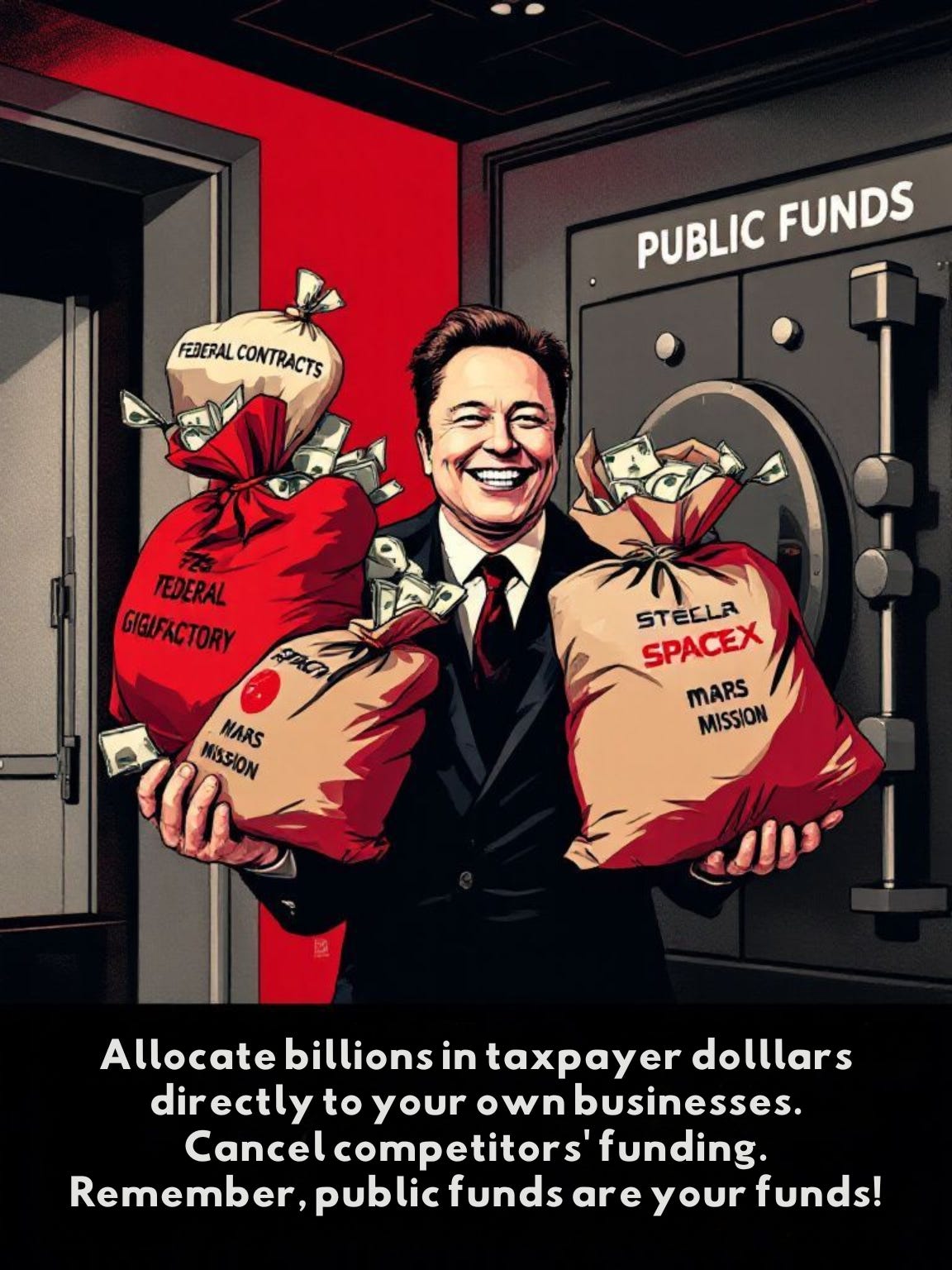
Quid Pro Quo: Public Office for Private Gain
According to several retired diplomats interviewed by news outlets in recent months, the promotion of Starlink marks a sharp break from standard U.S. foreign policy norms — one that could be interpreted as cronyism or soft coercion abroad. Instead of furthering national interests, it appears foreign policy is being hijacked to support Musk’s commercial expansion5.
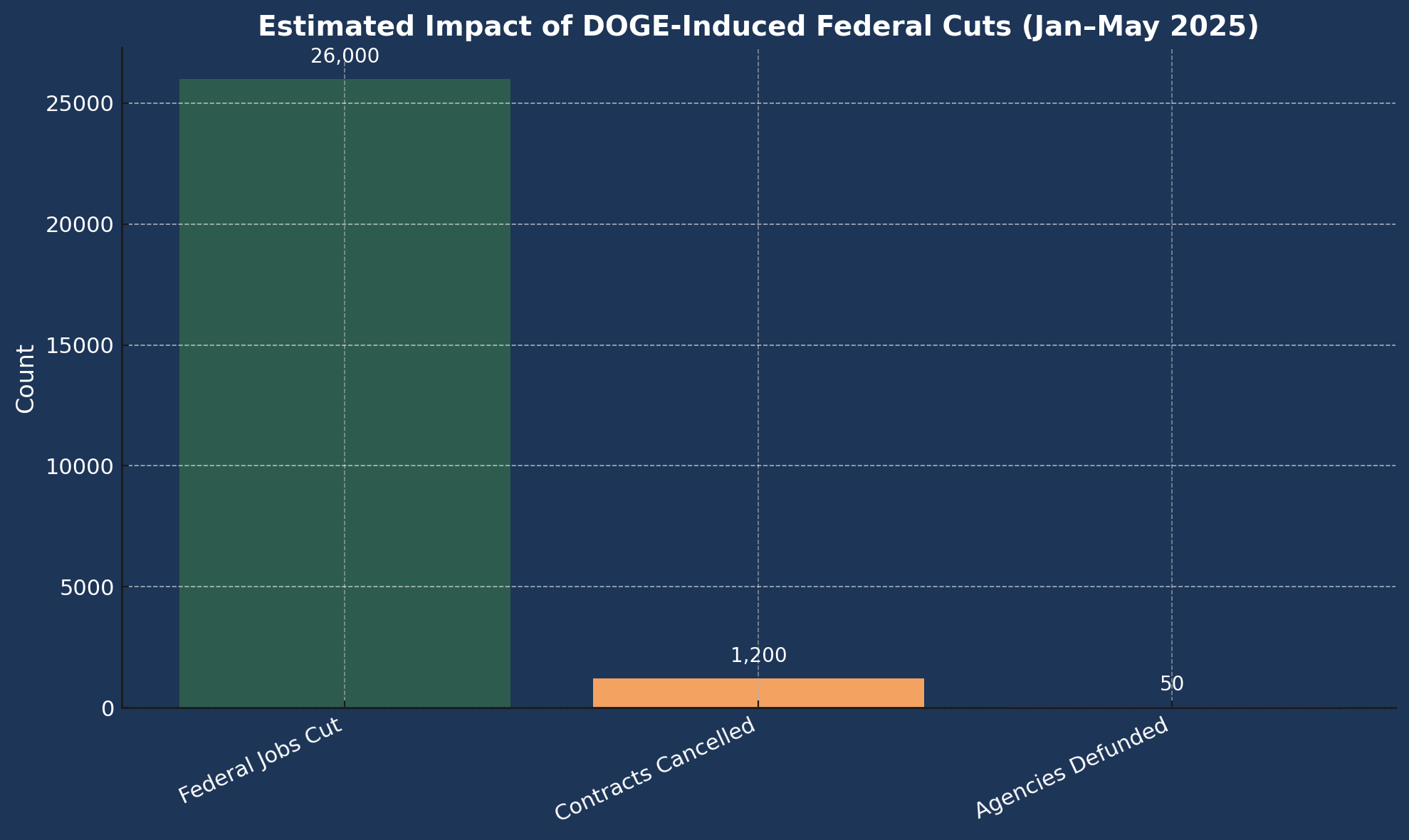
Inside the federal government, DOGE has functioned more as a wrecking crew than a reform effort. Musk’s software-driven purges have eliminated thousands of civil servants, shuttered agencies like USAID, and dismantled diversity, equity, and inclusion (DEI) offices6. According to CBS News, early retirements surged, federal contracts were canceled en masse, and DOGE staffers even moved into vacant GSA offices as makeshift residences7.
Rather than increase efficiency, DOGE has de-fanged oversight—leaving in its place a skeletal bureaucracy ripe for exploitation. What’s taken its place is not agility, but fragility—paralyzed by instability, hijacked by elite interests, and bent to the will of a tech tycoon who thrives on chaos8.
Mass emails encouraged federal workers to consider early departure—some described them as thinly veiled exit campaigns. Retirement systems were outsourced. Buyouts were mishandled9. Musk’s so-called reforms are not about streamlining government—they are about gutting it, then privatizing what remains.
Musk’s upside is immense. Unlike typical government contractors, he remains embedded inside the policy apparatus while also directly benefiting from it. Connolly argues this structure “signals to countries around the world that the doors of the White House can be opened by enriching the President’s wealthiest donor and employee.”10
Oversight Demands and Stonewalled Transparency
Weeks before Connolly’s IG request, House Oversight Committee Democrats sent letters to the Secretary of Defense, White House Chief of Staff, and others demanding Musk’s SF-86 security clearance form and a complete financial disclosure11. As of this writing, those disclosures have not been made public.
Federal law prohibits officials from participating in government matters where they have a financial stake unless a waiver is granted following full disclosure12. Musk has done neither. Instead, the Trump administration has deflected, arguing that Musk’s title exempts him from the rules—a claim legal scholars reject.
According to committee staffers and DOGE personnel records reviewed by CBS News, Musk’s presence has influenced over 100 federal decisions since his appointment13. His role, they say, represents an unprecedented consolidation of public power and private capital.
The conflict is no longer hypothetical. It’s structural. It’s systemic. And it's happening in plain sight.
Musk’s defenders argue he brings needed innovation to government—a disruption they see as necessary. But innovation without boundaries is simply corruption by another name.
Capturing the Controls: DOGE's Purge and the Pliable State
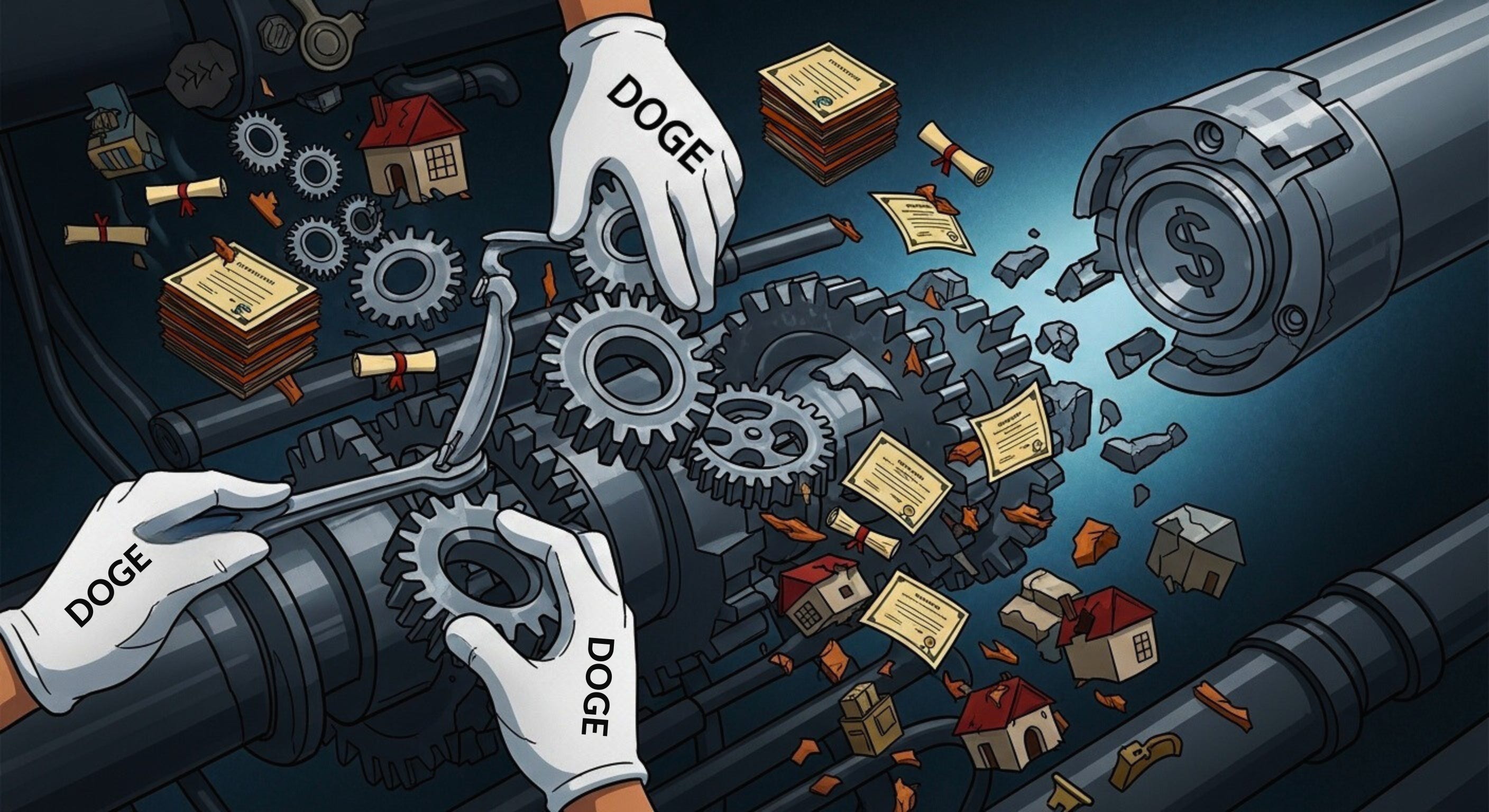
Musk’s influence isn't confined to Starlink. Through DOGE, he has led what critics call a hostile takeover of the federal government’s internal workforce. Under the guise of eliminating "ideological capture," DOGE has pushed mass layoffs, dismantled agencies like USAID, and defunded DEI initiatives across the federal bureaucracy14.
The goal? Strip agencies of experienced staff and replace them with loyalists—or with no one at all. This hollowing-out of institutional knowledge makes the bureaucracy more pliable, and less likely to resist initiatives like Starlink diplomacy.
Emails sent to millions of federal workers urged them to quit. Retirement systems were outsourced. Buyouts were mishandled. In some cases, DOGE staffers reportedly moved their families into unused GSA offices as makeshift residences. The chaos, critics say, was the point.
This isn’t just about efficiency—it’s about takeover. Public agencies risk becoming extensions of one man’s ambition.
Democracy at Risk: A Government for Sale
The broader implications of this saga extend far beyond Elon Musk. If U.S. foreign policy can be leveraged to favor one powerful businessman, what does that say about the state of our democracy? What signals are we sending to allies and adversaries alike?
Public trust in our institutions is already hanging by a thread. Using diplomacy to chase private profit could snap it for good. The Starlink example reveals a chilling precedent: that public policy is available for purchase, and that billionaires who blur the line between adviser and beneficiary can operate with impunity.
A Government of the Billionaire, by the Billionaire
We’re not just witnessing influence. We’re watching a system that should belong to all of us quietly slip out of our hands. An unelected billionaire is using diplomatic handshakes to secure market access, then reaping the profits personally. This fusion of government authority with corporate ambition is not innovation. It’s plutocracy.
And if Starlink is the beta test, what’s next? Water systems? Energy grids? Public education? What happens when every diplomatic deal comes stapled to a shareholder report?
Once democratic norms are replaced with shareholder logic, every public good becomes a commodity, every treaty becomes a transaction, and every government office becomes a potential profit center.
Conclusion: Will There Be Accountability?
Rep. Connolly’s demand for an investigation is a critical first step—but will it matter? Can mechanisms like the IG, already under political pressure, rein in someone with Musk’s influence? Or are we witnessing the normalization of plutocratic governance?
Make no mistake—this isn’t just a scandal unfolding behind closed doors. It’s a fundamental challenge to the pillars of democratic governance. When a billionaire CEO operates in the shadows—using the levers of government to expand his private empire, influence foreign governments, and weaken agencies designed to protect the public—the system is broken.
Supporters claim Musk is just speeding up innovation. But history is full of warnings—rush ahead without scrutiny, and you’re headed for a fall. Starlink diplomacy signals not just an ethical collapse—but the erosion of the firewalls meant to insulate democracy from private power.
But this isn’t about Musk alone. It’s about the precedent he sets—a world where unelected mega-donors don’t just influence policy, but design it to serve their financial empires. Where the highest bidder doesn’t lobby institutions, but repurposes them—to lock in power and profit.
Starlink diplomacy isn’t just about Elon Musk. It’s a test case for what happens when the boundaries between public trust and private ambition are allowed to blur. Whether this moment becomes a turning point—or a template—depends on what comes next.
When one billionaire can shape foreign policy from inside the government—and profit from the deals he helps make—the system isn’t just compromised. It’s captured.
This isn’t just a warning. It’s a call—to those across the spectrum who believe in checks and balances, shared power, and a government that works for people, not profit.
The question now isn’t whether this is happening. It’s whether we’re going to stop it.
Footnotes
Foreign Service Officers Roundtable (Brookings, May 2025). Summary drawn from diplomatic commentary on recent Brookings Foreign Policy Podcast episodes and participant notes from a private roundtable.
CBS News Investigation: DOGE.gov Contract Database and Personnel Reports, May 14, 2025; "Washington Got the Better of Elon Musk," City Journal, May 13, 2025; Connolly Letter to Inspector General, May 13, 2025.
18 U.S. Code § 208 - Acts affecting a personal financial interest. Federal conflict-of-interest law (18 U.S.C. § 208) prohibits executive branch employees from participating in official matters where they have a financial stake unless granted a publicly disclosed waiver.
According to committee staffers, Musk's presence has influenced over 100 federal decisions since his appointment. Source: CBS News Investigation, May 2025: DOGE.gov Contracts Database and Personnel Reports, May 14, 2025.
Honestly disgusting reality. Great essay though.
Great article. I think it would take a lengthy book to completely disclose the self-serving manipulative power Musk wields over the current regime. People were stunned by his quarter billion dollar financial support to elect Trump, but by doing so Musk gained the power to quash about $1.5 Billion in penalties, he faced from dozens of lawsuits. His $20 Million attempt to influence the Wisconsin Supreme Court election recently, in attempts to rid himself of another pesky lawsuit. Fortunately, his plan failed.
Musk has extensive business ties to China, as well as Russia, resulting in him withholding Starlink service to Ukraine and Taiwan, at crucial moments. Whistleblowers have claimed that DOGE used insecure systems to download citizens sensitive data, and quite possibly provided backdoor entry to Russia.
His acquisition of Twitter, under the guise of protecting free speech, has provided him with a racist bully platform, that regularly blocks dissent of himself and trump.
Musk is tied in with Palantir, the company receiving Billions in federal funding to streamline government services and security through AI. The white supremacist ideology driving this move is glaringly obvious. And the list goes on and on.
I agree that Musk needs to be thoroughly investigated, but I have little confidence in such an inquiry gaining traction. The old saying about closing the barn door after the horse has escaped comes to mind.