

The ALPR Trap: How America’s Plate Readers Turn Your Movements Into a Permanent Financial Surveillance Record
How a hidden national grid quietly turns local license‑plate readers into a financial‑behavior tracking system.

Part II of the Warrantless Surveillance Series By Restoring Democracy's Promise. Part III is here.
The Quietest National System You’ve Never Been Told Exists
You’ve probably driven past one of those cheerful Flock Safety signs posted near a neighborhood park and assumed what everyone else did: a local camera to catch local criminals.
That story is only the front porch of a much larger house. By design, each layer of the Automatic License Plate Reader (ALPR) system hides the layer above it. What looks like a small concession to public safety is actually the entry point to a coast‑to‑coast pipeline that converts your movements into financial intelligence.
Across hundreds of towns and cities, ALPR cameras capture far more than plate numbers. They generate streams of metadata about routes, times and direction. Those streams are fed into state hubs like Texas’s Financial Crimes Intelligence Center (FCIC), where algorithms categorize your movements as a kind of transaction. In this universe, your car becomes an “asset” to be traced, your daily commute morphs into a risk score and your life is reduced to metadata.
What most people—and many local officials—don’t realize is that this architecture doesn’t start or end in your neighborhood. Local plate reads are routed into statewide repositories, fused with financial‑fraud databases and then shared with federal contractors who build behavioral profiles. Because each agency sees only its own slice of the data, the national scope remains invisible. In some places, like Iowa, lawmakers promised a 30‑day retention limit for ALPR data. Yet contracts in Texas mandate a three‑year minimum retention period and require agencies to share their data with “local, state and federal” partners, with no opt‑out.
The result is a single, nationwide financial‑surveillance backbone that most people have never heard of. This investigation will map out how the data moves across state lines, show why the 30‑day promise quietly becomes years, and explain how a law about stopping bitcoin scams was used to legitimize turning your car into a financial asset.
Stay with us: the quietest national system is about to become very loud.
How the Data Actually Moves (Not What Your Police Chief Thinks)
When city councils vote on Flock cameras, they often think the evidence will live in a simple local system. Flock’s sales materials stress “30‑day retention” and reassure that plate data will be hard‑deleted after a month. In reality, the company runs a nationwide data network — more than 20 billion plate readings every month across 49 states and 4,800 agencies. Most police chiefs never see the layers above the Flock dashboard, but those layers determine where your car’s movement data ends up.
This is the part almost no city official, no journalist, and no police chief has ever been shown.
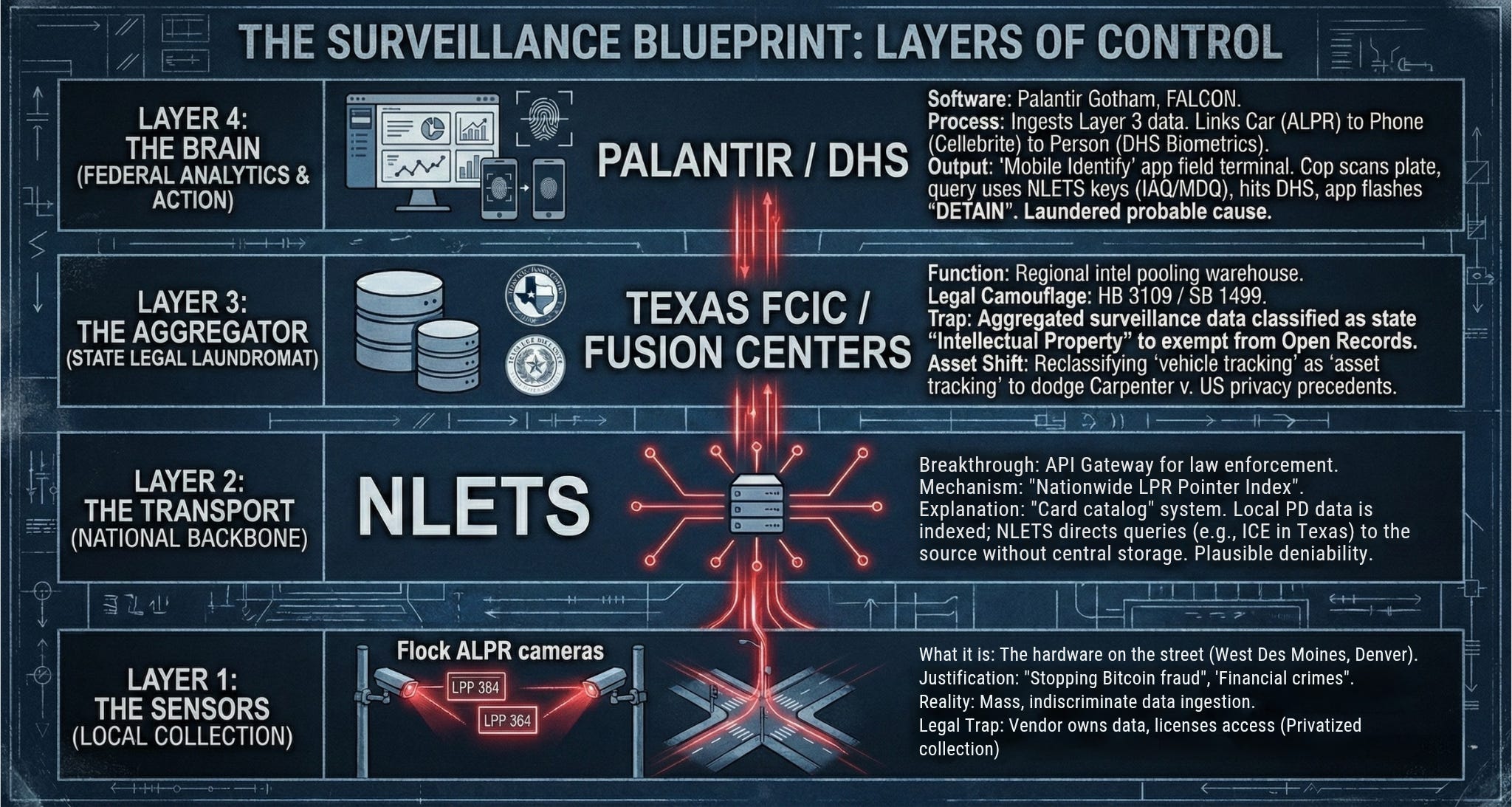
Step 1: Local cameras are Ingestion Points for a National Network
Flock cameras use automatic license‑plate recognition (ALPR) technology to photograph the rear of every vehicle that drives through a neighborhood. Each camera automatically uploads the plate number, vehicle image and location to Flock’s cloud. Flock’s National LPR Network pools those uploads and provides real‑time alerts and retroactive search to more than 4,800 law‑enforcement agencies. Flock advertises that the network connects police departments across states and allows investigators to watch vehicles travel from city to city. In other words, as soon as a plate is captured, it is replicated and distributed across the company’s national infrastructure.
Flock’s standard evidence policy says data is kept for 30 days and then deleted. That is true only within Flock’s own interface — the data is already being copied elsewhere. Flock’s user agreement gives the company a non‑exclusive, non‑transferable, royalty‑free, perpetual license to access and distribute customer data and integration data when an agency requests integration with third‑party investigative platforms. This license allows Flock and the recipient agency to retain vehicle data longer than the 30‑day window. Public records show that roughly 75% of law‑enforcement customers participate in Flock’s National Lookup Tool, which makes plate data visible to thousands of agencies. Once a department opts into this tool, its plate data is visible to roughly 7,000 agencies and organizations. Even if a city tries to opt out of certain sharing, the license terms allow Flock to distribute data for “investigative purposes,” and there is no mechanism for the local agency to delete data from the broader network. “Investigative purposes” is undefined and has included immigration enforcement, reproductive healthcare investigations, political surveillance, protest monitoring and ethnic profiling.
Step 2: Nlets — the National Backbone and Its Built‑In Deniability
After a plate is captured and copied into Flock’s network, the information is registered in the Nationwide License Plate Reader (LPR) Pointer Index, a service operated by the National Law Enforcement Telecommunication System (Nlets). This index doesn’t store the underlying images; it stores metadata such as the event number, time stamp and origin agency. Think of it as a card catalog: when a law‑enforcement agency enters a plate number, Nlets searches its index, then points the requester to the agency that captured the data. Authorized users include U.S. Customs and Border Protection, Homeland Security Investigations, Immigration and Customs Enforcement, the FBI and every state fusion center. Because Nlets only routes the queries, it’s used by counties that lack their own database to look up plates for federal partners, and immigration agencies routinely query it for “pattern‑of‑life” analyses.
This routing‑only design creates plausible deniability at every level. Since Nlets isn’t a storage database, no local police department can see where its data travels. A department in Iowa might upload a scan, and days later agents in Texas can access it, but Iowa has no record of that transaction. Nlets can truthfully say it doesn’t “hold” license‑plate data; it merely relays requests. That structural opacity defeats meaningful public‑records scrutiny: when journalists or FOIA requesters seek to trace a plate’s path, there is no single jurisdiction that can produce the full log. Each actor — the originating agency, Nlets, the receiving agency — can claim ignorance. The result is a national pipeline that makes local scans available to federal agents thousands of miles away while shielding the flow from public view.
Step 3: State Databases and Extended Retention
Once Nlets points to the source agency, the data flows into state‑level license‑plate repositories. Texas is the clearest example. The Texas Department of Public Safety (DPS) requires participating local agencies to send their Flock data to the Texas LPR Database. The DPS memorandum of understanding states that the database stores contributed data for a minimum of three years and that DPS may share the data with any authorized criminal justice agency. Local departments cannot opt out of this sharing once data has entered the system. In other words, even if a city promises a 30‑day retention, Texas DPS will keep the same records for three years and can give them to federal or out‑of‑state partners.
Step 4: Why Texas Turned Into America’s ALPR Laundromat
What makes the Texas layer so significant is a recently adopted legal structure that treats ALPR data as intellectual property of the state. House Bill 3109/Senate Bill 1499, which reorganized the Financial Crimes Intelligence Center (FCIC), stipulates that any information collected under an agreement “becomes the intellectual property of the center” under Gov’t Code §426.053(c), and that when a contract ends the information must be transferred to the department. By reclassifying aggregated collection of vehicle‑movement data as state‑owned IP rather than public records, Texas lawmakers have effectively shielded it from Freedom of Information Act (FOIA) requests and local transparency laws. The statute further authorizes the center to collaborate with federal, state and local agencies, creating a legal framework where data from cities around the country can be pooled in Texas and routed out again without public scrutiny.
Critically, this structure allows the laundering of nationwide plate data through Texas. Because many other states have more restrictive ALPR laws or open‑records statutes, routing the data into a Texas‑based intelligence hub provides a way to circumvent those restrictions. Public‑records requests obtained by the author from multiple Iowa police departments show that Texas hosts the largest number of Flock integration nodes in the national network, suggesting it is a principal hub. These same records reveal that local police chiefs sometimes justify ALPR use by invoking cryptocurrency fraud and other financial scams — arguing that license‑plate readers will help them stop victims on their way to a Bitcoin kiosk. Yet the arrest logs of those departments for the past two years show no cases where an ALPR scan disrupted a Bitcoin‑ATM scam or where prosecutors brought charges tied to local cryptocurrency fraud. This does not mean fraud never occurs; it simply illustrates how rare such incidents are in small Midwestern cities and underscores the mismatch between the “pre‑crime” rationale and the actual record. The fact that chiefs reach for a speculative financial‑crime narrative speaks to the power of the “payment fraud” framing in HB 3109: it recasts human movement as a financial asset, sidesteps Fourth Amendment scrutiny and justifies multi‑year retention. These details come from open‑records responses rather than published reports, but they demonstrate how Texas’ IP law and financial‑crimes framework allow data from across the country to be centralized without public oversight. This design decision helps explain why the national network can operate largely out of view.
The Financial Crimes Intelligence Center (FCIC)
Texas lawmakers codified another layer in 2025. Senate Bill 1499, signed into law, reorganized the Financial Crimes Intelligence Center (FCIC) located in Tyler, Texas under the Texas Department of Licensing and Regulation. The law authorizes the center to collect and analyze data from participating agencies and stipulates that any information collected under an agreement becomes the intellectual property of the center effectively shielding it from public transparency laws; when the agreement ends, the contracting agency must transfer the information to the department. The FCIC may collaborate with federal, state and local agencies. This means plate data supplied by local police becomes property of a state‑run intelligence center, not of the city that collected it, and is insulated from local open‑records laws.
Evidence of this pipeline came to light when the FCIC tipped off Lubbock police about ATM “jackpotting” suspects. Court documents show that an agent with the FCIC told police that a black Honda Civic with Florida plates used in the thefts had been photographed by a license‑plate reader system at a hotel. The lead allowed investigators to track the suspects across multiple jurisdictions. This case demonstrates that FCIC has real‑time access to plate‑reader data and can use it to flag vehicles statewide.
Step 5: Fusion Centers and Private Brokers
After state retention, plate data continues to circulate. Flock’s transparency portals reveal that local departments share data with dozens of agencies across the state. For example, Pflugerville TX PD’s portal notes that “in Texas, license plates are not subject to Open Records Requests” and lists the Texas FCIC among dozens of agencies that receive its data. This shows that not only is there no public transparency, but FCIC is explicitly authorized to ingest data from local Flock cameras.
Fusion centers — multi‑agency intelligence hubs created after 9/11 — further propagate the data. The Wisconsin Examiner reported that the Milwaukee Police Department’s Flock contract ties its cameras to the Southeastern Threat Analysis Center (STAC), a regional fusion center that shares information with the FBI and DHS. Similarly, Flock’s National Lookup Tool enables cross‑state queries by any connected agency. The pointer system and fusion center infrastructure mean there is no local boundary around the data; a query from a patrol car in one state can hit the national Nlets backbone and return results from another in 1.5 seconds.
Step 6: Commercial Data Brokers and Federal Apps
Once plate data is in state and federal systems, it can be reprocessed by private contractors. Thomson Reuters’ CLEAR investigation platform, widely used by ICE and other agencies, integrates license‑plate recognition data from Vigilant Solutions. A Thomson Reuters press release announced that CLEAR users can access Vigilant’s commercial database of more than 6 billion vehicle detections, allowing investigators to identify location histories for a plate and connect addresses and individuals. The Electronic Frontier Foundation notes that Thomson Reuters’ contracts with ICE provide data brokerage services that include license‑plate scans and other personal information. CLEAR and similar products like LexisNexis’ Accurint then feed this information into immigration enforcement and fraud investigations. Flock’s user agreement explicitly permits sharing data with “investigative data platforms”, so once the data is exported, there are no contractual limits on reprocessing or resale.
Other federal tools integrate these feeds. CBP uses mobile apps such as CBP One Vehicle Query to look up vehicle histories. Homeland Security Investigations deploys pattern‑analysis software to monitor travel patterns. Data from Flock, Vigilant, and other ALPR networks feeds into the Palantir Gotham analytics platform and other fusion‑center tools, creating detailed movement profiles for individuals. Palantir markets its platform as providing near‑real‑time tracking of people and vehicles across disparate datasets — a capability that is effectively defined by ALPR feeds. Because these tools rely on commercial data and routing systems like Nlets, they often bypass local privacy ordinances. Researchers have documented how fusion centers circumvent sanctuary‑city restrictions by sharing license‑plate data with ICE.
The Financialization of Movement Data
An emerging thread that ties these systems together is their treatment of human mobility as a financial asset. Texas’ FCIC grew out of statutes aimed at combating payment card fraud, and HB 3109 expands its mission to encompass “payment fraud” in general. By embedding ALPR data into a financial‑crimes framework, officials can argue that tracking vehicles is akin to tracking stolen credit cards or skimmer activity, thereby sidestepping Fourth Amendment protections. This framing also justifies longer retention periods — three years or more — because financial crime investigations often require historical data. Public statements from law enforcement to local reporters (citing, for example, bitcoin theft cases to defend ALPR deployment) reinforce this narrative. Treating location data as a financial commodity opens the door for private data brokers and analytics companies to market these feeds to banks, insurers and fraud‑detection services, further blurring the line between public‑safety surveillance and profit‑driven data mining. Public records obtained by Restoring Democracy’s Promise confirm this shift: financial‑crimes statutes are now being used to legitimize mass vehicle tracking that would otherwise require a warrant.
Why the 30‑day Retention Promise is a Myth
The supposed “30‑day retention” is a political fiction. Flock does remove data from its own interface after 30 days, but the same records are copied into Nlets pointers, state databases, fusion centers and commercial platforms that keep them for years. The Texas DPS MOU requires three‑year retention. Texas HB 3109/SB 1499 designates collected data as intellectual property of the FCIC. Flock’s own transparency portal acknowledges that license‑plate data is not subject to open‑records requests. Private data brokers like Thomson Reuters incorporate ALPR data into vast investigative systems. Once plate data leaves the Flock dashboard, there is no deletion mechanism and no practical way for a city to retract or audit how it is used.
Taken together, these layers reveal a surveillance architecture that is interstate, federal and private‑sector permanent, not a local safety tool. Understanding this data flow is essential for policymakers and residents who want to weigh the privacy and civil‑rights costs of Flock’s “quietest national system” against its purported benefits.
Documented Misuse and The Pincer Movement
As described, public‑records logs and open‑source investigations reveal that this architecture is not just a theoretical risk; it has already been misused.
In August 2025, an audit by the Illinois Secretary of State caught this laundering in action. Despite state laws prohibiting data sharing for immigration or abortion enforcement, the audit revealed that Flock had enabled federal agencies—including ICE and CBP—to access Illinois plate data through “pilot programs.” When exposed, Flock admitted it had “communicated poorly’” and paused the federal pilots, later adding a checkbox requiring out-of-state officers to attest they wouldn’t use the data for prohibited purposes. But as the Texas ‘jackpotting’ case proves, a checkbox is a flimsy barrier against a system designed for friction-less sharing. Once data flows into a fusion center or state intelligence hub, local restrictions evaporate.
Although Flock responded by pausing direct access for federal agencies and adding an Illinois‑specific attestation, the incident demonstrates how data can be laundered through fusion centers and state intelligence hubs, circumventing local restrictions.
Where the System Has Already Been Abused:
Oak Park, Illinois: 84% of Flock-related stops targeted Black drivers despite comprising only 19% of the population.
Tulsa PD: Officers searched for “protest” across hundreds of networks without specifying any crimes.
Multiple agencies: Hundreds of searches using ethnic terms like “roma” and “g*psy” without articulated probable cause.
San Francisco: At least 19 searches explicitly marked “related to ICE” violating California sanctuary laws.
These misuses and the pejorative search terms for “investigations” mirror the dynamic documented in our wider work, The Pincer Movement: a coordinated assault that combines top‑down pressure from state attorneys general and national groups with bottom‑up narratives that mobilize local officials. The data‑sharing infrastructure acts as the hinge where these forces meet. When local chiefs justify ALPR deployment by citing bitcoin scams, they are helping build the bottom‑up arm; when Texas designates plate data as intellectual property and invites federal agencies to collaborate, it completes the top‑down arm. In the next section we will explore how this pincer dynamic leaves cities trapped between their residents’ privacy concerns and the demands of a powerful surveillance machine.
The 30-Day Myth: A Comfortable Lie
“We only keep the data for 30 days.” It’s the line chiefs repeat at council meetings and the reassurance printed in Flock Safety’s Evidence Policy. The company’s standard retention period is indeed thirty calendar days from the date of capture; after that, Flock says, customer data is “hard deleted and will no longer be accessible”. That promise keeps city councils calm and gives residents a sense that privacy is preserved. But it’s a half‑truth.
A Network Built on Replication, not Deletion
What most local officials don’t understand is that the 30‑day deletion applies only to the data visible in Flock’s own interface. The moment a camera snaps a plate, it uploads the scan to Flock’s National LPR Network, which collects over 20 billion plate reads each month across 49 states and 4,800 agencies. Every participating police department becomes a node in this nationwide system. When an officer in Des Moines runs a search, Flock’s software doesn’t just query local cameras; it queries the entire network. In other words, the same plate data is replicated and broadcast across dozens of jurisdictions long before the 30‑day clock runs out.
That replication is by design. Flock’s user agreement grants the company a perpetual, irrevocable license to customer data for “investigative purposes,” allowing the company to provide search access to “law enforcement and public safety agencies” even after the customer deletes its own copy. Roughly 75 % of Flock’s law‑enforcement customers participate in the company’s National Lookup Tool, which makes plate data visible to about 7,000 agencies and organizations. There is no contractual mechanism for a city to retract its data once it’s been shared.
From 30 Days to Three Years and Beyond
Replication is only part of the story. Once a plate is ingested, its metadata is entered into Nlets’ Nationwide LPR Pointer Index, a routing system used by the FBI, CBP and other federal agencies. Nlets does not store the image itself; it stores an event number, timestamp and agency ID, then directs queries back to the origin. This “card‑catalog” system gives any authorized agency the ability to request the underlying record. Because Nlets only routes requests, no single jurisdiction can see where its data goes, and there is no audit trail to FOIA. A plate captured in Iowa can be routed to ICE in Texas without Iowa ever knowing it happened.
After Nlets points to the source, the data flows into state repositories. Here the 30‑day myth fully collapses. Texas is the clearest example: the Department of Public Safety requires local agencies to send their Flock data to the Texas LPR Database, which stores contributed data for a minimum of three years and allows the DPS to share it with any “authorized criminal justice agency”. Local departments cannot opt out once their data enters the system. Other states have similar practices. Even jurisdictions with more restrictive laws, like California’s SB 34, cannot prevent their data from being routed through Nlets to more permissive states.
A System Designed to Reward Participation — And Keep Users in the Dark
At every layer of the ALPR machine, the architecture offers a payoff to those who feed it. For police departments, the immediate reward is convenience. Flock’s automated alerts and national search tool reduce legwork and boost officers’ job satisfaction—departmental audits praise the system for “increasing officer efficiency” and saving time on investigations. But the bigger lure is access. Flock’s own documentation explains that “to use the service, each Flock Safety partner agency must opt in to either the local or national sharing feature”. In other words, a department that wants to search the thousands of Flock cameras in other jurisdictions must agree to share its own scans upstream. Checking that box opens the entire network; declining means seeing only your city’s data. This opt‑in structure quietly encourages departments to hand over local records in exchange for the powerful investigative reach that comes with national visibility. Crucially, once they opt in, their ability to control or retract that data vanishes—Flock’s perpetual license and Nlets’ routing architecture take over. The system rewards participation at the front end while shielding each layer from knowing precisely where the data travels, ensuring that everyone feels they benefit but no one feels responsible.
Intellectual Property and Legal Laundering
What makes the Texas layer especially dangerous is a new legal fiction. In 2025, Texas passed Senate Bill 1499, reorganizing the Financial Crimes Intelligence Center (FCIC). The law stipulates that any information collected under an agreement “becomes the intellectual property of the center” and authorizes the FCIC to collaborate with federal, state and local agencies. By reclassifying vehicle‑movement data as state‑owned intellectual property, lawmakers effectively removed it from public‑records laws. Once a local scan becomes “IP” residents cannot ask for it; city councils cannot audit it; even the capturing agency has no legal claim to it. It is stored for at least three years, and there is no statutory limit on how long it can be retained once “processed.”
This legal camouflage further undermines the 30‑day claim. Texas maintains the largest number of Flock integration nodes in the country, according to public‑records requests obtained by Restoring Democracy's Promise. When a Des Moines officer deletes a scan after 30 days, the identical record may sit in Tyler, Texas for three years or more under the guise of intellectual property.
The Comfortable Lie
So why does the 30‑day myth persist? Because it is politically convenient. Police chiefs can adopt a cutting‑edge surveillance tool while telling city councils that privacy is protected. The 30‑day figure appears in Flock’s marketing materials and is dutifully parroted by local officials. In one Iowa city’s audit, officers documented every search reason and emphasized that no images older than 30 days were retained. Yet the same audit showed the department accessed Flock’s network hundreds of times per month and relied on out‑of‑state alerts for stolen vehicles and warrants. The idea that these records evaporate after a month is comforting—but false.
Understanding the true data flow is essential for anyone weighing the civil‑rights costs of ALPR systems. A plate captured by a local camera does not remain local; it is replicated, indexed, warehoused and reclassified. The legal structures that allow this—perpetual licenses, pointer indexes, IP statutes—were built precisely to keep data from ever being truly deleted. The 30‑day promise is a comfortable lie; the real retention is as long as law enforcement wants it to be.
The hard truth is that the “30‑day deletion” promise is a marketing myth. Every license‑plate scan is replicated across Flock’s national network, indexed by Nlets, warehoused in state repositories like Texas for at least three years, and then treated as state intellectual property. So why are lawmakers and police chiefs so comfortable with a system that quietly builds a permanent record of Americans’ movements?
The answer lies in the legal alchemy performed by the “financial crimes” narrative. By reclassifying location data as a financial asset rather than a privacy‑sensitive surveillance record, states and vendors have created a framework in which perpetual retention and interstate sharing look like consumer protection instead of mass surveillance. The next section unpacks how this framing works and why it’s so effective.
Once lawmakers reclassified your movements as financial intelligence, the entire architecture changed overnight.
How “Financial Crimes” Became the Magic Key
Your movements have been monetized. Not by you — by the system.
Here’s the legal trick that makes it possible:
Step 1: Classify the Data as “Financial.”
Texas’ House Bill 3109/Senate Bill 1499 redefined aggregated ALPR data as the “intellectual property” of the state’s Financial Crimes Intelligence Center (FCIC). By placing vehicle‑movement data under the umbrella of payment‑fraud enforcement, lawmakers effectively removed it from public‑records laws and sidestepped constitutional protections against warrantless location tracking. The FCIC’s statutory mission is to collect and analyze data “from participating agencies” for payment‑card fraud investigations, but in practice the center now warehouses billions of license‑plate scans for three years or longer. When data is reclassified as a financial risk asset rather than personal information, it falls into a regulatory gray zone: financial records have long retention periods and can be shared freely with banks, insurers and law‑enforcement agencies, whereas location data triggers Fourth Amendment concerns.
Iowa took a similar path. As Part 1 of this investigation showed, the state’s crypto‑ATM law mandated blockchain‑analysis surveillance under the guise of consumer protection. Attorney General Brenna Bird’s office sued two crypto‑ATM operators for failing to prevent scams, calling Bitcoin ATMs a hotbed of fraud and warning that only aggressive surveillance could protect Iowans. Around the same time, Bird led multi‑state coalitions urging the U.S. Securities and Exchange Commission to limit federal crypto regulations. These actions weren’t random. Together with 20 other Republican attorneys general, Bird pushed a narrative that “Bitcoin fraud is rampant” and that “financial crimes are everywhere,” creating political cover for states to treat license‑plate data as financial intelligence rather than as location tracking.
Step 2: Build a Messaging Machine
The financial‑crime framing didn’t spread organically. State attorneys general, banking associations and law‑enforcement groups coordinated a messaging campaign. Press releases from Iowa’s AG office stressed that cryptocurrency ATMs were being used to “steal from Iowans”. Legislative hearings in Texas invoked “organized retail crime” and “gift‑card fraud” to justify expanding ALPR powers. National associations warned that surveillance was needed to protect consumers. These messages primed lawmakers and the public to accept extensive data collection as an anti‑fraud measure. As a result, when Texas SB 1499 designated ALPR data as intellectual property and transferred it to the FCIC, there was little public outcry.
Step 3: Reward Participation and Obscure Accountability
The surveillance machine offers rewards at every level. Local police departments are told that ALPR will increase job satisfaction and save investigative time; Flock’s national network provides out‑of‑state alerts for stolen vehicles and warrants, giving small agencies instant access to evidence from around the country.
There’s a catch: to search the nationwide database, agencies must “opt in” to data sharing. Checking that box means uploading all local scans to Flock’s servers and, by extension, to Nlets and state repositories. Departments that decline see only their own data. This incentive structure quietly persuades police to send their residents’ movements upstream in exchange for more investigative power. Meanwhile, the classification of the data as financial intelligence shields the pipeline from FOIA and judicial scrutiny.
Step 4: Close the Loop With Commercial Platforms
Once data is framed as a financial commodity, it flows seamlessly into the private sector. Thomson Reuters’ CLEAR investigation platform integrates license‑plate data from Vigilant Solutions and offers “more than 6 billion vehicle detections” to law enforcement and private investigators. Flock’s user agreement explicitly permits sharing data with “investigative data platforms”. Companies like Palantir and LexisNexis then fuse ALPR records with banking transactions, property records and facial recognition to deliver near‑real‑time “detain” alerts to federal agents. From the state’s perspective, this is still financial intelligence; from the individual’s perspective, it is a dossier of their daily life.
This strategy is morally debatable, but the legal logic is airtight. By classifying movement as an asset, states and corporations bypass constitutional privacy tests and perpetuate a surveillance regime under the banner of consumer protection. The move was coordinated, deliberate and effective.
This is not theory.
The architecture described above is already operating across the United States.
What follows are the public documents, contracts, MOUs, and federal records that confirm how local ALPR scans flow into state reservoirs, commercial platforms, and national law-enforcement networks every single day.
The Evidence — Across Dozens of States
This is no longer a hypothesis. The system’s backbone is clearly documented:
Texas DPS LPR MOU: The memorandum of understanding between local agencies and the Texas Department of Public Safety requires participants to send their ALPR data to the Texas LPR Database, where it is stored for a minimum of three years and shared with any authorized criminal‑justice agency. Local agencies cannot opt out once data enters the system.
Nlets’ Nationwide LPR Pointer Index: The National Law Enforcement Telecommunications System maintains a pointer index that stores the event number, timestamp and origin agency for each scan. Nlets facilitates hundreds of millions of queries every year, including DMV data. A 2025 congressional letter revealed that Nlets processed over 290 million DMV queries, including 292,114 from ICE and 605,116 from Homeland Security Investigations. States can block access, but only a handful do.
SB 1499: Texas’ 2025 law designates ALPR data as state intellectual property, authorizes the FCIC to collaborate with federal, state and local agencies, and requires that all data collected under contract be transferred to the department. This shields the data from public records requests.
San Francisco Data‑Sharing Scandal: Investigative reports revealed that the San Francisco Police Department allowed out‑of‑state agencies—including Georgia and Texas—to run more than 1.6 million searches of its Flock database, with at least 19 searches marked as related to ICE. California law prohibits sharing ALPR data with out‑of‑state law enforcement, yet nearly 4,000 outside agencies accessed SFPD’s system before the city cut them off.
Congressional Alerts: A bipartisan letter led by Senator Ron Wyden and Representative Adriano Espaillat warned governors that Nlets provides “frictionless, self‑service access” to states’ DMV data, allowing ICE and HSI to retrieve personal information without a warrant. The letter urged states to block ICE access and noted that only five states had done so.
Local Installations Everywhere: Flock boasts that its network spans 5,000 communities in 49 states and serves over 4,800 law‑enforcement agencies. Cities from Florida to Washington have installed Flock cameras, often under the impression that they control the data. In reality, once uploaded, the data is routed through Nlets and into state repositories. The architecture is interstate and the consequences are national.
These facts show that the ALPR system is not a patchwork of local experiments; it’s a coordinated, nationwide data‑sharing network. The evidence comes from public records, legislative texts and investigative reporting. When local officials talk about 30‑day retention or isolated crime‑fighting, they ignore the scale and complexity of the pipeline above them. Understanding this evidence is essential to any meaningful debate about privacy, civil rights and surveillance.
These public records, statutes, and investigations show unmistakably that ALPR is not a scattershot collection of local experiments. It is a coordinated, nationwide data-sharing system with unified architecture and shared incentives.
So when local leaders speak of “30-day retention” or “local control,” they are describing only the lowest rung of a multi-layered system they do not oversee.
The system is national.
The data flow is national.
The consequences are national.
Before moving forward, it is important to confront the familiar defenses of this system — the success stories, the “we’re just solving crime,” the assurances of responsible use. These arguments deserve to be heard. But they must be weighed against the documented reality of how the system actually operates, who has access to it, and what cannot be undone once the data leaves local control.
This investigation engages those counterarguments honestly — not to dismiss them, but to evaluate them against the evidence.
Counterarguments: Answered Honestly
Supporters of ALPR systems say they make communities safer.
Police chiefs, sheriffs, some city managers, and even a few neighborhood associations and HOAs point to success stories: a stolen car recovered, a missing child’s vehicle found, a hit-and-run suspect identified in a town like Marshalltown. They argue that if a camera helped solve even one serious crime, it is worth the tradeoff.
Those stories are real.
Nothing in this investigation disputes them.
ALPR can be used in a way that is both effective and compatible with civil rights. A responsible version would look something like this:
A warrant or documented probable cause for any search that is not purely real-time.
48-hour retention, long enough to investigate a fresh crime but too short to build years of travel history on everyone.
Case-specific queries, tied to an incident number and subject to audit.
No interstate laundering, where local data silently feeds national indexes.
No federal backdoor, where ICE, HSI, or other agencies can self-serve DMV and movement data without a judge ever seeing the request.
No private-vendor permanence, where a for-profit company keeps its own shadow copy in the cloud, outside normal public-records and oversight rules.
Under those rules, Marshalltown Iowa still gets to catch its hit-and-run driver.
You can have that case — and still refuse to run a dragnet on every driver who ever used that road.
But that is not the system we actually built.
What We Have Instead
What we have instead is a financial-intelligence architecture wrapped around everyone’s daily movements. ALPR data is treated the way banks treat suspicious wire transfers: copied, scored, warehoused and cross-referenced with other datasets over years. Once your city opts in, your local scans don’t stay local. They’re replicated into state repositories, pointer indexes like Nlets, and in some cases fusion centers designed to hunt “financial crime” and “transnational threats,” not just stolen Hondas.
Supporters inside city hall and police departments rarely see that full picture. From their vantage point, they asked for a crime-fighting tool, got a vendor demo, saw a couple of success stories and voted yes. The incentives are stacked in their favor:
Officers get a tool that makes some parts of their job easier and more “data-driven.”
Chiefs get dashboards and success metrics they can show to councils and local news.
Cities get to say they are “doing something” about crime without hiring more people.
Vendors get recurring revenue and, most importantly, access to a river of data.
The public never sees the contract language that quietly authorizes multi-year retention, interstate data-sharing and vendor copies.
They hear about the cameras that caught the drunk driver. They do not hear about how that same pipeline can be queried for protest routes, clinic visits, or the commuting patterns of immigrants and activists— or how easily future officials could repurpose it for those goals.
Given these facts, the question is not whether ALPRs can be used responsibly or whether they sometimes catch bad actors. They can and they do.
The question is what else it does — and who else it serves.
Because once this infrastructure exists, it does not only serve your local detective. It serves state financial-crime units, federal agencies, and any future administration that decides to aim the same machinery at different targets.
Right now, innocent people’s movements are treated like cartel money: aggregated, stored for years, analyzed through financial-crime algorithms and sold to the highest bidder. Politicians say the cameras catch thieves. Meanwhile, federal immigration agents use the same network to track abortion patients and protest organizers. Private vendors make a permanent record of your daily commute and sell it to banks and insurers. State repositories classify your data as intellectual property, shielding it from accountability.
That is not “responsible” policing. It is a mass‑surveillance infrastructure that erodes civil rights and benefits a constellation of actors whose interests have little to do with local crime.
In the next section, we’ll strip away the jargon and follow one ordinary driver through this system — step by step — to show how a perfectly legal day in your life can be quietly turned into a permanent entry in someone else’s risk file.
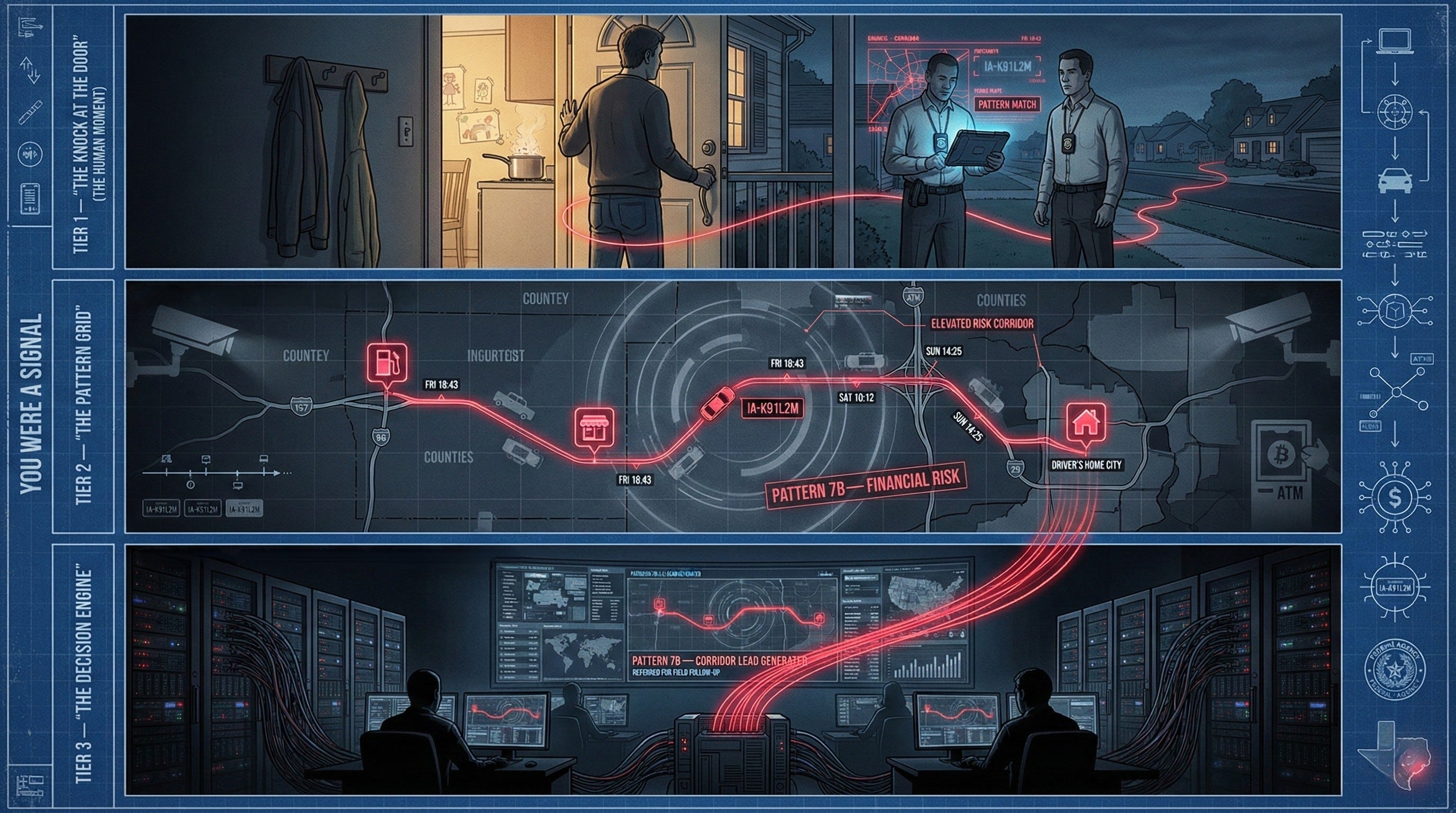
A Human Moment
What This System Feels Like When It Comes Home
Imagine this.
You’re driving north for a weekend.
It’s one of those ordinary American Fridays: the kids are with their other parent, your phone is on low battery, the weather is fine. You toss an overnight bag in the trunk, grab a coffee from the drive-through, and head out.
You stop at a gas station off the interstate — the one with the faded awning and the two pumps that are always out of receipt paper. There’s a pole at the edge of the lot you’ve never really paid attention to. Today, if you looked closely, you’d see a small box strapped to the top, with a dark glass panel pointed at the road.
You don’t look. You tap your card, fill the tank, and go.
You cross a county line. The scenery doesn’t change much — the same farm fields, the same billboards, the same highway patrol cruiser tucked into the median. You turn off for a smaller town to pick up snacks. There’s a grocery store with a faded “OPEN” sign and a little parking lot. On the way in, you glance up just long enough to catch a glimpse of a camera near the entrance, but you’re thinking about whether you remembered to pay the utility bill.
Nothing special.
Nothing criminal.
Nothing memorable.
You drive north, finish your weekend, and come home. You wash the car at some point. You delete the trip directions from your GPS. Life moves on.
You forget the trip.
A year passes.
The following spring, on a random weeknight, you’re in the kitchen stirring a pot on the stove when you hear a knock at the door. It’s not loud — polite, measured. The kind of knock that expects you to answer.
Two people are on your porch. They’re not in full uniform, but you can see badges on lanyards, clipped to belts. They introduce themselves as investigators. They say it will only take a few minutes.
You’re tired. You’ve had a long day. But you step outside anyway, because that’s what people do when someone with a badge says they have questions.
They start with something vague:
“We’re following up on a pattern we’re required to check.”
You ask what this is about. They don’t answer directly. One of them glances at a tablet in their hand — a government-issue rugged device, screen tilted just enough that you can see colored lines on a map.
They already know:
which highway you took that weekend
where you exited
what time you pulled into the gas station
how long you were parked near the small grocery store
which nearby locations have been tagged as “financial risk” nodes.
They know what direction you turned leaving the lot. They know you crossed back through a certain intersection ten days later at almost the same time of day. They know there were other vehicles on the same route whose plates have also been flagged.
You ask — again, more firmly this time — how they know any of this.
They don’t say “Flock.” They don’t say “Texas.” They don’t say “Nlets” or “Financial Crimes Intelligence Center.” They say:
“Your vehicle was associated with a pattern we’re required to check.”
They use the passive voice. No one “decided” anything; the pattern did. The system did.
You feel your stomach drop anyway. You rack your brain: Did I bounce a payment? Did my card get skimmed? Did I do something wrong? You’re not thinking about the cameras on poles and gas-station lots. You’re thinking about your mortgage, your job, your kids. You’re thinking about what it means to have two strangers on your porch who already know where you were a year ago when you barely remember the trip yourself.
You never committed a crime.
You never knew you were scanned.
You never consented.
But the questions keep coming:
Have you ever used that gas station ATM?
Do you know anyone who sends money overseas from that corridor?
Have you ever given a ride to [they read a name you don’t recognize, or half recognize, or wish you didn’t]?
What were you doing in that town that weekend?
The subtext isn’t subtle. You are being asked to prove that your normal life, your normal movement, your normal choices are not suspicious. You are presumed relevant to a pattern, and the burden is on you to prove otherwise.
You were not a suspect.
You were a signal.
Somewhere upstream, your plate was pulled into a cluster: a set of times and locations that an algorithm labeled as “elevated risk” under a financial-crime model. That pattern got stored in a database in Texas, where your weekend errand was fused with other people’s movements and scored like a credit card anomaly.
When the pattern tripped a threshold — maybe because someone else on that route did commit a crime, maybe because a corporate risk model updated, maybe because a new law redefined what “risk” means — your car became a lead.
Not because of who you are.
Because of where you happened to be when a camera blinked.
Because under this system, your car is a financial asset, and your movement is a risk profile. And once your data entered Texas, it never came back the same.
This isn’t a science-fiction script. Everything in this scene is within the documented capabilities of the system we’ve just mapped: ALPR cameras at gas stations and store entrances, national pointer indexes, Texas’ financial-crime hub, vendor dashboards that color-code your life into risk scores. The only thing we don’t know is whose door it will be — and what label the system will put on them by the time it knocks.
That’s the point where the personal story loops back into the bigger one.
Because no matter who is standing on the porch, the architecture behind them is the same — and it’s an architecture nobody ever got the chance to vote on.
The Part Nobody Voted For
This is the line nobody crossed at the ballot box:
A nationwide, financial-intelligence tracking system for 330 million people.
Nobody debated that phrase in a statehouse hearing. It never appeared on a city-council agenda. No candidate put it in a campaign ad. There was no up-or-down vote on whether your everyday movement should be scored like a bank transaction and warehoused in another state.
Instead, the system grew in the shadows of ordinary paperwork.
It started with vendor contracts pitched as “local safety tools,” sold with glossy decks and crime-reduction anecdotes. It expanded through federal pointer systems like Nlets, quietly stitching together the data of thousands of separate agencies into a single routing fabric. It deepened as fusion centers — originally marketed as anti-terror hubs — broadened their mandate to anything that could be described as a “threat,” including financial fraud and border enforcement. And it hardened in state legislatures where financial-crime statutes and reorganization bills reclassified your movement as a form of “intellectual property,” placing it under the control of specialized centers that never have to answer your records requests.
Each piece, on its own, looked bureaucratic and technical: a memorandum of understanding here, a “data-sharing enhancement” there, an amendment that tidied up language around “payment fraud.” None of it sounded like a vote on whether your family’s weekend drive should end up in a permanent risk model. But when you line those pieces up end to end, what they form is exactly that: an architecture in which your life is converted into telemetry and then evaluated as a financial risk.
Your car is not a derivative. Your daily commute is not a wire transfer. Yet the system treats them as if they are.
The same logic that flags an unusual card charge in another country is now applied to the pattern of which gas stations you use and which towns you pass through on a Saturday. A machine decides which combinations of time, place and plate number look “interesting,” and that decision can summon a knock at your door a year later.
Today, the labels on the dashboards say things like “fraud,” “organized retail crime,” “transnational threat.” But nothing in the pipeline limits how those labels can change. Once the infrastructure exists — once every small town feeds its scans into financial-intelligence hubs and federal pointer systems — tomorrow’s models can just as easily score trips to a clinic, attendance at a rally, visits to a mosque, patterns common to new immigrants, or routes associated with political dissent.
No one voted for that.
But it’s the logical endpoint of the wiring we have now.
Unless the public intervenes — not in some abstract future, but in the near term, while contracts can still be cancelled and laws can still be rewritten — this grid will lock into place. The longer it runs, the more “normal” it looks, and the more difficult it becomes to roll back or even see clearly.
Because at this point, the core facts are no longer a hypothesis:
They built it.
They are using it.
And unless someone stops it, it will be used on everyone.
A dragnet built in the dark will only ever grow.
Unless we drag it into the light.
What You Can Do Next
This system was not designed to be explained to you. It was designed to run quietly in the background of your daily life. But that doesn’t mean you are powerless.
If you live in a city or county that uses ALPR cameras, you can:
• Ask your council or school board which vendors they contract with and who has access to the data.
• Demand to see the data-sharing agreements: can ICE, fusion centers, or private brokers query your community’s cameras?
• Push for independent audits to identify biased searches, protest surveillance, and misuse of hotlists.
• Urge your representatives to close the “replication loophole” so a 30-day deletion policy actually means the data is gone.
The dragnet only works if nobody asks where the data goes. The moment we start asking, the system has to answer—or be forced to change.
References
Texas Department of Public Safety, License Plate Reader MOU (primary contract text).
Electronic Frontier Foundation, License Plate Surveillance Logs Reveal Racist Policing Against Romani People, 2025.
Electronic Frontier Foundation, How Cops Are Using Flock Safety’s ALPR Network to Surveil Protesters and Activists, 2025.
ACLU, I’m Hearing About More Pushback Against Flock, Fueled by Concern Over Anti-Immigrant Uses, 2025.
Yash Dattani, Big Brother is Scanning: The Widespread Implementation of ALPR Technology in America’s Police Forces, Vanderbilt JETLaw, 2022.
Tucker, T. C., ALPR Leviathan (RDP web exhibit companion).
© 2025 Restoring Democracy’s Promise. All rights reserved. Permission to quote brief excerpts with attribution is granted for news, academic, and advocacy purposes.
Camera locations.
https://deflock.me/map#map=11/41.816873/-93.831139