


On Friday, Governor Kim Reynolds announced Martin Noven as her choice to lead the Iowa Public Employees' Retirement System (IPERS) into the next administration. He begins August 24 with a term ending in April 2028. Noven comes to Iowa from Maryland's state pension system, where he served as executive director from 2021 to 2025. The fund Noven is assuming keeps $47 billion in trust for over 424,000 Iowa public workers.
He is also inheriting a set of documents and governance questions that IPERS has not previously explained in public.
In June, Restoring Democracy's Promise reported that state payroll records carried the same line beside the name of IPERS's chief investment officer, Sriram Lakshminarayanan, three years running:
Exceptional Job Performance Pay: $25,000.00. 2023, 2024, and 2025.
The chief executive's line read zero each time. What remained unknown was how those numbers were calculated. The performance plans themselves had not been produced.

On July 8, 2026, Restoring Democracy’s Promise obtained IPERS’s Investment Team Incentive Compensation Plans for fiscal years 2023–24, 2024–25, and 2025–26 through an open-records request.
📂 Don’t take our word for it. Read the records.
The complete IPERS Chapter 22 production behind this investigation—including the incentive-compensation plans and supporting records—is available to paid subscribers in the RDP Evidence Locker.
Those records spell out how the incentive formula is supposed to work. They do not show how any particular employee was scored. When RDP requested individual evaluation ratings, scorecards, and award worksheets, IPERS cited Iowa Code § 22.7(11), the personnel-records exemption.
Because those individual ratings remain private, the examples below show what the fund’s published formula permits—not how any specific past award was actually calculated.
Before getting into basis points and payout multipliers, it is worth remembering whose retirement security is at stake. IPERS is not a Wall Street hedge fund. It is a $47 billion retirement system serving more than 424,000 Iowans—teachers, snowplow drivers, state social workers, and other public employees who contribute from every paycheck. The question is not simply how an incentive award is calculated, but whether the formula—and the controls around it—serve the workers whose retirement security depends on the fund.
What the Formula Permits
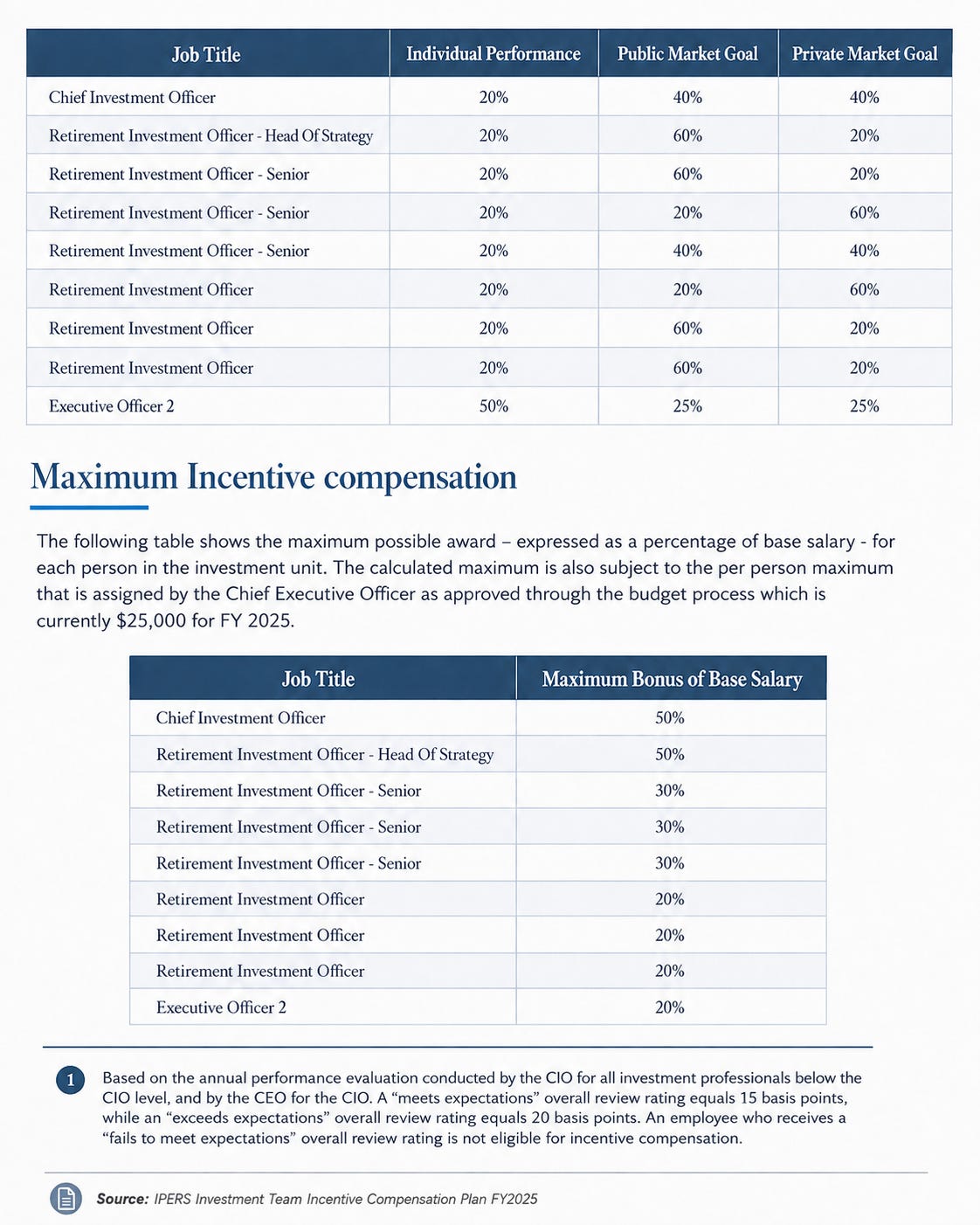
For the CIO and the listed investment-officer positions, the plans allocate 20 percent of the incentive formula to an employee’s annual performance evaluation. Executive Officer 2 is weighted differently, at 50 percent. Footnote 1 of each plan assigns specific basis-point values to that rating: a "Meets Expectations" review counts as 15 basis points (0.15%), while "Exceeds Expectations" counts as 20 basis points (0.20%). A “Fails to Meet Expectations” rating makes an employee ineligible for incentive compensation.
For the chief investment officer, that evaluation rating carries a 20 percent weight, alongside public and private markets at 40 percent each. The plan sets the CIO's maximum possible award at 50 percent of base salary, subject to the $25,000 individual budget cap.
When those published mechanics are applied to the chief investment officer’s 2025 state-payroll salary of $300,802—holding both public and private market excess returns at exactly zero:
At "Exceeds Expectations": The evaluation rating alone contributes 4 hundredths of a percentage point (0.04%) to the blended total. On the plan's payout scale, 0.04% yields a 20 percent payout factor. Against a 50 percent salary multiplier and a $300,802 base salary, the formula calculates an award of $30,080. Because that figure exceeds the $25,000 ceiling, the evaluation rating alone clears the cap and pays the maximum $25,000.
At "Meets Expectations": The evaluation rating contributes 3 hundredths of a percentage point (0.03%) to the blended total, yielding a 15 percent payout factor. On the same salary, the formula calculates an award of $22,560—filling 90 percent of the $25,000 cap with no positive excess return assumed in either market component.

The mathematical threshold behind this result: For any CIO with a 50 percent maximum incentive, an annual base salary of at least $250,000 makes an "Exceeds Expectations" rating sufficient to reach the $25,000 cap on paper without any positive market excess return.
The same dynamic does not automatically apply to every investment employee. The applicable maximum varies by position: 50% for the Head of Strategy, 30% for senior investment officers, and 20% for the other listed investment-officer and Executive Officer 2 classifications.
Independent investigations are built one document at a time.
If you value reporting that follows the records, checks the math, and publishes the evidence, support Restoring Democracy’s Promise with a free or paid subscription.
The Mechanics: One Basis Point
To understand how market performance enters the formula, the plans set one goal across public and private portfolios alike: 20 basis points (0.20%, or two-tenths of one percent) of excess return above benchmark.
Against that goal sits a payout schedule:
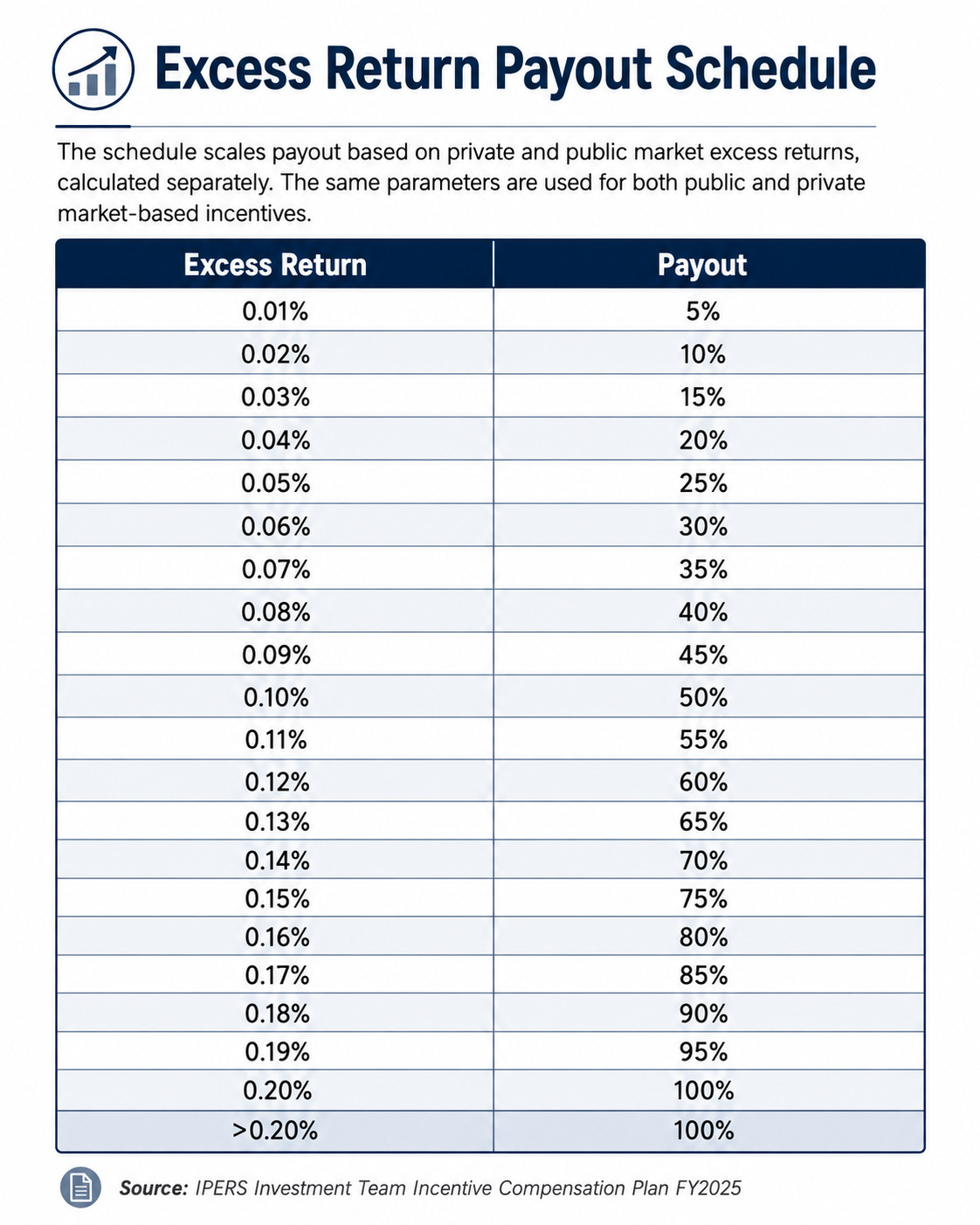
Beat the benchmark by 0.01 percentage point (one basis point), and the scale credits 5 percent.
Beat it by 0.02 percentage points (two basis points), and the scale credits 10 percent.
The line climbs 5 percentage points per basis point until reaching 100 percent at 0.20% excess return, where it stops. Anything above 20 basis points pays what 20 basis points pays.
The payout factor is applied against the employee’s maximum incentive amount, which is calculated as a percentage of base salary, and the resulting award is then constrained by the $25,000 ceiling.
Recruit and Retain
IPERS has a real problem to solve here. It is trying to retain investment professionals who can often make considerably more money in private finance. Some form of incentive pay is therefore not hard to understand.
But that explains why the program exists. It does not answer the harder questions: how much investment performance should matter, how much weight an internal personnel review should carry, or who independently checks the calculation before public money is paid out.
Who Runs the Numbers
All three plan documents contain the same procedural sentence: "The Chief Investment Officer calculates incentive compensation amounts using the IPERS performance book of record." The next sentence reads: "All incentive compensation payments are checked and approved by the Chief Executive Officer prior to submission to the Department of Administrative Services for payment."
None of the three plans contains an exception for calculating the chief investment officer's own award.
So the chain is unusually compact. The CIO performs the calculation. The CEO checks and approves the payment, sets the per-person ceiling through the budget process, resolves disputes with DAS, and evaluates the CIO’s performance.
What the plans never describe is a separate set of eyes—an independent audit of the arithmetic before the payment leaves the state.
The Board's Role
The board is not absent from the incentive system. It helped create the environment in which the system operates.
It endorsed the original budget request. It sets the policy benchmarks against which investment performance is measured. And in December 2024, it was told that IPERS wanted to remove the $25,000 ceiling.
At the individual-award stage, however, the board’s role narrows sharply. Iowa administrative rules require the board to participate in the CIO’s annual performance evaluation, which feeds the personnel component of his incentive formula. But the incentive plans give the board no role in calculating or approving an individual award.
The $25,000 ceiling was not imposed by the Legislature. RDP reviewed the state rule authorizing Exceptional Job Performance Pay, Iowa Code chapter 97B, the relevant IPERS appropriations acts and legislative budget analyses. None sets a $25,000 individual limit. The figure appears instead in IPERS’s own incentive plans, which say the per-person maximum is assigned by the chief executive “as approved through the budget process.”
Legislative budget analysis does show a $200,000 incentive-and-retention allocation when the program was created — the same total pool printed in IPERS’s first two plans — but the enacted appropriation did not specify either that amount or a $25,000 employee-level ceiling.
In December 2024, IPERS told its board that its FY2026 budget submission sought to remove the ceiling. RDP found no corresponding cap-removal proposal in the subsequent public Governor’s recommendation, legislative analysis or enacted appropriation.
What the plans do not give the board is a role in approving individual awards. Eligibility, calculations, approvals, and dispute resolution route through the CIO, CEO, and DAS. Across 24 sets of Investment Board minutes from March 2022 through March 2026, RDP found no open-session vote on an individual incentive award.
The Year Private Equity Left the Formula
In FY2024, the incentive plan included private markets in the formula. IPERS used a weighted average of three-year excess returns. For incentive-compensation purposes, private equity was measured against the Russell 3000 plus 300 basis points and weighted at 20 percent. Private credit was weighted at 40 percent and private real assets were weighted at 40 percent.
Then the FY2025 plan changed the calculation. Private equity was no longer included in the incentive plan’s private-market excess-return calculation.
“The Private Equity portfolio for IPERS are not included in excess considerations.” - IPERS
That was not a minor housekeeping adjustment. It changed which investment results could affect incentive compensation. Private credit and private real assets—the two remaining private-market categories—each received a 50 percent weight, while private-equity performance no longer entered that component of the formula.
Separately, in its most recent public performance reporting as of March 31, 2026, IPERS reported that private equity trailed its Russell 3000 objective across every published horizon: 11.3 percentage points over one year, 4.1 over five, and 1.5 over ten. Board materials described short- and medium-term performance as “meaningfully lagged” public markets.
Those later results postdate the FY2025 incentive period. They show the consequence of private equity no longer being part of the incentive calculation; they do not establish why IPERS made the change or who authorized it.
And the unanswered question over who authorized that change is not isolated. Elsewhere in the same records, another governance gap is even easier to see: the official responsible for independent investment-risk oversight disappeared from the organizational structure and remained vacant as of IPERS’s response.
These records matter only if people see them.
If you think Iowans should know how incentive pay is calculated, who oversees it, and why IPERS reported a key risk position vacant, share this investigation with someone who should be asking the same questions.
The Empty Risk Chair
The documents did provide some insight into a similar governance issue: the makeup of the fund’s internal risk management function.
June 2022 saw IPERS recruit Rich Wiggins for the Retirement Investment Risk & Operations Officer position. Wiggins' hiring paperwork stipulated he would report to Chief Investment Officer Lakshminarayanan. IPERS own investment policy is at odds with that move. It states that the Chief Risk Officer reports to the CEO, not the CIO.
Wiggins was fired in February 2023. That timeline is confirmed in state-court filings in Wiggins v. State of Iowa. The state denies the suit’s substantive allegations; a judge declined to dismiss the case, and litigation remains ongoing.
Asked what became of the position, IPERS responded, "The position is vacant."
The state's formal job specification for the classification (DAS Class Code 00834) defines the Chief Risk Officer role as "responsible for alerting the IPERS investment Board and chief executive officer if risk level exceeds limits." IPERS stated that no records exist regarding deliberations to replace the position, nor any records of independent outside validation of its risk calculations since January 1, 2022.
What "Not Available" Means
There is a small but important difference in the language IPERS used.
In some portions of its response, the agency said plainly that “no documents exist.” But when RDP asked for compensation-benchmarking studies and personnel materials, IPERS used different language: the records were not “available,” citing statutory exemptions.
Those are not necessarily the same thing. “Not available” may mean records exist but are being withheld. RDP has asked IPERS to clarify which it means.
IPERS responded to two sections of RDP’s open-records request with legal statutory exemptions rather than documents:
Requests for compensation-benchmarking studies were met with citations to Iowa Code § 22.7(3) (trade secrets).
Requests for evaluation scorecards and criteria were met with citations to § 22.7(11) (personnel records).
While withholding benchmarking studies under trade-secret exemptions, IPERS did produce an invoice showing it paid McLagan (a division of Aon) $8,750 on April 2, 2025, for participation in the "2025 Specialty Report – US Public Funds."
The underlying master agreement, executed by former CEO Greg Samorajski in June 2024, explicitly acknowledges that confidential information may be subject to disclosure under Iowa’s Open Records Law.
RDP sent detailed questions to IPERS and the Governor’s Office on August 9 concerning the incentive formula, the $25,000 ceiling, Noven’s compensation and the state’s role in IPERS compensation policy. We have not received a response by the time of publication. This article will be updated with any substantive response
What Noven Inherits, and What the Next Governor Faces
Noven’s term will end on April 30, 2028. In January 2027, the incoming governor will inherit an agency head they did not appoint. A year later, by January 31, 2028, the Investment Board and Benefits Advisory Committee must send that governor their evaluation and recommendation concerning Noven’s reappointment.
That timeline puts several governance choices directly in front of the next administration. They are not abstract questions. By 2027, the people taking office will have inherited the compensation structure, the review process, and a risk-oversight position IPERS reported as vacant.
Those choices should not wait until after the election to become public questions. Iowa voters, public employees, retirees, journalists, editorial boards, and forum moderators should put them directly to candidates for governor and the Legislature: at debates, town halls, campaign stops, and every other opportunity to get their answers on the record:
Should the state’s largest pension fund be led by a gubernatorial appointee or an executive hired directly by its board?
Should the board that sets the CEO’s salary have a formal role in approving investment-team incentive pay?
Should internal incentive calculations be independently audited before state checks are issued?
And should the officer charged with alerting the board to portfolio risk answer to the chief investment officer whose strategy they monitor?
Candidates do not need to wait until 2027 to answer those questions. They can tell Iowans now what they believe the proper safeguards should be, and what, if anything, they would change.
Noven will not inherit a blank sheet. The formula is already written, the compensation system is operating, and the independent risk position remained vacant as of IPERS’s response. The question for the next phase of IPERS is not whether those structures exist. It is whether the controls around them are strong enough.
Those questions do not depend on party labels. Whichever administration takes office in 2027 will inherit the same system.
That is why the answers matter now. Once candidates have been asked publicly, their positions become part of the record. And once the warning signs themselves are on the record, a future administration cannot credibly describe the system as somebody else’s problem. Leaving it unchanged becomes a governing decision of its own.
Reference List
Aon Consulting, Inc., & Iowa Public Employees' Retirement System. (2024, June 14). Aon human capital solutions services agreement [Executed agreement].
Iowa Code § 21.5(1)(i) (2026). Closed session — evaluation of professional competency.
Iowa Code § 22.7(3), (11) (2026). Confidential records.
Iowa Code § 97B.3 (2026). Chief executive officer [Appointment, senate confirmation, four-year term, salary set by investment board, performance evaluation and reappointment report].
Iowa Department of Administrative Services – Human Resources Enterprise. (2023). Retirement investment risk and asset allocation officer, class code 00834 [Job classification description; effective 05/23].
Iowa Public Employees' Retirement System. (2023). IPERS investment team incentive compensation plan for FY 2023/4 [Produced under Iowa Code ch. 22].
Iowa Public Employees' Retirement System. (2024). IPERS investment team incentive compensation plan for FY 2024 [Produced under Iowa Code ch. 22].
Iowa Public Employees' Retirement System. (2025). IPERS investment team incentive compensation plan for FY 2025 [Produced under Iowa Code ch. 22].
Iowa Public Employees' Retirement System Investment Board. (2022, September 22). Minutes and meeting materials.
Iowa Public Employees' Retirement System Investment Board. (2024, December 6). Minutes [CIO Updates].
Lode, S. (2026, July 8). Response to Iowa chapter 22 records request — IPERS investment compensation, benchmarking, and risk oversight records [Agency response]. Iowa Public Employees' Retirement System.
Office of the Governor of Iowa. (2026, August 7). Gov. Reynolds appoints Martin Noven CEO of IPERS [Press release].
Tucker, T. C. (2026, April 6). Newly obtained amended IPERS lawsuit expands allegations on risk, fees, and benchmarking. Restoring Democracy's Promise.
Tucker, T. C. (2026, May 19). A resignation is not an audit: Why Iowa still owes its public employees answers. Restoring Democracy's Promise.
Wiggins v. State of Iowa, No. LACL163118 (Polk Cnty. Dist. Ct. Iowa) (amended petition filed January 30, 2026; defendant's answer filed May 21, 2026).