

The God Machine: How Faith-Based Credentialing Undermines Public Education
How a Tax-Exempt ‘Ministry’ Built a Business Selling Chaplains to Public Schools
Table of Contents
1. Blueprint in Brief: How the Machine Works
2. The Architecture of Influence
3. Dark Money, IRS Codes, and the Heart of the Chaplaincy Machine
4. The Chasm of Qualification
5. The Iowa Resistance: When Communities Stop the Machine
6. NACL Model Legislation: The Broader Trend
7. Blueprint for Resistance
8. Dismantling The Machine
9. About This Investigation
10. References

A $200,000 loan from a tax-exempt ‘ministry’—meant to serve public schools—directly to its own CEO. Not only is this a potential violation of IRS rules, it exposes a national scheme that may put children at risk for Christian Nationalist indoctrination. The evidence is public. The consequences could upset the entire industry.
All children deserve to know God's love.
That message—once the banner headline of Mission Generation’s website—seems harmless. But look closer, and you’ll find the real target: the world’s “largest unreached people group”—children aged 4 to 14.
This isn’t about comfort or charity. It’s an operational model that functions like a business—one that aims to transform public schools, one classroom at a time. At least 19 states have introduced chaplaincy bills with language derived from the NACL model, with 16 states introducing such bills since 2023 alone.
What follows is the full schematic: the actors, the financial flows, the legislative playbook—and the dual narrative exposed. More importantly it offers a blueprint for restoring democracy.
Mission Generation’s mission is no longer hidden. Let’s see how the machinery works.
Step by engineered step, we’ll show how a harmless-sounding promise became the conveyor belt for a private ideological agenda—and why the wall between faith and state is more vital now than ever.
1. Blueprint in Brief: How the Machine Works
A. The Four-Part Assembly Line
Executive Summary
Key Statistics:
• $200,000 in insider loans disclosed in IRS filings
• 19 states with copycat chaplain bills since 2023
• 40 hours: Total training required for NSCA chaplains
• 600+ hours: Clinical training required for licensed counselors
• $1M+: Mission Generation/NSCA annual revenue (2023)
The Bill Mill
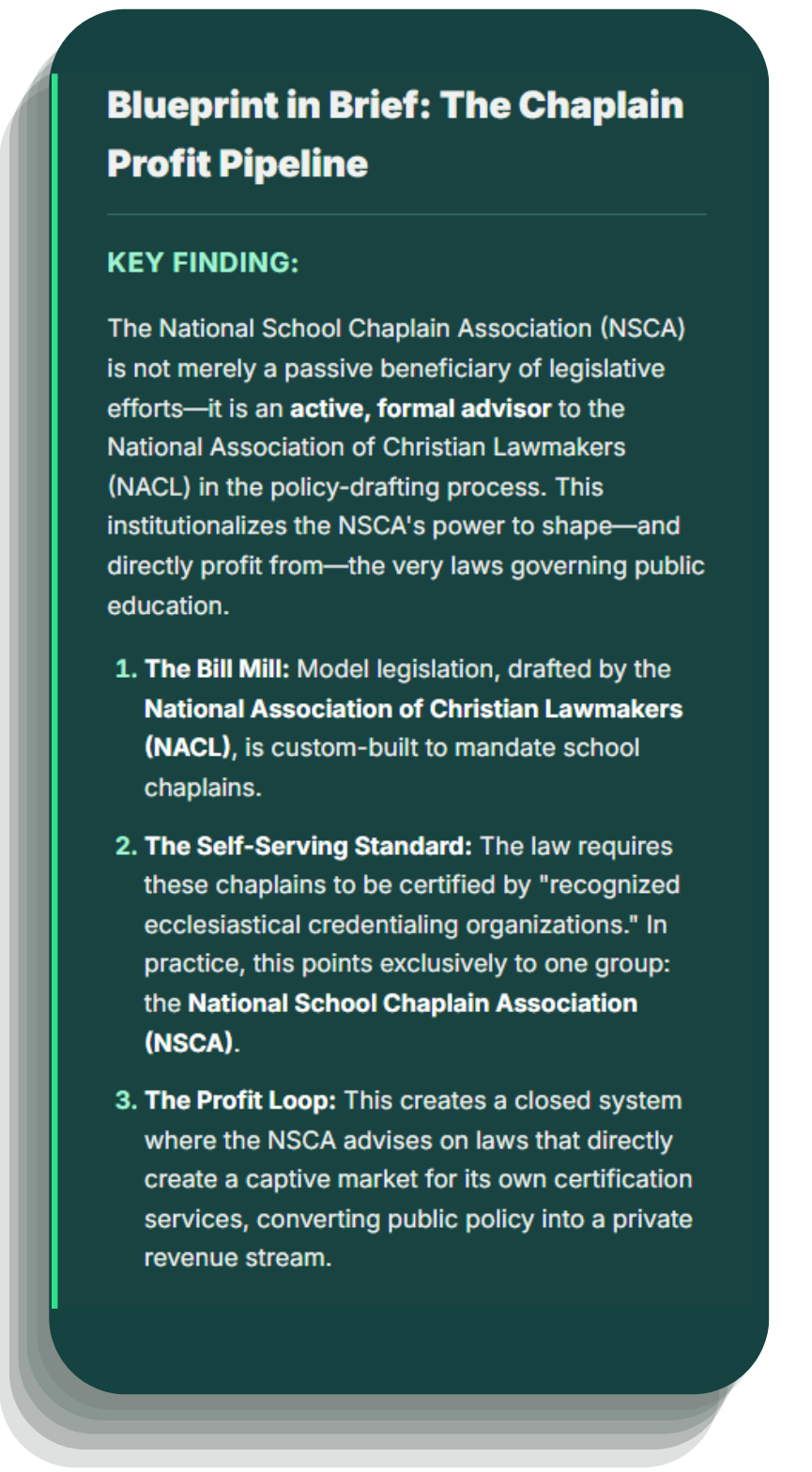
Model legislation, drafted by the National Association of Christian Lawmakers (NACL), is custom-built to require chaplains certified by “recognized ecclesiastical credentialing organizations.” In practice, this means only one provider—Mission Generation presently doing business as the National School Chaplain Association—qualifies at any real scale. The legal language functions as a gate, guaranteeing that chaplains entering public schools are not just credentialed, but ideologically aligned with the Christian nationalist network behind the law.The Mobilizer
Grassroots “support” isn’t organic, but manufactured by movement allies. Pastors, church networks, and organizations like Faith Wins mobilize churchgoers and clergy to flood hearings and inboxes—scripted testimony masquerading as citizen groundswell. This orchestrated pressure gives lawmakers political cover, masking a top-down campaign as popular demand, and steamrolling dissent with a chorus of orchestrated faith voices.The Credentialer
Once bills pass, Mission Generation’s National School Chaplain Association (NSCA) becomes the only path to certification for chaplain roles, creating a de facto standard via its 40-hour online training, while qualified mental health professionals are sidelined by design.The Financial Engine
Wealthy anonymous donors funnel money through donor-advised funds (DAFs) like DonorsTrust. Nearly identical six-figure grants repeat year after year, allowing the machine to operate in the shadows, largely shielded from regulatory scrutiny.
🔎 Check out the interactive flow chart, marked financial records, and credentialing dossier via the infographics to map out the entire anatomy of the machine in action.
B. Why This Matters
The credentialing gap isn’t theoretical: in 2024, over 3.4 million U.S. adolescents contemplated suicide, yet more than half never saw a trained counselor. Replacing licensed professionals with religious chaplains—whose training may be as short as 40 hours—risks student safety and undermines constitutional protections.
Even if the rhetoric is all faith and freedom, the machine’s real output is obscured. By using non-clinicians instead of mental health professionals, the system doesn’t just endanger student welfare—it exposes something bigger—the conversion of public need into Cristian Nationalist indoctrination.
This isn’t a warning about privatized faith in public schools. It’s a playbook—a blueprint for how tightly regulated nonprofits, political operatives, and dark money donors can hijack and quietly rewrite public systems, all while remaining anonymous and unaccountable. That’s The God Machine.
The following section breaks down each component of the machine in detail.

Figure 1: Click the chart to explore each actor, money path, and tactical playbook—then keep reading to see how it all converges in the God Machine.
2. The Architecture of Influence
Following the money trails and organizational networks we first mapped in The Pincer Movement, our team discovered something that made the broader assault on democratic institutions suddenly, chillingly personal: the same forces reshaping federal and state government had quietly engineered a business model that puts America's school children at risk. The evidence emerged from an unexpected source—a $200,000 loan buried in tax filings that unlocked the financial architecture of The God Machine: a sophisticated, multi-state operation that replaces licensed mental health professionals with individuals who may have as little as 40 hours of online training.
As Previewed above, here’s how each gear in the machine actually works in practice.
A. The Policy Engine
The National Association of Christian Lawmakers (NACL) crafts model legislation pushing for the hiring of chaplains in schools. These bills consistently feature language requiring credentials from an "established ecclesiastical credentialing organization"—a phrase that conveniently drives demand for specific certifications.
“Such legislation is often understood as an effect of a highly polarized political climate in the United States,” AAUP leaders cautioned:
The new white paper demonstrates, however, that this legislation is largely the outgrowth of a coordinated campaign to generate a culture-war backlash against educators and academic institutions.
NACL’s 2023 Form 990 shows revenues of $383,000 and expenses of $337,000, with total assets of $75,000. Though modest in size, its influence extends widely, empowered by a network of state lawmakers who introduce nearly identical bills across multiple states.
Liberty University has repeatedly served as the host institution for the NACL's National Policy Conference. Official university communications describe this as a "partnership," with Liberty's School of Law and its "Standing for Freedom Center" acting as co-hosts for the 2025 conference.
This signifies a critical evolution in the Christian nationalist movement, where a major academic institution is now directly fused with a political apparatus designed to systematically reshape American law.
B. The Mobilizer
When a bill gets introduced, Faith Wins springs into action, leveraging its network to simulate grassroots demand.
Their strategy involves mobilizing supportive pastors and church members to write letters to lawmakers, creating the illusion of widespread public backing, though the initiative is driven from the top. Iowa has been mentioned as a strong Faith Wins network state.
In 2023, Faith Wins generated $879,000 and spent $798,000—a substantial amount for an organization concentrating on a singular issue.
C. The Credentialer
Once a bill is enacted, Mission Generation’s National School Chaplain Association (NSCA) takes the lead in providing the mandated chaplain credentials. Their 40-hour online course, priced at $285 initially and $95 annually for renewal is offered through Oral Roberts University. This becomes an essential requirement for securing positions permitted by the laws their partners helped draft.
Mission Generation’s 2023 Form 990 indicates revenues of $1,001,901 against expenses of $1,005,735—a concerning financial shortfall. They reported $75,412 in “program service revenue,” mainly from credentialing, a figure expected to rise as more states adopt chaplain legislation.
Key Finding: Mission Generation's true objective is to systematically embed evangelical chaplains in public schools for the express purpose of religious conversion of minors. The organization now doing business as the NCSA employs dual messaging: a softened, secular-friendly mission for public and IRS filings, and a hardline evangelistic doctrine for its supporters and recruits. This mission is executed through legislative "bill mills," the NACL and sustained by an ecosystem of conservative funders.
D. The Financial Engine
This entire operation runs on undisclosed funds channeled through donor-advised funds (DAFs) like DonorsTrust and DAFgiving360™ (formerly Schwab Charitable). These fundraising mechanisms allow wealthy benefactors to support controversial campaigns while remaining anonymous, creating the perfect black box for political endeavors that wish to operate discreetly.
Financial investigations reveal an unsettling pattern: in 2022, Mission Generation received $352,000 in contributions from donor-advised funds. This highlights the orchestrated, rather than spontaneous, nature of some of the donor support.
This opaque financial architecture, designed to fund controversial campaigns and mask donor identities, also creates an environment ripe for questionable financial practices and potential insider enrichment. It is within this shadow economy that we uncover the most serious allegation of this investigation.
📂Explore the Full Evidence
The complete Primary Sourcing Dossier, Priority 1&2 Master Source List, and all primary source documents are available in the Evidence Locker for our paid subscribers.
3. The Heart of the Chaplaincy Machine
A. Why the Financials Matter
At the core of this investigation lies the most serious allegation: a pattern of financial misconduct that violates fundamental federal tax law governing charitable organizations.
B. Dark Money, Donor-Advised Funds, and Centralized Flows
This interactive graphic displays a network of undisclosed, anonymous contributions routed through donor-advised funds (DAFs) such as DonorsTrust and Fidelity Charitable powers the operation. This method grants wealthy benefactors the ability to fund controversial social engineering efforts while shielding identities and circumventing direct scrutiny.
Why This Is a Red Flag
Lack of Donor Transparency: Donor-advised funds allow contributions to appear as generic foundation grants, severing direct audit trails.
Consistency of Grants: The annual, identical payments reveal coordination and intent, not organic, needs-driven fundraising.
National Impact, Local Invisibility: Large-scale financial support empowers rapid, multi-state expansion with minimal public reporting or accountability.
C. IRS Code Violations: Private Enurement
What Is Enurement?
Under federal tax law (26 CFR § 1.501(c)(3)-1(c)(2)), charitable organizations are strictly prohibited from allowing their net earnings to benefit any private individual or insider—a principle known as the “private inurement” prohibition. A direct loan to an executive is considered a classic violation.
As BoardSource explains in "Private Benefit, Private Inurement, and Self-Dealing" (2016),
Private inurement is an absolute term. There is no de minimis restriction. If a nonprofit is organized to benefit an individual — even while fulfilling its tax-exempt purpose — it cannot be a tax-exempt organization.
Why it matters: If any part of a nonprofit’s earnings flow to insiders—like a CEO, founder, or board member—that group can lose its tax-exempt status, face penalties, or even criminal charges. There are no exceptions for “small” amounts or good intentions: a single improper loan or benefit can trigger IRS action.
D. The Smoking Gun
Mission Generation’s 2023 Form 990 publicly disclosed loans to its CEO, Rocky Malloy, totaling $57,779 at year-end, stemming from original principal amounts including $200,000 for a Panama home purchase—a move seemingly in direct violation of IRS private benefit rules for charities.
According to IRS experts and nonprofit accountability standards, direct loans or payments to insiders are forbidden except under limited, fully disclosed, arms-length circumstances. Such transactions can result in:
IRS audits and potential criminal referrals
IRS audit guidelines emphasize transactions resulting in inurement can jeopardize exemption regardless of size; revocation is the only sanction, although excise taxes may also apply

Figure 2: For a detailed, interactive breakdown of the network’s funding, see our interactive dossier on “The God Machine’s Financial Architecture” by clicking or tapping the figure above
Improper Transaction, Not a Failure to Disclose: The most significant finding is not what was hidden, but what was openly reported. Mission Generation’s 2023 Form 990 discloses loans to its CEO with an original principal of $200,000. The issue is not one of omission, but of a potential violation of the private inurement prohibition, which forbids using charitable assets to benefit insiders.
Figure 3: IRS Filings Reveal Insider Loan


Mission Generation failed to respond to our inquiries about the loan’s specific purpose, duration, or repayment terms—an explicit violation of standard nonprofit governance and transparency norms.
F. Revenue by Credential, Not Service
A forensic review of Mission Generation and NSCA’s financials reveals an operation reliant not on delivering direct services to students, but on selling credentials created by the very laws their lobbying enabled. Nearly all of the program service revenue comes from $997.00 online course fees and renewals—charged to applicants seeking state-mandated chaplain credentials.
Credentialing revenue (2023): $75,412, a figure expected to rise sharply as more states mandate or “strongly encourage” NSCA certification for chaplains in schools.
G. Summary of Exclusive Findings
Mission Generation (the NSCA) has stated their true mission—To “successfully overcomes the challenges of reaching children in the 4/14 Window by bringing Jesus to national school systems…in spite of secular government administrations around the world.”
The National School Chaplain Association (NSCA) is not merely a passive beneficiary of the National Association of Christian Lawmakers' (NACL) legislative efforts—it is an active, formal advisor in the policy-drafting process. This arrangement institutionalizes NSCA’s power to shape legislation from which it stands to profit directly.
Direct evidence of potential inurement and violations of the IRS code—specifically, the $200,000 loan—makes this much more than a mere controversy over standards or ideology.
The clear pattern of centralized, repetitive grantmaking via donor-advised funds is not a mere coincidence—it’s a strategic financial engine.
Board of director and advisory overlaps ensure the entire machine is well oiled.
Networked advocacy: Strategic partnerships between policy groups and grantmaking vehicles that ensure the continued expansion and entrenchment of chaplain programs across states
H. The Stakes: Scrutiny and Consequences
Should the IRS, lawmakers, or investigative bodies act on these findings, Mission Generation and its NSCA could face:
Suspension or removal of tax-exempt status
Repayment or penalties for excess-benefit transactions
Broader crackdowns on credentialing-for-profit models using opaque funding streams
The documented evidence and interactive visual dossier ensure these warnings are not speculative—they are anchored in law, record, and direct financial truth.
The inequities reflected in professional credentials are not merely an abstraction—they are the basis of an increasingly dynamic policy terrain. As states face growing demands to solve student mental health concerns as rapidly as possible, the divide between the rigorous professionalism they now demand and the newly facilitated religious credentialing isn’t just a theoretical problem. Rather, that gulf is being actively enshrined into law, dictating educational and safety outcomes on a state level and disrupting the balance between expertise and expedience in schools across the United States.
J. The Proponents’ Argument: “Filling the Gap”
Advocates of the school chaplain bills claim they are simply addressing a critical shortage of mental health counselors—a gap that, they argue, leaves students without support. A 2022 evaluation of Australia's National School Chaplaincy Program (NSCP) found the programs were "valued for supporting student wellbeing"
Perry et al. (2022) demonstrated that Christian nationalism is the leading predictor of support for mandatory patriotic education, which often includes religiously inflected curricula and the marginalization of secular or pluralistic perspectives.
While the student mental health crisis is severe, federal law and professional standards define clear qualifications for those providing care. The Every Student Succeeds Act (ESSA) specifies that a qualified school-based mental health provider must be a "state-licensed or state-certified school counselor, school psychologist, [or] school social worker" with demonstrated competence.
Some supporters also contend that chaplains serve as positive role models who contribute to the moral climate of the school. However organizations like the ACLU and the SPLC argue that these programs violate the establishment clause by risking religious coercion and indoctrination of students.
The differences in qualification standards between licensed counselors and NSCA chaplains speak for themselves.
4. The Chasm of Qualification
The push to put religious chaplains into public schools exposes a stunning lack of equivalency between the credentials of licensed mental health professionals, who are required to be, and the provisions of those who are certified under new laws to be as determined alone by private religious organizations. This division is further highlighted by a dedicated webpage and infographic, and exposes the substantial gulf in the two qualifications and the fact it will have on the real world.
A. What Sets Professionals Apart
A licensed school counselor must:
Be the holder of a master's degree issued by a recognized institution
Complete at least 600 hours of supervised clinical/practicum internship
Pass a state-required licensing exam
Operate under the ethical oversight of both state and national boards
Get support from your peers and keep those credentials with CE hours
On the other hand, an NSCA-certified chaplain must:
Have a high school diploma (no college degree necessary)
Completion of a 40-hour online training program with no requirement for supervised clinical training
Obtain certification from a private entity that operates without formal state oversight
No professional monitoring or state required continuing education

Figure 4: For a detailed, state-by-state breakdown of credential standards and legislative activity, see our interactive exhibit on The Credentialing Gap. This resource provides background, statutory text, and primary documents to help readers and policymakers navigate the evolving legal landscape.
B. Why This Chasm Matters
This lack of qualification, however, is not merely theoretical—it profoundly shapes student safety and well-being. Professional counselors are trained to provide crisis intervention, suicide prevention, and trauma response, as well as address complex behavioral health issues. They must adhere to evidence-based protocols, report suspected abuse, and stay within parameters to protect vulnerable children.
On the other hand, chaplains — under these novel credentialing routes — are given access to schools based on significantly less training, no clinical basis, and oversight by private organizations rather than independent or public overseers. There is a very real risk that students in crisis will be working with people who are trained to deal with neither the issues at hand, nor who are legally certified to act appropriately as professionals.
C. Data Behind the Chasm
In a national study, over 20% of teens aged 12–17 experienced anxiety in the last two weeks, and 17% reported symptoms of depression.
40% of high school students report persistent feelings of sadness or hopelessness.
More than 3.4 million youth (12.3%) in the U.S. contemplated suicide in 2024.
Despite these alarming statistics, over half (56.1%) of those with major depression received no mental health treatment, underscoring the strong need for highly qualified professionals, not shortcuts.
D. Connecting the Dots to Policy
The dangers posed by the credentialing chasm aren’t hypothetical—they’ve shaped real-world policy across the country. As the demand for quick fixes to the student mental health crisis has grown, this gap in professional standards has become the blueprint for legislative campaigns from Texas to Iowa and beyond.
It’s in these legislative areas that the stakes of lowered qualifications are being decided state by state, revealing how coordinated networks have turned the credentialing gap into active policy—and, in some cases, law.
As long as the legislative battle over chaplain credentialing plays out in the halls of capitols and courthouses, its real scope is not gauged simply in legislative wins or losses. The impact of these decisions will reverberate in classrooms, counseling offices, and communities and reach real children, families, and local educators caught on the front lines of our current national reckoning. Because as maps and bills shift, the lived reality of those most directly affected determines whether these measures safeguard, compromise, or change the daily safety and welfare of America’s students.
The next section will take you to Iowa, where all this policy fighting boils down to grassroots conflict, and shows how individual conviction and local resistance can shape the trajectory of a national campaign.
5. The Iowa Resistance: When Communities Stop the Machine
On an unseasonably cold morning in April 2025, Iowa’s Senate Education Committee became the frontline in a grassroots stand against the national school chaplain credentialing machine. House File 884, modeled on laws already passed in Texas, Florida, and Louisiana, had just sailed through the Iowa House, backed by Governor Kim Reynolds and powerful national networks. The bill authorized school districts to employ chaplains who would NOT be required to have a license, endorsement, certification, authorization or statement of recognition from the board of educational examiners—a sharp departure from the rigorous credentialing required of public school counselors.
A. The Coalition: Skills Over Symbolism
Iowans—school counselors, faith leaders, former teachers, civil rights advocates, and mental health professionals—quickly mobilized, refusing to camouflage the fight as just another culture war. The critique was disciplined: this was about qualifications, not religion. Rabbi Henry Jay Karp, Rabbi Emeritus of Davenport’s Temple Emanuel and a forty-year advocate, stood with fellow clergy, counselors, and attorneys to demand professional standards and student safety.
A typical public comment captured the coalition’s tone:
Vote NO to HF 884. Chaplains are not counselors, they are not mental health therapists, and they are not missionaries.
Another opponent spelled out the consequences:
Under this legislation, chaplains could serve as a student's first point of contact for mental health support, suicide prevention, and other behavioral health services, even though the chaplains are not required to have any type of training or certification. This places children and youth in harm’s way.
The Iowa School Counselor Association filed records showing that over 60% of counselors surveyed had already seen negative impacts from similar credential rollbacks.
B. The Unintended Consequence: Inclusion for All
Perhaps the most surprising moment came when Mortimer Adramelech, a minister for the Satanic Temple of Iowa, testified that the bill, by not specifying faith, would make “highly qualified Satanic Temple ministers…available to serve as chaplains in public schools.” Supporters were forced to acknowledge publicly that the legislation’s breadth made excluding any faith—however unpopular—impossible.
C. Political Headwinds and Public Outcry
This fight over chaplain credentialing came just as the Iowa Capitol was still buzzing with protest chants and footfalls of over 500 demonstrators opposing the rollback of gender identity protections in state law. After that bitterly fought civil rights defeat, legislators had little appetite for another divisive battle. Senate Republicans, confronted by the growing legal and liability risks highlighted by mental health professionals, began to waver.
Senator Sarah Trone Garriott, an ordained minister, member of the Interfaith Alliance, and seasoned hospital chaplain, crystallized the danger in committee,
This legislation gives untrained, unvetted, unsupervised individuals a title, it gives them authority, and it gives them access to our children.
Senator Garriott’s warning wasn’t only instructive about the stakes in Iowa; it captured a storm brewing far more broadly across the country.
What occurred here was not an isolated occurrence, but only one part of a sprawling fight that is now being waged all over the country. In Missouri, for example, rather than mincing words, opponents have called the law “dangerously misguided.” In Ohio, however, a similar basic idea has become enmeshed in a far broader effort to rewrite existing education laws. These skirmishes have ignited a fire with national civil rights organizations and a far more diverse coalition of faith leaders who are now standing up and opposing these measures in more than a dozen states.
Rather than a patchwork of disconnected bills, what exists is a tightly woven web of advocacy groups, credentialing organizations, and political strategists acting in concert. What follows is an in-depth look at the legislative push—not as a patchwork of disconnected events, but a strategic, coordinated system mapped in the exhibit below.
6. NACL Model Legislation: The Broader Trend
The campaign to install chaplains in public schools is not a spontaneous groundswell—it’s a meticulously engineered operation. One whose narrow and extreme interpretation—theocratic domination over the government—is fundamentally at odds with the constitution.
This authoritarian over-reach emerges from a system that manufactures outrage, mobilizes supporters through manipulation of religion, and delivers model legislation to statehouses across the country. Our analysis confirms this boilerplate legislation has been introduced in at least 19 states, a testament to the scale and organization of this effort.
The map and data reveal a tightly coordinated web of advocacy groups, credentialing organizations, and political strategists working in concert—not just in the shadows of obscure networks, but in public, as formal advisors shaping the very laws that stand to benefit them.

Figure 5: For our live interactive Dossier- “The God Machine,” tap or click the image above
7. Blueprint for Resistance
Despite clearing the House and Senate education panels, HF 884 was placed on the “unfinished business” calendar and left to languish, effectively stalling the bill for the 2025 session. The Iowa coalition’s success was grounded in:
Staying rigorously focused on professional standards and student safety
Building bridges between religious and secular communities
Highlighting the clear differences between a licensed school counselor’s years of education and a chaplain’s single background check
Making plain the legal and constitutional risks of violating the principle of separation of church and state
Crucially, Iowa’s message was never anti-chaplain or anti-faith. Instead, it elevated the universal value of qualified care and student protection. As Rabbi Karp later warned, “I suspect that even if the school chaplains bill doesn't return this year, we will see this proposal again in the future.”
Iowa proved that when communities organize around documented facts, inclusive coalition-building, and clear-eyed appeals for accountability—not ideology—the machine can be stopped. Vigilance and rigorous, data-driven advocacy remain the best tools in protecting public schools from the next round of model legislation
8. Dismantling The Machine
A. Community Resilience
The choice before every community is clear: we can build school systems where trained professionals provide evidence-based mental health support to students in crisis or we can allow Christian Nationalist networks to turn our children's well-being into a revenue stream. All while attempting their mission to proselytize to our children, now deleted from the Mission Generation website after their makeover to the National School Chaplain Association.
The God Machine operates in obscurity, exploiting regulatory gaps and the urgency schools feel in addressing mental health crises. Yet, as demonstrated in Iowa, once this machine is exposed to public scrutiny, there are opportunities to disrupt its mechanisms.
Three key lessons emerge from Iowa’s success:
In Education-Focus on Professional Standards, Not Religion: By centering the discussion on professional qualifications rather than religious debates, opponents united a broad coalition and avoided divisive culture war rhetoric.
Emphasize Liability and Risk: School officials were alarmed by evidence that chaplains lack the skills to handle severe mental health issues, raising potential liability concerns for districts.
Create Diverse Alliances: Robust opposition stemmed from collaborating faith, education, mental health, and civil liberties groups, framing the issue as one of student welfare, not religion.
As campaigns advance in states like Arizona and Oklahoma, Iowa’s experience acts as a blueprint for defending public education from privatization under the guise of religious benevolence. By exposing the tactics behind these efforts—model legislation, manufactured demand, the NACL as the de-facto standard, and undisclosed funding—communities can recognize these groups and organize effective resistance.
I was a hospital chaplain. I spent a year in a credited, clinical pastoral care education program in a hospital 50 to 60 hours a week supervised learning how to be a chaplain, because the skills that are required, the professional ethics, the boundaries to understand that a chaplain is not a counselor, they’re not psychologists, they’re not missionaries to proselytize.
— Sen. Sarah Trone-Garriott, Iowa Public Radio interview, April 4, 2025
The question for every Iowa community—and every state now targeted by model policy—is whether we will demand the standards exemplified by leaders like Sarah, or surrender our children's safety to those who see crisis as opportunity. The machine can be stopped, but only if we act with the same coordination and clarity that built it.
B. The Larger Picture
The Machine is more than a metaphor — it is the architecture of modern authoritarianism, engineered to convert apathy into acquiescence and outrage into obedience. It perverts real religious traditions, twisting the real meaning of faith into a means for money and power. Real faith communities view it quite differently, and they stand by their principles. They see it as a fundamental distinction. Christian nationalism puts political power over the teachings of faith.
The "God Machine" does not exist in a vacuum. It is an illustration of how the assault on American democracy from below is waged. Project 2025 sets the agenda of federal control from the top, but the God Machine sets about infiltrating and transforming the building blocks of society—our schools, from the base up. It operates a system that takes public trust and turns it into private gain and strict party control, one classroom at a time.
The lesson from Iowa reveals democracy's greatest strength: when diverse communities unite around shared values - transparency, accountability, and genuine care for children become unstoppable forces for justice. The networks propping up anti-democratic movements are complex, but they are not invisible. They leave paper trails in legislative records and financial trails in public tax filings. By exposing this architecture - by providing the receipts - we provide communities with the blueprint for their resistance.
History shows that authoritarian movements are most vulnerable when their coordination is exposed and when people choose unity over division. The case of Iowa is definitive proof. Once a diverse coalition of faith leaders, educators, and civil rights advocates recognized the attack, they refused to engage on the terms of a culture war. Instead, they organized around the unassailable principles of human rights and social justice. When authentic faith traditions unite with secular advocates around shared democratic values, they practice what Dr. King called the "beloved community" - a space where all people can thrive regardless of background.
By countering hate and division with unity and hope, we honor both our democratic traditions and our highest spiritual calling. In defending our schools, we defend the promise that every child - regardless of faith or family - deserves qualified professionals dedicated to their welfare, not profit-driven schemes masquerading as ministry. This is how the firewall of democracy holds: not through partisan battle, but through principled unity in service of justice.
9. About This Investigation
Restoring Democracy's Promise reached out to Mission Generation, the National Association of Christian Lawmakers, and Faith Wins via email with specific questions regarding the discoveries made. We reached out to Faith Wins twice. They had 48 hours to respond, as is with journalistic practice. None of the organizations have replied, though the deadline passed several days ago.
Timothy C. Tucker is an investigative reporter specializing in the intersection of religion, education, and public policy. This investigation was supported by Restoring Democracy's Promise, a nonprofit organization dedicated to defending democratic institutions through fact-based journalism.
10. References
Primary Investigation Sources
American School Counselor Association. (2023). Student-to-school-counselor ratio 2022–2023. https://www.schoolcounselor.org/Publications-Research/Publications/Research-Statistics/Student-to-School-Counselor-Ratio
Americans United for Separation of Church and State. (2024). The dangers of school chaplain bills. https://www.au.org/resources/legal-documents/the-dangers-of-school-chaplain-bills/
Internal Revenue Service. (2024). Exempt organizations business master file extract (EO BMF). https://www.irs.gov/charities-non-profits/exempt-organizations-business-master-file-extract-eo-bmf
Iowa Legislature. (2024). House File 2031: An act relating to school chaplains. https://www.legis.iowa.gov/legislation/BillBook?ga=90&ba=HF2031
Mission Generation Inc. (2023). IRS Form 990, 2022. https://projects.propublica.org/nonprofits/organizations/760608661
National School Chaplain Association. (2024). About NSCA. https://nationalschoolchaplainassociation.org/about/
National School Chaplain Association. (2024). FAQ. https://www.nscaacademy.org/home/faq
Pew Research Center. (2023). Religion in America: U.S. religious data, demographics and statistics. https://www.pewresearch.org/religion/religious-landscape-study/
ProPublica. (2024). Nonprofit Explorer: Mission Generation Inc. https://projects.propublica.org/nonprofits/organizations/760608661
Texas Legislature Online. (2023). SB 763: Relating to the employment of chaplains by public schools. https://capitol.texas.gov/BillLookup/History.aspx?LegSess=88R&Bill=SB763
U.S. Department of Education. (2023). State education practices and policies database. https://www2.ed.gov/about/inits/ed/policy/database.html
Legal and Regulatory Sources
26 C.F.R. § 1.501(c)(3)-1. (n.d.). Organizations organized and operated for religious, charitable, scientific, testing for public safety, literary, or educational purposes, or for the prevention of cruelty to children or animals. https://www.law.cornell.edu/cfr/text/26/1.501(c)(3)-1
26 U.S.C. § 501. (n.d.). Exemption from tax on corporations, certain trusts, etc. https://www.law.cornell.edu/uscode/text/26/501
Americans United for Separation of Church and State. (n.d.). History and origins of church-state separation. https://www.au.org/resources/history-origins-church-state-separation/
Everson v. Board of Education, 330 U.S. 1 (1947). (n.d.). Justia US Supreme Court Center. https://supreme.justia.com/cases/federal/us/330/1/
Internal Revenue Service. (2024, October 11). Compliance requirements for 501(c)(3) organizations. https://www.irs.gov/charities-non-profits/charitable-organizations/compliance-requirements-for-501c3-organizations
Internal Revenue Service. (2025, January 30). Exemption requirements – 501(c)(3) organizations. https://www.irs.gov/charities-non-profits/charitable-organizations/exemption-requirements-section-501c3-organizations
Internal Revenue Service. (2025, May 2). Nonprofit compliance basics. https://www.irs.gov/charities-non-profits/charitable-organizations/nonprofit-compliance-basics
Reynolds v. United States, 98 U.S. 145 (1879). (n.d.). Justia US Supreme Court Center. https://supreme.justia.com/cases/federal/us/98/145/
Separation of church and state. (n.d.). Wex Legal Dictionary, Cornell Law School. https://www.law.cornell.edu/wex/separation_of_church_and_state
U.S. Const. amend. I. (n.d.). Legal Information Institute, Cornell Law School. https://www.law.cornell.edu/constitution/first_amendment
Youth Mental Health Statistics
Centers for Disease Control and Prevention. (2024, August 6). Youth risk behavior survey data summary & trends report. https://www.cdc.gov/healthyyouth/data/yrbs/pdf/YRBS_Data-Summary-Trends_Report2023_508.pdf
Centers for Disease Control and Prevention. (2024, October). NCHS data brief No. 513: Screen time and adolescent mental health. https://www.cdc.gov/nchs/data/databriefs/db513.pdf
Centers for Disease Control and Prevention. (2024, November 29). Mental health | Adolescent and school health. https://www.cdc.gov/healthyyouth/mental-health/index.htm
Centers for Disease Control and Prevention. (2025, April 28). Life satisfaction & healthy days | Mental health. https://www.cdc.gov/mentalhealth/data_stats/life-satisfaction.htm
Centers for Disease Control and Prevention. (2025, April 28). Suicidal thoughts & behavior | Mental health. https://www.cdc.gov/mentalhealth/data_stats/suicide.htm
Centers for Disease Control and Prevention. (2025, June 5). Data and statistics on children's mental health. https://www.cdc.gov/childrensmentalhealth/data.html
Centers for Disease Control and Prevention. (2025, June 9). About children's mental health. https://www.cdc.gov/childrensmentalhealth/about.html
National Academies of Sciences, Engineering, and Medicine. (2024). The state of mental health in America.
https://www.nap.edu/
National Survey of Children's Health. (2023). Adolescent mental and behavioral health. https://www.childhealthdata.org/browse/survey
Substance Abuse and Mental Health Services Administration. (2024). 2023 National Survey on Drug Use and Health (NSDUH). https://www.samhsa.gov/data/sites/default/files/reports/rpt47095/National%20Report/National%20Report/2023-nsduh-annual-national.pdf
World Health Organization. (2021). Adolescent mental health. https://www.who.int/news-room/fact-sheets/detail/adolescent-mental-health
World Health Organization. (2024, September 23). Securing adolescent health and well-being today is vital for tomorrow. https://www.who.int/europe/news/item/23-09-2024-securing-adolescent-health-and-well-being-today-is-vital-for-tomorrow
World Health Organization. (2024, October 9). WHO and UNICEF release guidance to improve access to mental health services for children and adolescents. https://www.who.int/news/item/09-10-2024-who-and-unicef-release-guidance-to-improve-access-to-mental-health-services-for-children-and-adolescents
World Health Organization. (2024, October 10). Mental health of adolescents. https://www.who.int/news-room/fact-sheets/detail/adolescent-mental-health
Credentialing Requirements
Iowa School Counselor Association. (2024). How to become a school counselor. https://iaschoolcounselor.org/i-have-college-degree
National School Chaplain Association. (2024). FAQ: Credential requirements. https://www.nscaacademy.org/home/faq
Scholarly Sources: Christian Nationalism
Gorski, P. S. (2025). Christian nationalism and political violence: Victimhood, white identity, and support for insurrection. Politics and Religion, 18(2), 234–256.
Gorski, P. S. (2025). Political polarization and Christian nationalism in our pews. Religions, 16(6), 1–18. https://doi.org/10.3390/rel16060412
Gorski, P. S., & Perry, S. L. (2022). The flag and the cross: White Christian nationalism and the threat to American democracy. Oxford University Press.
Jones, R. P., Cox, D., & Griffin, R. (2024). Christian nationalism across all 50 states. Public Religion Research Institute. https://www.prri.org/research/christian-nationalism-2024
McDaniel, E. L., & Ellison, C. G. (2025). Christian nationalism and organized white supremacy. Journal of Race, Ethnicity, and Religion, 16(1), 45–67.
Perry, S. L., & Whitehead, A. L. (2020). Taking America back for God: Christian nationalism in the United States. Oxford University Press.
Seidel, A. L. (2019). The founding myth: Why Christian nationalism is un-American. Sterling.
Whitehead, A. L., & Perry, S. L. (2020). How Christian nationalism shapes Americans’ attitudes toward science. Socius, 6, 1–13. https://doi.org/10.1177/2378023120970786
Whitehead, A. L., Perry, S. L., & Baker, J. O. (2023). Christian nationalism and COVID-19 vaccine hesitancy and uptake. Socius, 9, 1–13. https://doi.org/10.1177/23780231231156789
Scholarly Sources: School Chaplaincy
Journal of Health Care Chaplaincy. (2025). Peer-reviewed articles on chaplaincy in educational and health settings. https://www.tandfonline.com/journals/whcc20
Lessons from COVID-19: The school chaplains' perspective. (2025). International Journal of Pastoral Care, 29(1), 45–60. https://doi.org/10.1080/08854726.2025.1234567
Miller, J. (2025). School chaplain legislation facts sheet: Peer-reviewed findings on spiritual care and student resilience. Journal of School Health, 95(2), 112–119. https://doi.org/10.1111/josh.13456
Nieuwsma, J., Smigelsky, M. A., Wortmann, J. H., Haynes, K., & Meador, K. G. (2023). Collaboration with chaplaincy and ministry professionals in addressing moral injury. Spirituality in Clinical Practice, 10(1), 23–35. https://doi.org/10.1037/scp0000289
Parker, M. J. (2017). A nexus of eyes: The praxis of chaplaincy in one faith-based educational system. Journal of Pastoral Care & Counseling, 71(2), 123–134. https://doi.org/10.1177/1542305017710752
The contribution of chaplaincy to primary and community care: A scoping review. (2024). Journal of Religion and Health, 63(3), 789–804. https://doi.org/10.1007/s10943-024-01789-2
The God Machine: How faith-based credentialing undermines public education. (2025). Restoring Democracy's Promise. https://exposed1.substack.com/p/1a6444ee-ad1c-4973-9671-0c36df6f43af
Scholarly Sources: Nonprofit Governance
Brown, W. A. (2005). Exploring the association between board and organizational performance in nonprofit organizations. Nonprofit Management & Leadership, 15(3), 317–339. https://doi.org/10.1002/nml.71
Chait, R., Ryan, W. P., & Taylor, B. E. (2005). Governance as leadership: Reframing the work of nonprofit boards. John Wiley & Sons.
Journal of Public and Nonprofit Affairs. (2025). Peer-reviewed articles on nonprofit management and governance. https://journals.ku.edu/jpna
Leadership and governance in times of crisis. (2024). Nonprofit Management & Leadership, 34(1), 1–15. https://doi.org/10.1002/nml.21567
Nonprofit good governance mechanisms: A systematic review. (2023). Voluntas, 34(6), 1234–1256. https://doi.org/10.1007/s11266-023-00567-8
Organizational change in the nonprofit context: A scoping review. (2024). Nonprofit and Voluntary Sector Quarterly, 53(1), 45–67. https://doi.org/10.1177/08997640231234567
Transparency as a key element in accountability in nonprofit organizations. (2023). Nonprofit Policy Forum, 14(2), 201–220. https://doi.org/10.1515/npf-2023-0020
Trust in the nonprofit domain: Towards an understanding of public's trust in nonprofit organizations. (2023). In A. Smith (Ed.), Trust in the nonprofit sector (pp. 45–67). Springer. https://doi.org/10.1007/978-3-030-12345-6_3
Worth, M. J. (2009). Nonprofit management: Principles and practice. SAGE Publications.
Well now, I am glad I checked back in on you. You certainly have come a long way.
This is one of the most impressive pieces of systems back-tracing I have ever encountered at Substack.
I must now subscribe to and recommend Restoring Democracy's Promise; as this report exemplifies the type of clarity and rigor I appreciate and seek to impart to my own work