

The Performance Of Protection
Why Iowa’s Crypto Crackdown Doesn’t Stop Fraud — But Supercharges Surveillance
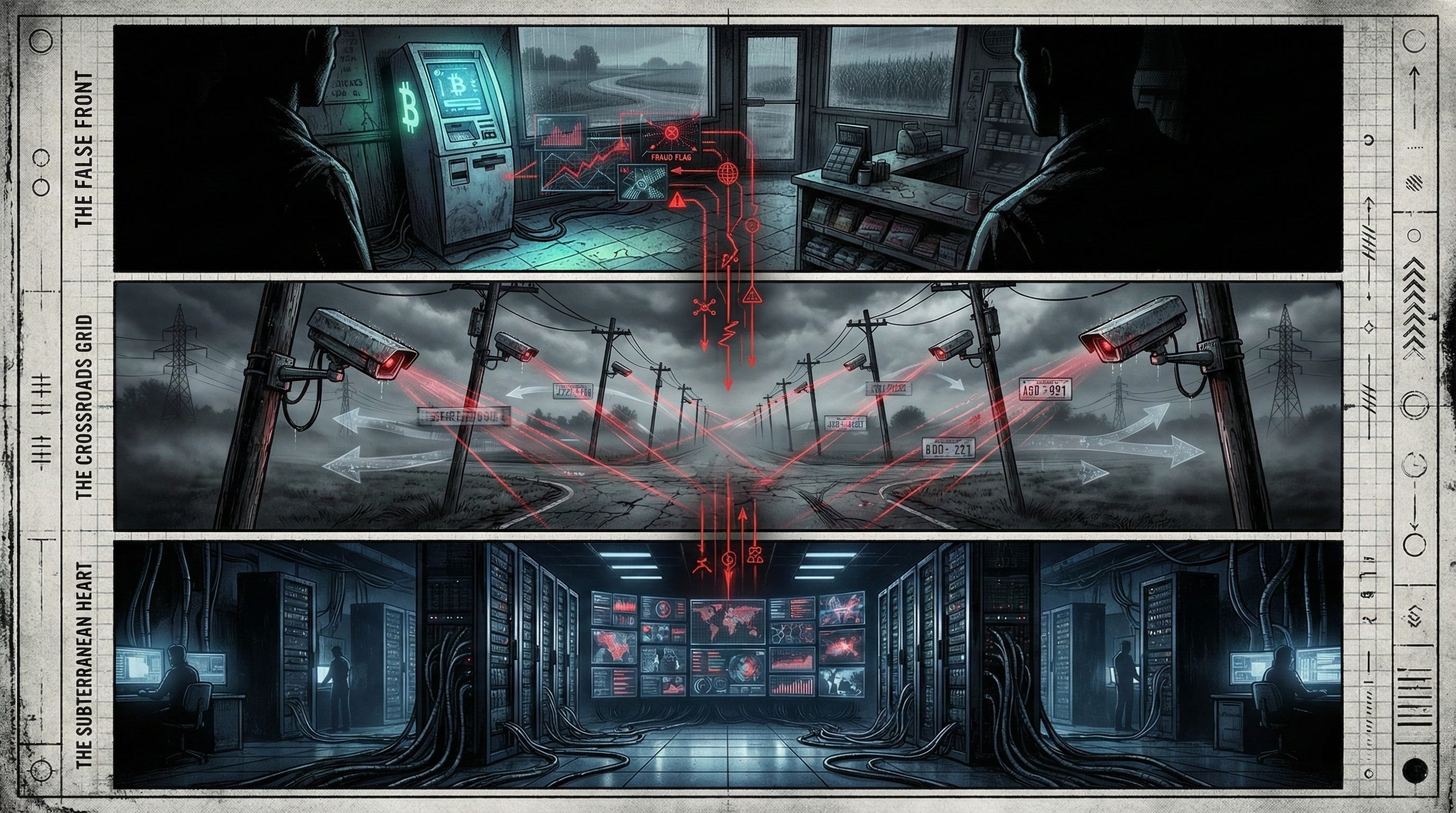
Part I of the Warrantless Surveillance Series By Restoring Democracy's Promise. Part II is here.
I. The Widow’s Obituary
Attorney General Brenna Bird is a gifted storyteller.
When she filed lawsuits this year against Bitcoin Depot and CoinFlip — the two largest cryptocurrency ATM operators in Iowa — she described a crime almost operatic in its cruelty: international scammers scanning obituaries, calling newly widowed Iowans, and coercing them into draining their life savings.
She wasn’t alone. Twenty Republican attorneys general across the country launched parallel actions using strikingly similar language, timing, and legal theories — part of the increasingly coordinated enforcement model advanced by the Republican Attorneys General Association (RAGA), whose members frequently act in tight policy alignment.
The story Bird told was powerful. It was emotional. It was politically effective.
And it was incomplete.
Because while the widow is real and the crime is real, the target of Bird’s lawsuit — the crypto ATM machine — is not the source of the crime at all.
II. The Wrong Target
The state’s own filings concede a simple fact: The scammer is never standing at the ATM.
They’re in Cambodia. Or Laos. Or Nigeria. Or a boiler room in Dubai.
The fraud is executed through weeks of social engineering:
Fake Amazon refund calls
Romance scams
“Grandson in jail” emergency scripts
Pig-butchering tactics targeting older Iowans
The victim — often elderly, often grieving, often isolated — is manipulated into withdrawing money and depositing it into a stationary kiosk at a gas station.
Bird’s lawsuit blames the kiosk. Not the scammer. Not the pipeline that brings the call into the home. Not the law enforcement gaps that allow the syndicates to flourish.
Her stated remedy?
A fee reduction from ~23% to ~15%, and a warning sticker.
Ask any fraud analyst: A sticker does not stop social engineering. It only makes the last mile of the scam cheaper.
Nothing Bird sued for actually disrupts the crime itself.
III. The Hidden Architecture: Surveillance Disguised as Safety
If Bird’s lawsuits don’t stop the scammers, then what do they accomplish?
The answer lives in the structural center of her new crypto law — Senate File 449, Iowa’s new digital financial asset kiosk law, was passed in 2025 during the 91st General Assembly with Bird’s full support and direct policy shepherding. Now codified as Iowa Code § 533C.1004, the law contains a clause buried in its quiet middle that has gone almost entirely unnoticed:
“An operator shall use blockchain analytics software… to detect transaction patterns indicative of fraud or other illicit activities.” — Iowa Code § 533C.1004(7)(c)
In a single sentence, Iowa rewrote consumer protection into a data-extraction regime — one where every “fraud prevention” transaction becomes raw material for permanent behavioral surveillance.
What looks like a safeguard is, in structure and effect, an intake valve — converting the grief of Iowans into analytic fuel for a surveillance architecture that no one voted for and no one can audit.
This is the hidden architecture of the law.
It doesn’t block scam calls. It doesn’t disrupt foreign networks. It doesn’t stop international syndicates.
What it does is create a statewide financial-pattern surveillance system operating through private vendors, outside public view, and outside the constitutional safeguards that normally apply to government monitoring.
To detect “patterns,” the system must first collect them. To collect them, it must log them. To log them, it must retain them. To retain them, it must analyze them. And to analyze them, it must centralize them.
This is the purpose of Bird’s analytics requirement — not to stop crime, but to institutionalize the permanent collection and analysis of Iowans’ financial behavior.
And Bird didn’t design this model alone. The same analytics-first, surveillance-under-consumer-protection strategy is being pushed by 29 other Republican attorneys general as part of a coordinated RAGA-aligned enforcement wave.
Crypto wasn’t the target. The data was.
IV. The Pattern: From Crypto to ALPR to National Surveillance
Bird’s office justifies the law as protecting Iowans from fraud. But the operational design — analytics, pattern detection, external vendors, and cross-jurisdictional sharing — is identical to the statewide expansion of ALPR surveillance through Flock Safety.
The structure is the same:
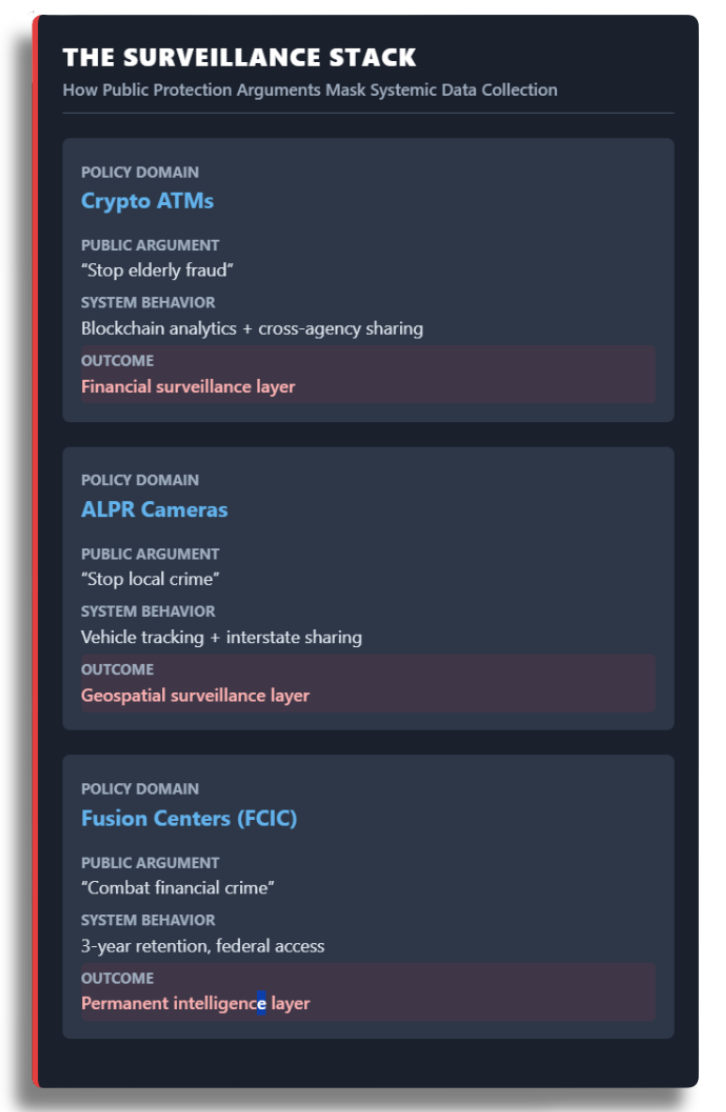
In each case, the public narrative is protection. The operational reality is infrastructure.
Infrastructure built through private vendors. Infrastructure that bypasses open records. Infrastructure that routes through Texas, where data becomes “intellectual property” exempt from disclosure. Infrastructure that returns to Iowa in forms the public can never FOIA.
This is the model. This is the pattern. And Bird is Iowa’s primary fulcrum for it.
V. The Performance of Protection
We are watching a $20 million performance.
Bird gets headlines. RAGA gets policy victories. Analytics vendors get contracts. Fusion centers get data. Federal agencies get access. Foreign scammers keep scamming.
The only Iowan who loses is the widow Bird used as a political prop.
Her phone still rings. The criminal still calls. The ATM fee is slightly lower. And the only system that actually grew stronger was the surveillance architecture tracking her behavior — not the scammer’s.
“Cryptocurrency wasn’t the crime scene — it was the gateway. In Bird’s Iowa, the scammer keeps the money, the state keeps the data, and the victim keeps the illusion that someone protected her.”
VI. References
American Bankers Association. (2025). Iowa targets crypto ATMs for role in alleged scams. ABA Banking Journal. https://bankingjournal.aba.com/2025/03/iowa-targets-crypto-atms-for-role-in-alleged-scams/
Bird, B. (2025, February 27). Attorney General Bird sues crypto ATM companies for costing Iowans more than $20 million [Press release]. Iowa Attorney General’s Office. https://www.iowaattorneygeneral.gov/newsroom/attorney-general-bird-sues-crypto-atm-companies-for-costing-iowans-more-than-20-million/
Bitcoin Depot. (2025). State of Iowa investigatory materials (Redacted Petition). Iowa Attorney General’s Office. https://www.iowaattorneygeneral.gov/media/cms/Final_Bitcoin_Depot_Petition_Redact_4FC03C49F36FD.pdf
Iowa Fraud Fighters. (2025, July 3). Attorney General Bird reminds Iowans of new crypto law now in effect. https://iowafraudfighters.gov/2025/07/03/attorney-general-bird-reminds-iowans-of-new-crypto-law-now-in-effect/
Iowa Legislature. (2025). Senate File 449: Consumer Protection and Cryptocurrency Transactions. https://www.legis.iowa.gov/docs/publications/LGI/91/SF449.pdf
Radio Iowa. (2025, February 27). Iowa Attorney General suing cryptocurrency companies. https://www.radioiowa.com/2025/02/27/iowa-attorney-general-suing-cryptocurrency-companies/
Regulatory Oversight. (2025). State AGs allege Bitcoin ATMs increasingly facilitate scams. https://www.regulatoryoversight.com/2025/03/state-ags-allege-bitcoin-atms-increasingly-facilitate-scams/
San Francisco Standard. (2025). SFPD’s illegal Flock data sharing exposed. https://sfstandard.com/2025/09/08/sfpd-flock-alpr-ice-data-sharing/
NextGov. (2025). States inadvertently share driver data with ICE, lawmakers warn. https://www.nextgov.com/digital-government/2025/11/nearly-20-democratic-states-inadvertently-share-driver-data-ice-lawmakers-say/409469/
Texas Department of Public Safety. (2025). License Plate Reader User Agreement (MOU). https://www.dps.texas.gov/sites/default/files/documents/administration/crime_records/pages/lprmou.pdf
Texas Legislature. (2025). SB 1499 / HB 3109: Financial Crimes Intelligence Center Act. https://fastdemocracy.com/bill-search/tx/89/bills/TXB00075959/
Jesus. Perfectly analagous to Hannah Arendt's observations on banality. I clearly don't yet have a sufficient stock of canned goods sufficient for 'thriving' in the 'new economy' . Thanks for this reporting AND insight.
Tim Long, Just Up the Hill from Lock 15.