

The SAVE America Act: From Voter Verification to Identity Infrastructure
Why the Bill Matters Beyond Voting

On its face, the SAVE America Act (H.R. 1238) appears to be a straightforward effort to prevent noncitizens from voting: run names through a federal database and remove anyone who isn’t a U.S. citizen.
But beyond politics, this is a systems-architecture decision. Once you follow the data flows, you realize the capabilities extend far beyond elections. The SAVE America Act does not create a new verification system. It codifies one already active.
Using legislative backfill, the SAVE Act provides regulatory cover while formalizing and nationalizing a verification system already partially operational through executive agreements and federal–state data exchanges.
The bill doesn’t just check IDs. It mandates that states route entire voter rolls through federal immigration databases, extends photo‑ID mandates that push millions more voters into DMV systems, and deepens data pipelines between election officials, motor‑vehicle agencies and the Department of Homeland Security (DHS).
In other words, it tries to turn DHS’s Systematic Alien Verification for Entitlements (SAVE) database into a national citizenship-eligibility verification tool that elections are then forced to rely on.
Supporters frame it as fraud prevention; critics see something larger: the construction of a unified identity framework.
Once state election databases, DMV records and federal immigration data are stitched together, those pipes can be used for more than checking citizenship. The legislation encourages the creation of cross‑system identifiers—sometimes join keys, linkage keys or unique linking IDs—that allow disparate systems to match a person across agencies and states.
When Verification Meets Reality
Three states have tried to use SAVE or similar systems to purge rolls. Their experiences reveal technical and civil‑rights problems that the federal bill doesn’t solve.
Texas: When the System Broke
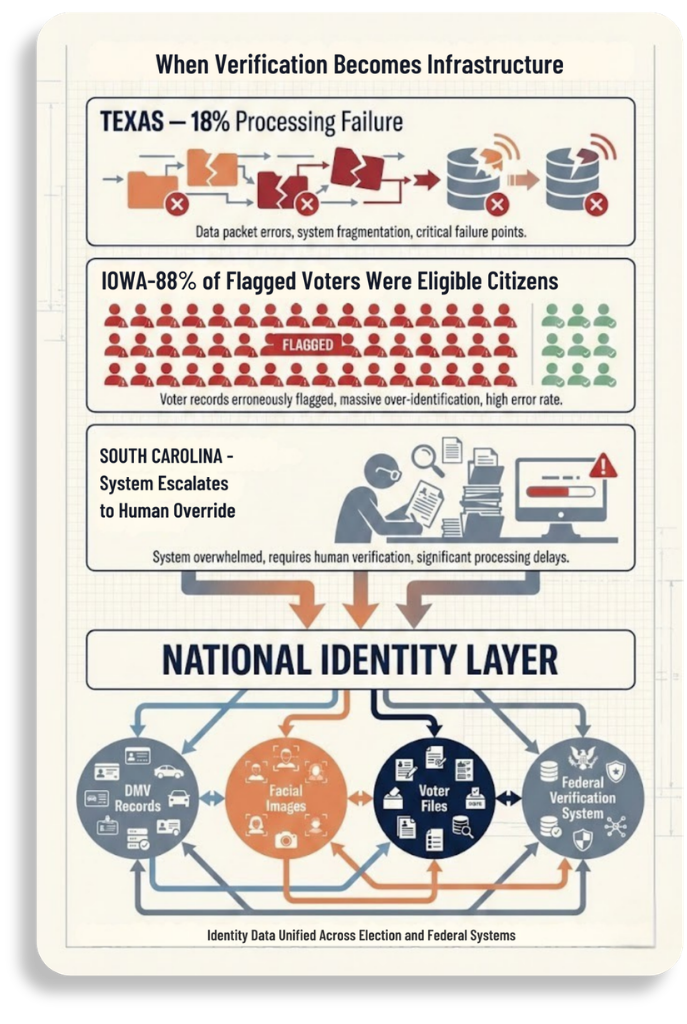
During a pilot program, Texas ran 1,657 voter‑file records through the updated SAVE system. Because SAVE was built to verify benefits eligibility for specific individuals, it was never designed for bulk election screenings. Roughly 300 queries failed outright, an 18 % processing failure rate blamed on duplicate entries, formatting differences and other data problems. In other words, nearly one in five records couldn’t be resolved.
In engineering terms, that isn’t statistical noise. It’s structural instability. The SAVE verification system wasn’t designed for this caseload.
Iowa: When Citizens Were Flagged as Suspects
In 2024 the Iowa secretary of state used old DMV records to mark 2,176 registered voters as potential noncitizens. The list was kept secret, and the targeted voters received no notice. Civil‑rights groups sued and discovered that only 277 of the 2,176 were not U.S. citizens. At least 88% of those flagged were U.S. citizens, many of them naturalized citizens whose earlier lawful permanent resident records had never been updated in legacy DMV files. The American Civil Liberties Union (ACLU) of Iowa argued that the program was a “discriminatory and unreliable” attempt to undermine voters of minority race and naturalized citizens.
The system is most confident where it is most wrong. Naturalized citizens.
South Carolina: The Data Demands Expand
South Carolina’s experiment, outlined in 2023 planning documents, highlighted the same structural weaknesses.
Officials warned that SAVE data would miss naturalisation updates, mis‑match names and require manual follow‑up in a large number of cases. In effect, the state would have to build a parallel review process to account for stale or ambiguous matches.
These are not passive verification fields. They are structural linking mechanisms — persistent identifiers that allow records to match and migrate across agencies.
Figure 1 summarizes the real world results.
The technical failures are only part of the story.
How Identity Keys Become Infrastructure
To match voter rolls to immigration data, states need more than names and birth dates. They need persistent identifiers that can link records across systems. The SAVE America Act encourages states to work with DHS and DMVs to create or access “golden records” and cross‑agency linking identifiers.
As we outlined in Part 4 of our series, DHS and states have already signed memoranda of understanding (MOUs) that let election officials query SAVE and DMV data in bulk. The technical paperwork describes linkage keys built from Social Security numbers, driver‑license numbers or other unique codes. Such keys make it easy to join disparate databases, but once they exist they can be used far beyond voter registration. The Department of Homeland Security has already proposed linking these records to facial images at DMVs and state agencies.
These cross‑system keys or persistent identifiers are quietly building a national identity layer. Voting systems do not need to see your face to confirm your citizenship. Yet the architecture increasingly allows them to. Those links can be reused for other purposes—from tracking immigration enforcement to matching protest footage to driver‑license photos. Once facial images and DMV records are linked to voter files, we leave election administration and enter the world of persistent person-tracking.
Our earlier report showed that this architecture already exists thanks to MOUs signed between DHS, the Social Security Administration and several states. The SAVE America Act would codify that infrastructure rather than building it from scratch.
Experts Warn the Infrastructure Is Unstable
Civil‑rights attorneys warn that the bill’s underlying technology threatens more than voting rights. After the Iowa purge, Rita Bettis Austen, legal director of the ACLU of Iowa, said that the program was an “unjustified, intimidating effort” that risked disenfranchising eligible voters.
National ACLU attorney Jonathan Topaz said the Iowa list targeted citizens and “created a real risk that those voters would be wrongfully denied their right to vote”. Election officials involved in pilot programs also noted that using SAVE at scale would produce many false matches and require manual adjudication, undermining the supposed efficiency of automated checks.
Even immigration analysts have raised alarms. They note that linkage fields designed for benefits management can be repurposed for surveillance. Once a person has a universal linking ID shared across agencies, it becomes trivial to aggregate travel records, DMV photos, health data and voting history. Such a system is ripe for abuse unless strict limits are imposed on data use and retention.
From a systems perspective, they’re describing the same failure mode Texas and South Carolina flagged in technical memos: a tool built for case‑by‑case checks behaves unpredictably when repurposed for bulk screenings inside election timelines.
From Election Law to Identity Records
For two decades, debates about voting have centered on ballots, access, and fraud prevention.
The SAVE America Act reframes the debate.
It does not simply adjust voting rules. It embeds voter eligibility into a broader identity verification architecture — one that links election systems to DMV databases, federal immigration records, and persistent identity keys that can outlive any single election cycle.
The question is no longer just:
Who is eligible to vote?
It becomes:
What permanent identity record is being built in the process of answering that question?
When voter verification requires interoperable identifiers, cross-agency matching, and photo-linked credentials, the scope expands beyond election law. It becomes a matter of how the state constructs, links, and retains identity records.
Infrastructure matters because infrastructure persists.
Election laws change.
Data systems endure.
That is the shift this bill represents.
References
American Civil Liberties Union of Iowa. (2026). Settlement agreement reached in ACLU, LULAC lawsuit over “potential noncitizens” voter list.
Texas Secretary of State filings (2025). SAVE system pilot testing documentation.
South Carolina election planning documents (2023). SAVE integration memoranda.
U.S. Department of Homeland Security. (n.d.). Systematic Alien Verification for Entitlements (SAVE) program.
U.S. House of Representatives. (2026). H.R. 1238 — SAVE America Act.
That’s the second nefarious part of the bill. It removes local control and tracks how each person votes.
One can extrapolate a nightmare future in which a government could track ever more granular information about individuals.
Taking this to the ridiculous: Do I want a government that can discern whether I use tampons or sanitary napkins? Or how many? Or…