

This story builds on our Leviathan and warrantless‑surveillance reporting, which has traced how Iowa records can move from state agencies into federal systems. The new court rulings don’t start that story — they raise the stakes on the question we’ve been asking for months: what data moved, who authorized it, and where is the audit trail?
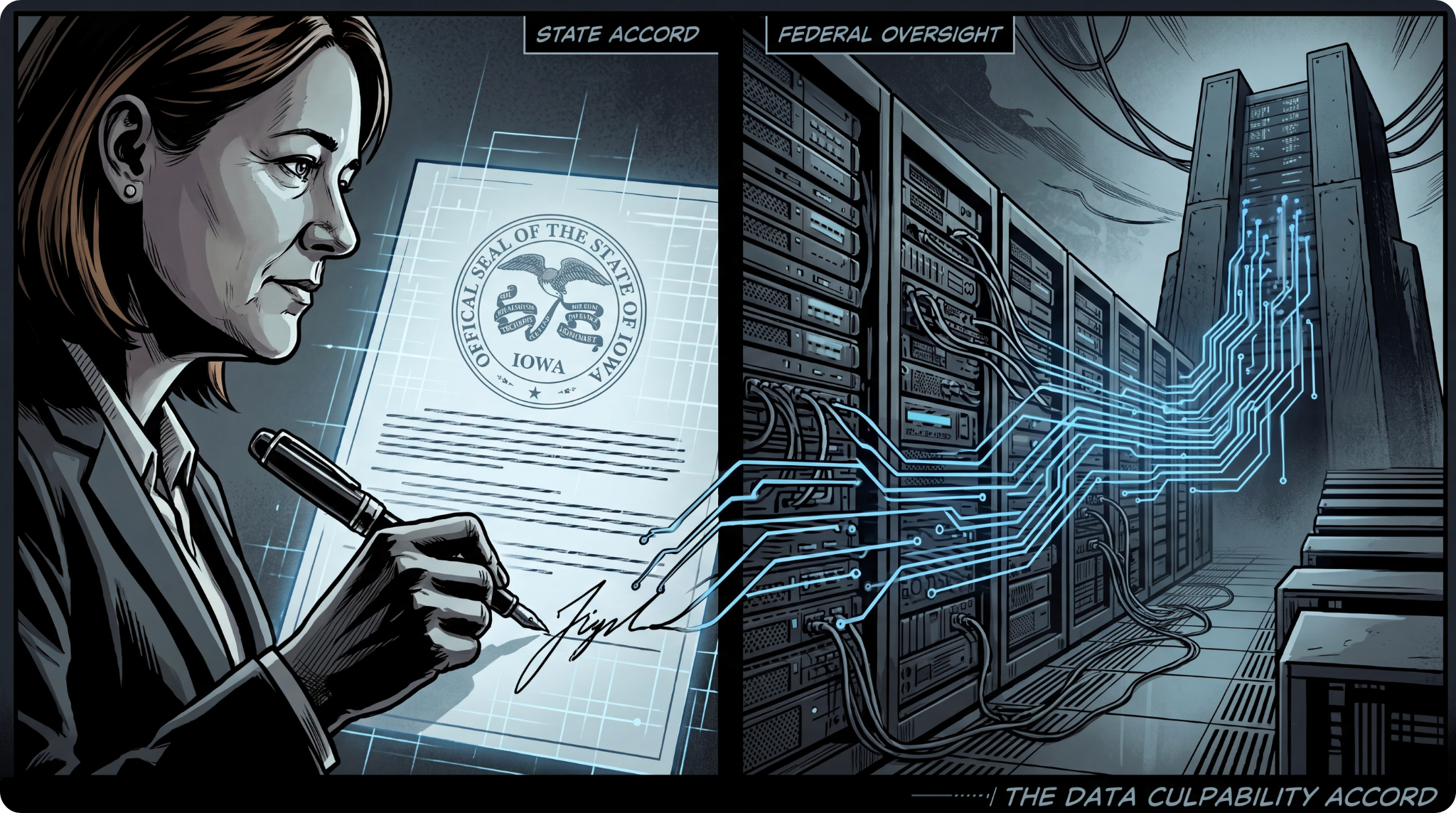
On June 22, 2026, a federal judge in Washington threw out the machine. In League of Women Voters v. U.S. Department of Homeland Security, Judge Sparkle L. Sooknanan vacated the 2025 "modified" Systematic Alien Verification for Entitlements system (SAVE) along with two related System-of-Records Notices, one from the Department of Homeland Security and one from the Social Security Administration. She did not mince words. The federal agencies, the court found, "haphazardly combined and repurposed the private information of millions of Americans, including citizenship data that they knew to be unreliable," and in doing so "knowingly trampled on the privacy rights of American citizens in a manner that threatens the sacred right to vote." The overhaul was unlawful three times over: it violated the Social Security Act's bar on disclosing Social Security numbers, breached the Privacy Act, and exceeded the agencies' authority under the Administrative Procedure Act.
Iowa matters because its own records place the state at the front end of this machine, not once but twice. Two of its highest officials opened the doors. The record of what happened to Iowa’s data at the back end has never been produced.
The national scoreboard: when states fight, they win
The SAVE ruling landed on top of a pattern that has only grown since we first wrote about this architecture in December 2025. The Trump–Vance Justice Department has sued more than 30 states and the District of Columbia, demanding unredacted statewide voter‑registration lists. As of June 24, nine federal district courts have already rejected those demands, and the campaign is winless where judges have reached the merits.
On June 18, a Maryland court denied DOJ’s motion to compel and dismissed its suit, noting that the case was “one of thirty similar lawsuits” and that eight had already been dismissed. Maryland made nine.
Six days later, the first appellate merits decision arrived. In United States v. Benson, a published Sixth Circuit opinion affirmed dismissal of DOJ’s Michigan case and held, 2–1, that Title III of the Civil Rights Act does not entitle the government to a state’s unredacted voter file. Because Kentucky sits in the Sixth Circuit, where DOJ is pursuing a nearly identical demand in United States v. Adams, the Michigan ruling is now binding precedent there as well.
Parallel to that litigation, Sooknanan’s ruling against DHS and SSA did something different: it shut down the modified SAVE system itself. The same database DOJ had acknowledged planning to use to “scrub aliens from voter rolls.”
Within forty‑eight hours of those defeats, Trump escalated. On June 24, he cancelled a planned Capitol Hill signing for a bipartisan housing bill that had cleared both chambers with support from both parties, and announced on Truth Social:
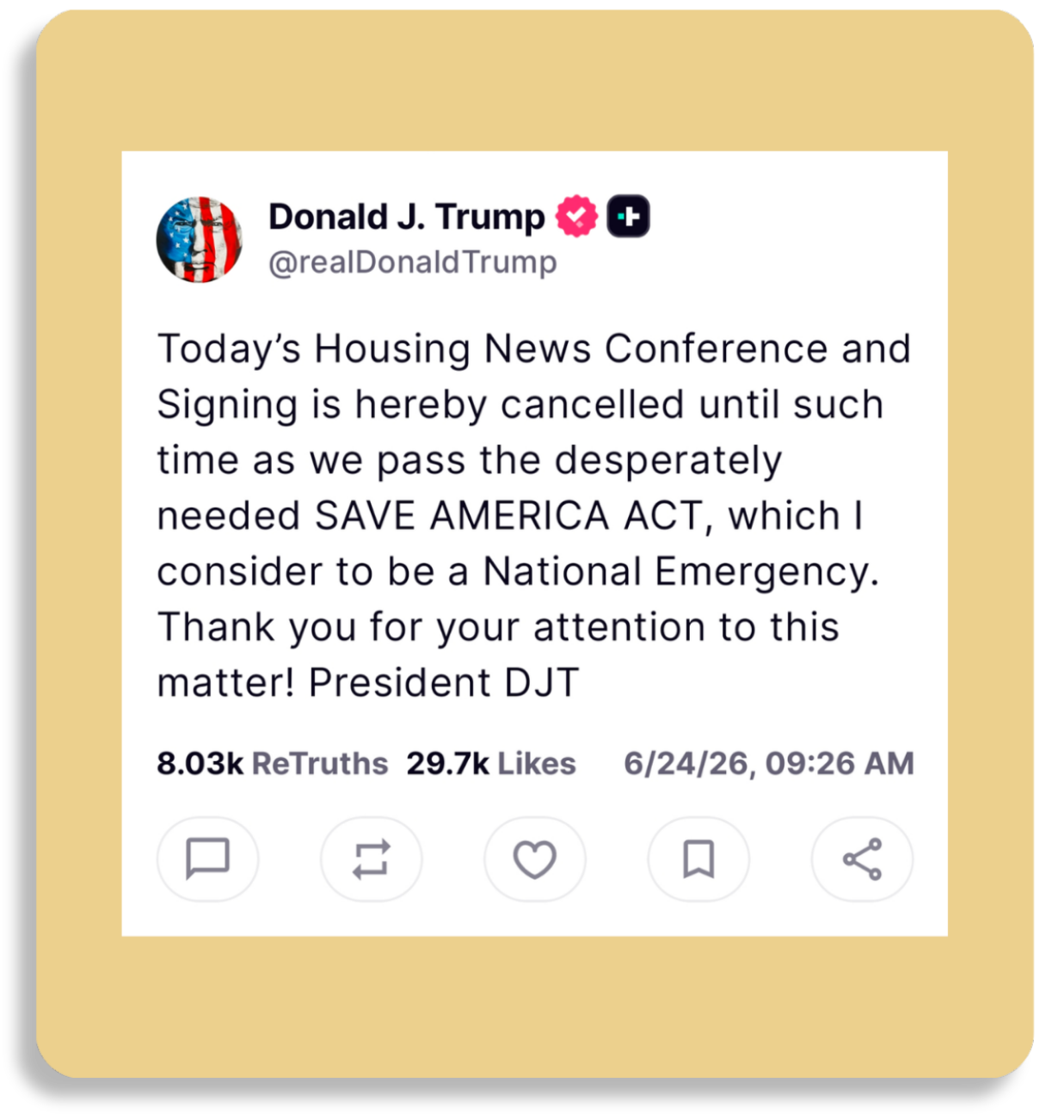
The SAVE America Act, the modified DHS SAVE database, and DOJ’s voter‑file lawsuits are not the same legal instrument; they are parts of the same political project: federal proof‑of‑citizenship and voter‑data control.
That sequence is not subtle: a string of court losses, then a presidential demand that Congress pass his voter‑data bill before an unrelated housing measure can move.
We Traced This Wiring Before It Blew Up
This didn’t start here. In December 2025, in Part 3 of our warrantless‑surveillance series, “SAVE: The Benefits Database Now Monitoring Every Licensed Iowan,” we documented how a September data scandal, an October state executive order, and a November federal settlement assembled Iowa’s access to the federal verification system, including a path from the state’s driver records toward the federal engine.
We showed that the SAVE America Act did not create a new verification system; it would codify an architecture that was already active. We traced DOJ’s “confidential” memorandum of understanding that turns SAVE into a de facto national eligibility gate, and we pulled Iowa’s own correspondence that plugged our state into that architecture.
This installment builds on that record with primary documents that have since entered the case: a federal ruling; a signed settlement; Iowa’s own correspondence; and sworn admissions from the Justice Department. The picture now is sharper. Iowa is not just in the wiring diagram. It is in the litigation record — twice.

Read the graphic as a map of the record, not a claim that every transfer has been proven. The documented doors are on the edges. The unanswered questions sit in the middle.
Two Doors, Not One
The two Iowa channels were legally distinct but politically connected. One ran through the Attorney General’s lane: a DHS/SAVE settlement that promised access, modernization, and long-term federal use. The other ran through the Secretary of State’s lane: the Justice Department’s demand for Iowa’s voter-registration list. Different documents. Different agencies. Different legal authorities. Same state. Same officials. Same missing audit trail.
Door One: The DHS/SAVE Settlement
The bridge from Iowa politics to federal plumbing has Iowa's signatures on it. On November 28, 2025, Attorney General Brenna Bird and Secretary of State Paul Pate were named plaintiffs—alongside Florida, Ohio, and Indiana—in a settlement with the Department of Homeland Security, filed in State of Florida, et al. v. U.S. Department of Homeland Security in the Northern District of Florida. Bird did not merely sign it; she celebrated it. Her office's press release announced an "Election Integrity Win"; said the deal "requires the Department of Homeland Security to provide Iowa officials with access to the federal immigration database"; and promised Iowa "free access" to the technology for 20 years.
The settlement itself is more specific than the victory lap. It commits the states and DHS to execute a new information-sharing agreement and a "new or updated" SAVE memorandum of agreement. It says each state plaintiff "may provide" DHS with 1,000 randomly selected driver's-license records—name, date of birth, license or state ID number, and state of issuance—to help develop and modernize SAVE. It gives DHS "full use" of state driver's license records through the Nlets network and the state licensing agencies. And then comes the part that should stop a reader cold: the agreement orders DHS to build into SAVE the exact capabilities a federal court would declare unlawful seven months later—bulk-upload verification, full- and last-four-digit Social Security number searches, and downloadable, "paper-verifiable" output—and asks the court to keep the whole arrangement under its jurisdiction for twenty years. Iowa's attorney general signed onto a 20-year deal to build the machine the D.C. court has now torn down.
Iowa is no bystander in the federal record that case produced. A government declaration filed in League of Women Voters v. DHS lists Iowa among the 27 states registered with DHS to use SAVE for voter verification—part of a system that, by the government's own count, processed 59.7 million voter-verification queries nationwide between January 2025 and April 2026. The administrative record in the same case also contains the Iowa Secretary of State's SAVE memorandum of agreement with DHS's immigration-services arm.
The settlement treats the 1,000-record driver sample as optional — each state “may provide” it — but the broader access architecture is not optional in the same way. The agreement gives DHS “full use” of state driver’s-license records through Nlets and state licensing agencies, and it asks the court to keep the arrangement under its jurisdiction for twenty years.
Door Two: The Transfer
The second channel is the Justice Department’s, and Iowa’s own records define it. Beginning in August 2025, DOJ’s Civil Rights Division asked Iowa for its statewide voter‑registration list. On Aug. 21, the Secretary’s office sent a link to its standard list — name, address, date of birth, and voter ID — and stated plainly that the file “does not include social security numbers or driver’s license numbers.”
By spring, the demand had grown to the unredacted list. In a March 5, 2026 letter, the Secretary of State’s office wrote that “after consulting with and receiving advice from the Iowa Attorney General’s office,” it would comply and hand over the unredacted data. On May 5, 2026, the office confirmed that Iowa “has complied” and that the list “was securely transferred” to the Department of Justice. That is the documented fact: Iowa took a compliance route while other states were litigating.
For a year, whether DOJ was funneling state voter data into DHS’s citizenship database was treated as an open question. It isn’t anymore. On September 11, 2025, a DHS spokesperson confirmed — on the record, to Democracy Docket — that voter‑registration data “being collected by the Department of Justice is being shared with” DHS to “scrub aliens from voter rolls.” Six months later, in a Rhode Island courtroom, DOJ’s acting Voting Section chief, Eric Neff, told a federal judge in plain language: “Our intention is to run this against DHS’s SAVE database.” The architecture is acknowledged at the top and admitted under oath in open court.
After Neff’s admission, the Justice Department filed a clarification stating that it had begun its own analysis but had “not shared the information with any other agency.” The intent is on the record; the completed, dated hand‑off of any single state’s file is the piece the government has not confirmed. That is precisely where Iowa’s missing record would speak.
What This Means for Iowa Voters
Here’s what this ruling and Iowa’s two federal “doors” actually mean for someone walking into a polling place in Iowa.
Iowa’s attorney general and secretary of state opened both doors: a 20‑year settlement to modernize SAVE’s verification capabilities, and a voluntary hand‑over of the state’s unredacted voter‑registration list after consulting the AG. No court order forced Iowa’s hand.
The modified SAVE system those decisions were built to feed has now been vacated as unlawful under the Social Security Act, the Privacy Act, and the APA. Judge Sooknanan found that the agencies “knew” some of the citizenship data they were relying on was unreliable, and that their overhaul “threatens the sacred right to vote.
DOJ’s own architecture routes each state’s roll through a secure federal file‑sharing portal that logs every transfer, and SAVE returns a verification case number and result for every query it runs. Those systems are designed to leave audit-trail records. Iowa has produced none of them.
In practical terms, that leaves Iowa voters with three risks and one opportunity:
Mis‑flagging. SAVE has already been found to flag U.S. citizen voters as “non‑citizens” when it relies on stale or mismatched data, a risk documented in NPR’s reporting and in litigation over voter‑purge efforts. An erroneous “tentative nonconfirmation” can translate into a letter demanding proof of citizenship or a quiet challenge to a voter’s right to cast a ballot.
Lack of notice. If Iowa has run its roll through SAVE or any DHS tool and received flags back, voters have not been told that their registration status might have been scored against a federal database a judge has now declared unlawful.
Accountability gap. In state after state, officials fought to keep that data out of federal hands, and judges agreed with them. Iowa went the other way. The proven story is one of participation and missing records: our officials opened both doors, and the trail of what moved through them has not been produced.
The opportunity is this: because the courts have now ruled, and because the architecture is documented, Iowa voters can demand to see what happened to their data.
What We Asked — And What You Can Do
We put these questions to the offices involved. We sent questions to the Iowa Attorney General’s office — about its role in the four‑state settlement and its advice to the Secretary of State on the separate DOJ request — and the same day filed an Iowa Code Chapter 22 request seeking any records that would show what became of Iowa’s data downstream. As of publication, the Attorney General’s office had not responded. We have also sent questions to the Iowa Secretary of State, DOJ’s Civil Rights Division, and DHS. This story will be updated if any office responds or produces responsive records.
In the meantime, here is what Iowa readers can do:
Check your registration. Use the Iowa Secretary of State’s voter‑lookup tool to confirm you are registered at your current address and that your status is “active.”
Tell us if you’ve been flagged. If you have received a letter from a county auditor, the Secretary of State, or any election office saying you must “cure” your registration, prove citizenship, or respond to questions about your eligibility, we want to hear from you. Send us a tip and, if you are comfortable, a redacted copy of the notice.
Demand the audit trail. Ask Bird and Pate — in writing — whether Iowa executed the settlement’s “new or updated” SAVE agreements, whether the “may provide” driver-record sample was sent, whether Iowa’s voter file was run through SAVE or any DHS tool, and whether any result, flag, or “tentative nonconfirmation” came back. If those transfers or queries happened, the systems are designed to leave records behind. Voters are entitled to know whether their registrations were scored against a system a federal court has now vacated.
Strip it to the question that matters. Two federal doors opened in Iowa within months of each other, both signed by officials who answer to Iowa voters. Voter data — and, through the settlement, potentially driver data — were positioned to move through them toward a system a court has now declared unlawful. Across the rest of the country, officials fought to keep that data out of federal hands, and judges agreed with them. Iowa went the other way. The proven story is one of participation and missing records: Iowa entered both doors, and the trail of what moved through them has not been produced. So the question is documentary, not rhetorical — who opened which door, what data moved through it, and where is the audit trail?
References
Primary legal & government records
League of Women Voters v. U.S. Department of Homeland Security, No. 1:25‑cv‑03501‑SLS (D.D.C. June 22, 2026) (memorandum opinion and order vacating modified SAVE system).
Settlement Agreement, State of Florida v. U.S. Department of Homeland Security, No. 3:24‑cv‑509‑TKW‑HTC (N.D. Fla. Nov. 28, 2025), ECF No. 30‑1.
United States v. Amore, No. 1:25‑cv‑00639‑MSM (D.R.I.): Transcript of Proceedings (Mar. 26, 2026); Notice of Clarification, ECF No. 46 (Mar. 27, 2026).
United States v. DeMarinis, No. 1:25‑cv‑03934‑SAG (D. Md. June 18, 2026) (memorandum opinion denying motion to compel and dismissing suit).
United States v. Benson, No. 1:25‑cv‑01148‑HYJ‑PJG (W.D. Mich. Feb. 10, 2026) (opinion dismissing DOJ’s Civil Rights Act Title III voter‑roll claim for failure to state a claim), aff’d, No. 26‑1225 (6th Cir. June 24, 2026) (published opinion affirming that Title III does not entitle the government to a state’s unredacted voter file).
Executive Order No. 14248, Preserving and Protecting the Integrity of American Elections, 90 Fed. Reg. 14,005 (Mar. 25, 2025).
Iowa Attorney General’s Office. (2025, December 1). Attorney General Brenna Bird secures election integrity win for Iowa [Press release].
Iowa Secretary of State. (2026, May 5). Secretary Pate releases statement on Department of Justice request [Press release].
Pate, P. (2026, March 5). Letter to Eric Neff, Acting Chief, Voting Section, U.S. Department of Justice, Civil Rights Division [Iowa Secretary of State open‑records production].
U.S. Department of Justice, Civil Rights Division. (n.d.). VRL/Data Sharing confidential memorandum of understanding [template; Iowa Secretary of State open‑records production].
Pending related litigation (reported)
American Civil Liberties Union. (2026). United States v. Adams [Case page].
Reporting (context)
Saksa, J. (2025, September 11). Trump administration sharing voter data across agencies, DHS confirms. Democracy Docket.
Brennan Center for Justice. (2025–2026). Tracker of Justice Department requests for voter information.
NPR. (2025, December 10). Trump’s SAVE citizenship tool is flagging U.S. citizen voters.
NPR. (2026, March 27). DOJ plans to share states’ sensitive voter data with DHS.
Rivas, Y. (2026, June 24). Trump DOJ suffers first appeals court loss in floundering voter roll crusade. Democracy Docket.
Prior Reporting
Tucker, T. (2025, December 10). SAVE: The benefits database now monitoring every licensed Iowan. Restoring Democracy’s Promise.
Tucker, T. (2026, February 18). The SAVE America Act: From Voter Verification to Identity Infrastructure. Restoring Democracy’s Promise.
Tucker, T. (2026, May 7). Iowa Handed Over the Voter Data — The Legal Blueprint Was Already There. Restoring Democracy’s Promise