

DHS Built a Four-State SAVE Workaround After a Judge Struck Down the 2025 System
One ruling forced the disputed features offline nationwide. Another judge ordered them restored for four states. The federal government’s answer was a special channel for those four states alone.
RDP ORIGINAL INVESTIGATION
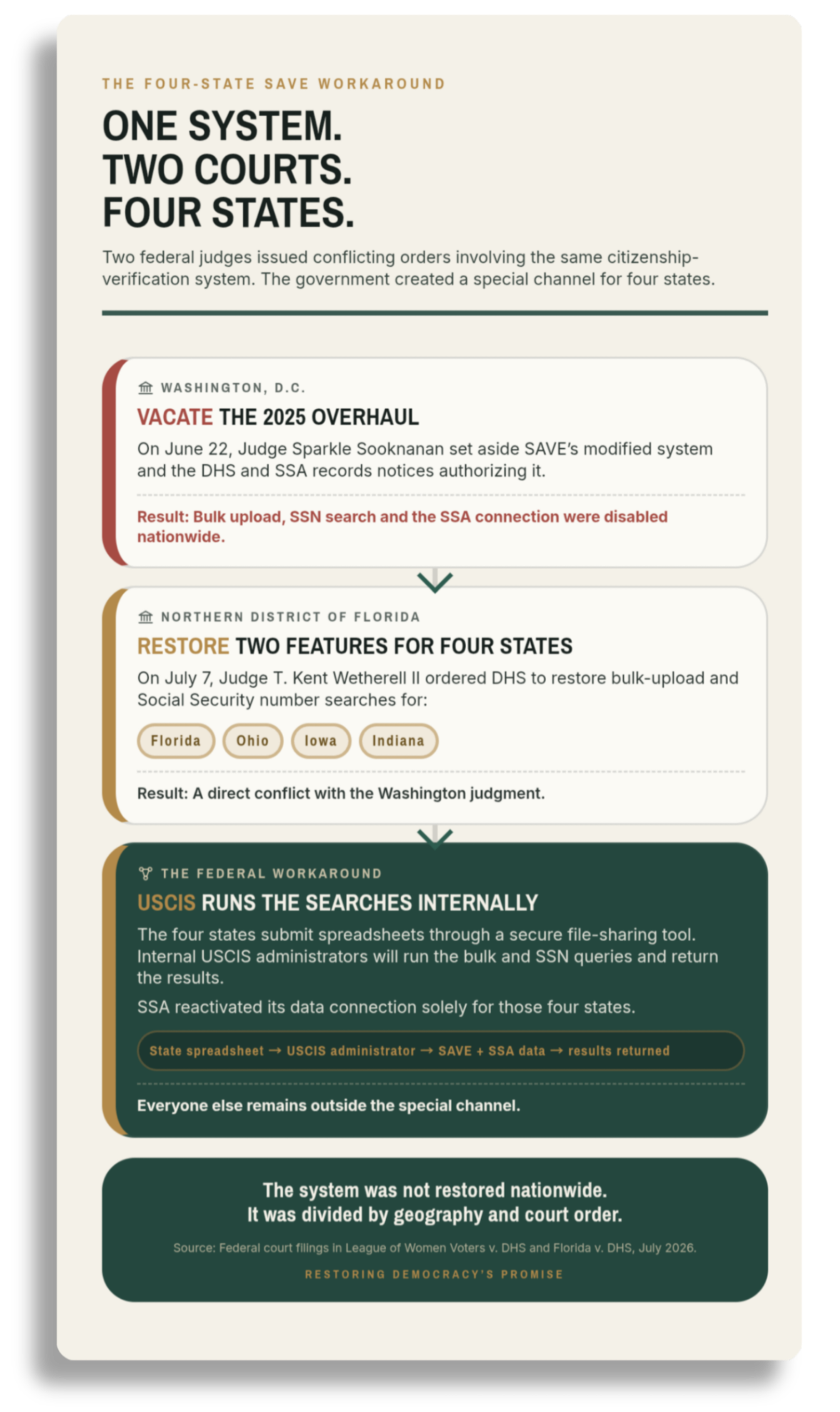
The federal government has told a judge in Washington how it plans to respond to two courts pulling the same citizenship-verification system in opposite directions. It will not restore ordinary SAVE access nationwide. Instead, Florida, Ohio, Iowa, and Indiana send spreadsheets through a secure federal file-sharing tool; USCIS administrators run the bulk and Social Security number searches internally; and Social Security has reactivated its data connection for those four states alone.
The arrangement appears in a July 10 Joint Status Report and three accompanying records, including sworn declarations from USCIS and the Social Security Administration. Together, they reveal not a nationwide restoration, but a geographically limited federal workaround.
The Exception was Already in the Paperwork
The four-state idea itself is not new. As RDP reported after the June ruling — building on our investigation dating to December 2025 — the court decisions did not begin this story. They exposed an architecture Iowa and the other settlement states had already spent months putting into place.
The settlement also contains a federal-law escape clause. Paragraph 17 says it imposes no duty on the government that is “inconsistent with” federal law — a reading the D.C. plaintiffs pressed and DHS itself acknowledged in an earlier briefing. Judge Sooknanan nevertheless rejected the settlement as a shield against relief and vacated SAVE’s 2025 overhaul. Just over two weeks later, the Florida court ordered restoration anyway.
The July workaround is the operational endpoint of a collision RDP has been documenting — and that has been visible in the federal paperwork — for more than seven months.
Inside the Four-State Workaround
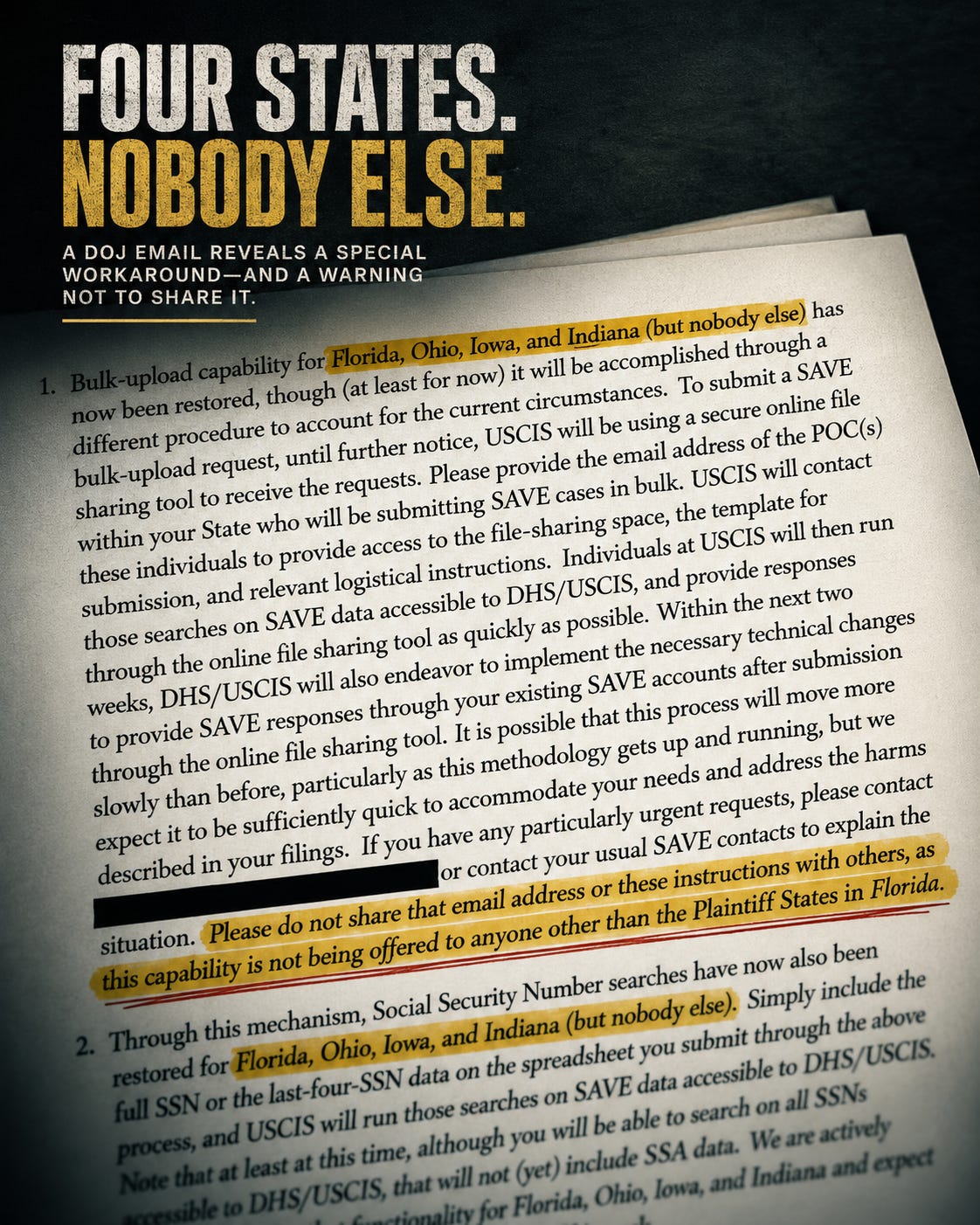
Pezzi’s July 9 email provides the clearest blueprint. “Bulk-upload capability for Florida, Ohio, Iowa, and Indiana — but nobody else — has now been restored,” he wrote, through a “different procedure” created for the circumstances.
Instead of running bulk or Social Security number searches themselves, the four states send spreadsheets through a secure federal file-sharing tool. USCIS employees run the queries against data available to DHS and USCIS, then return the results through the same channel.
The same arrangement applies to Social Security number searches. States can include full or last-four SSNs on the spreadsheet, and USCIS performs the lookup. The exclusivity was explicit: DOJ told the states not to share the address or instructions because the capability was not being offered to anyone else.
Broderick’s sworn declaration confirms who holds the keys: “Only internal USCIS administrators will have the ability to initiate SAVE queries in bulk and using an SSN.” This is not ordinary state access to a federal database. It is a closed, federally operated channel built for four states.
What Was Shut Down — and What Came Back
The declarations establish the sequence. On June 23, the day after the D.C. court vacated SAVE’s 2025 overhaul, USCIS disabled four capabilities nationwide: the bulk-upload tool, the API used for automated queries of SSA data, the SSN field for full and last-four searches, and related passport-query functionality. SSA disabled its API connection with DHS the same day and removed the vacated records notice from its website on June 24. Three automated test transactions slipped through on July 6. The government says they produced no response for any public SAVE user and were stopped the next day.
Then the machinery selectively reversed. On July 9, Broderick declares, USCIS began reenabling bulk and SSN-query capability for the four plaintiff states in the Florida case. That afternoon, per Steffensen, SSA reactivated the connection for use by DHS USCIS solely for the four plaintiff states. The Joint Status Report puts it flatly: SSA is making NUMIDENT records — the master file behind Social Security number verification — available for SAVE requests solely from Florida, Ohio, Iowa, and Indiana.
One timing seam remains. In the same July 9 email, Pezzi told the states their searches would run on DHS-held data that "will not (yet) include SSA data," with the SSA component expected "by the end of this week." The record does not yet establish precisely when SSA-backed responses began reaching state users end to end. The larger finding stands either way: the pipe was rebuilt, and it was rebuilt for four states.
“The ‘Partial Stay’ That This Court Denied”
The plaintiffs who won the Washington judgment do not treat any of this as compliance. In their half of the Joint Status Report, the League of Women Voters, the Electronic Privacy Information Center, and their co-plaintiffs argue that running the vacated system's features for four states — with no valid System of Records Notice in effect at DHS or SSA — violates the court's final judgment. They argue SSA was never a party to the Florida case and therefore faces no conflicting order at all.
On July 11, Judge Sooknanan put that question directly to Social Security. She ordered SSA to explain by 5 p.m. July 13 whether it is bound by the Florida consent decree or Judge Wetherell’s restoration order at all. In doing so, she pointed to Wetherell’s own acknowledgment that there is “merit” to the argument that SSA is not bound by his order.
The chronology gives their sharpest argument its teeth. The government asked the D.C. court for a partial stay covering exactly these four states. The D.C. Circuit did not grant an administrative stay and instead set a briefing schedule. The SAVE screening features came back on for those four states anyway — in the plaintiffs' words, the defendants are "effectively granting themselves the 'partial stay' that this Court denied."
If the dispute is not promptly resolved, the plaintiffs said they anticipate seeking an order requiring the defendants to show why they should not be held in contempt. No contempt motion has been filed to date. The government says it is complying with all outstanding orders "to the greatest extent possible" and proposes that the parties file a schedule for resolving the fight by 3 PM Monday, July 13.
For Iowa, the consequences of that legal collision were not abstract.
Why Iowa Matters
Iowa is one of the four states inside the special channel, and Iowa is where the workaround's stakes are most concrete, at least about voting.
The sworn declaration of Aaron Baack of the state's Department of Inspections, Appeals, and Licensing said Iowa had submitted more than 8,150 SAVE cases since December 2025, and that after the SSN pathway went dark, more than 350 professional licenses could not be verified and therefore could not be issued.
The immediate Iowa injury used to obtain emergency relief was not a challenged voter registration. It was a licensing system Iowa had wired into SAVE — with hundreds of licensure applicants waiting to work.
Iowa’s entanglement with SAVE runs through at least three doors: a voter-verification agreement at the Secretary of State’s Office, a licensing clearinghouse at the Department of Inspections, Appeals, and Licensing, and the state’s role as a plaintiff in the Florida settlement.
A memorandum of agreement between USCIS and the Iowa Secretary of State, dated January 22, 2025, sits in the federal administrative record in the Washington case, and a sworn USCIS declaration filed there last April lists Iowa among the states holding voter-verification SAVE agreements. But Iowa has not told the public what moved through those lanes.
Restoring Democracy's Promise sent questions to both the state Attorney General's Office and the Secretary of State's Office about Iowa's use of SAVE and received no response. A related public-records request was met with a blanket privilege response rather than operational records. Iowans still do not know whether Iowa voter or driver’s-license records were submitted to or processed through SAVE: not because the question cannot be answered, but because the state has not answered it.
Iowa’s own statute complicates the picture. Division VI, Section 35 of SF 2218 says the law’s verification requirements are suspended whenever the federal government does not provide Iowa access to SAVE. They resume automatically when access returns, and state and local officials face no liability for noncompliance during the interruption.
Iowa's own law, in other words, may contain a failsafe for the very federal disruption the state cited as emergency harm.
Whether Section 35 applies remains unresolved because Iowa never defined what counts as SAVE "access." Did Iowa lose access when the SSN search disappeared, or did the remaining query methods keep the law in force? Does the new federal spreadsheet workaround count as restored access? No Iowa official has answered, and the issue does not appear in the Florida filings. That matters because it could determine whether Iowa's verification mandates were suspended during the outage, and whether they are in force now.
The Florida Fight Widens
The Florida fight widened the same day. On July 10, the four states opposed LWV and EPIC's emergency request to enter the case and appeal Judge Wetherell's restoration order. They argue the groups waited too long after learning of the settlement in December and may not have standing to appeal if the federal government does not appeal. That filing is signed by counsel for Florida, Ohio, Indiana, the Iowa AG, and Iowa Secretary of State.
Hours later, the federal government filed its own opposition, also arguing that the request came too late. The sequence is striking. The federal government opposed the states' emergency motion to enforce the settlement, then began carrying out the order after the court ruled against it. It initially took no position on intervention — and now joins the states in trying to keep LWV and EPIC out of the Florida case. For now, the federal government and the four states are aligned against intervention.
The states' brief frames the litigation broadly, opening with their "obligations to maintain accurate and current voter registration records to prevent voter fraud, including non-citizen voting." Iowa's specific emergency harm declaration in this enforcement round remained licensing-focused. The intervention motion is pending and no ruling has been issued.
Learning the System from the Docket
The mechanics became public because a judge demanded an accounting. Neither DHS nor SSA has published an explanation of the four-state channel; no Iowa official has publicly addressed what the outage or the workaround means for the state's licensing backlog or its suspension clause. DOJ's email asked recipients not to share the address or instructions because the capability was not being offered outside the four plaintiff states. The dockets are, right now, the clearest public record of who can use the workaround, how searches are submitted, and who runs them.
Step back, and the litigation has exposed something larger than a fight between two judges. States have built everyday government functions around a shared federal identity system: SSA's NUMIDENT records, USCIS's SAVE service, state licensing programs, and voter-verification agreements. The legality of SAVE's 2025 overhaul is now before the D.C. Circuit on appeal. But the machinery itself is no longer hidden. The filings show who operates it, how the four-state workaround works, and which states received the special channel.
That workaround also emerged alongside a separate DOJ campaign to obtain statewide voter files and a May 2026 legal opinion asserting authority to share them with DHS — a parallel track RDP is investigating separately. The story is power moving through paperwork.
What Happens Next
Judge Sooknanan moved quickly after the workaround became public. On July 11, she ordered the Social Security Administration to file a notice by 5 p.m. July 13 explaining whether it is bound by the Florida consent decree and Judge Wetherell’s July 7 enforcement order.
She also directed the parties to meet by July 13 and try to resolve the dispute. If they cannot, the Washington plaintiffs have until July 14 to move to enforce or clarify the judgment. The federal government must respond by July 16, with a reply due July 17. The court told the parties to be ready for a hearing at 10 a.m. July 20 if one is needed.
The order places the narrowest and most consequential question squarely before SSA: what legal obligation, if any, required an agency that was not a party to the Florida case to reconnect its data for four states alone?
Until then, the basic sequence is clear. Judge Sooknanan vacated SAVE’s 2025 overhaul. Judge Wetherell ordered two of its features restored for four states. The federal government created a separate channel through which USCIS administrators can run those searches internally, while Social Security reactivated its data connection only for Florida, Ohio, Iowa, and Indiana. The Washington plaintiffs call it the four-state stay Judge Sooknanan refused to grant. The court is now demanding answers directly from SSA.