

Trump’s 278,000 Claim Rests on Two Searches the Government Has Not Explained
One came through SAVE. The other did not. Neither release shows enough methodology to validate the result.
In a primetime address on July 16, President Trump presented a federal review as having “identified approximately 278,000 non-citizens who are registered to vote in federal elections.” Because Democratic states had refused to share their files, he claimed, “the real number is actually much higher.”
The next day, his Homeland Security secretary, Markwayne Mullin, told the country that DHS had found “over 250,000 potential non-citizens illegally registered to vote in just 4 U.S. states,” and warned that election officials who received the administration’s information and declined to act could face “fines,” “penalties” and “prison time.”
The 278,000 figure does not appear in any of the 58 supporting documents the White House released alongside the address. RDP reviewed all of them. Exactly one addresses noncitizen registration: an undated, one-page DHS sheet titled “PREVENTING ALIEN VOTING.” It contains no 278,000 — only two other numbers, describing two populations found two different ways, and it explains the method behind neither.
That is the rhetoric. Here is the record.
Two Searches, One Headline Number
SAVE, the Systematic Alien Verification for Entitlements program, was not built as an elections tool. It started as an immigration and public‑benefits database, designed to let agencies verify status for things like Medicaid and driver’s licenses. In 2025, the administration wired it into a broader identity stack and began using it to screen voter rolls at scale. RDP has been following that shift since late 2025, documenting DOJ’s “confidential” SAVE memorandum with states and the 26‑state pattern of federal data‑sharing it created.
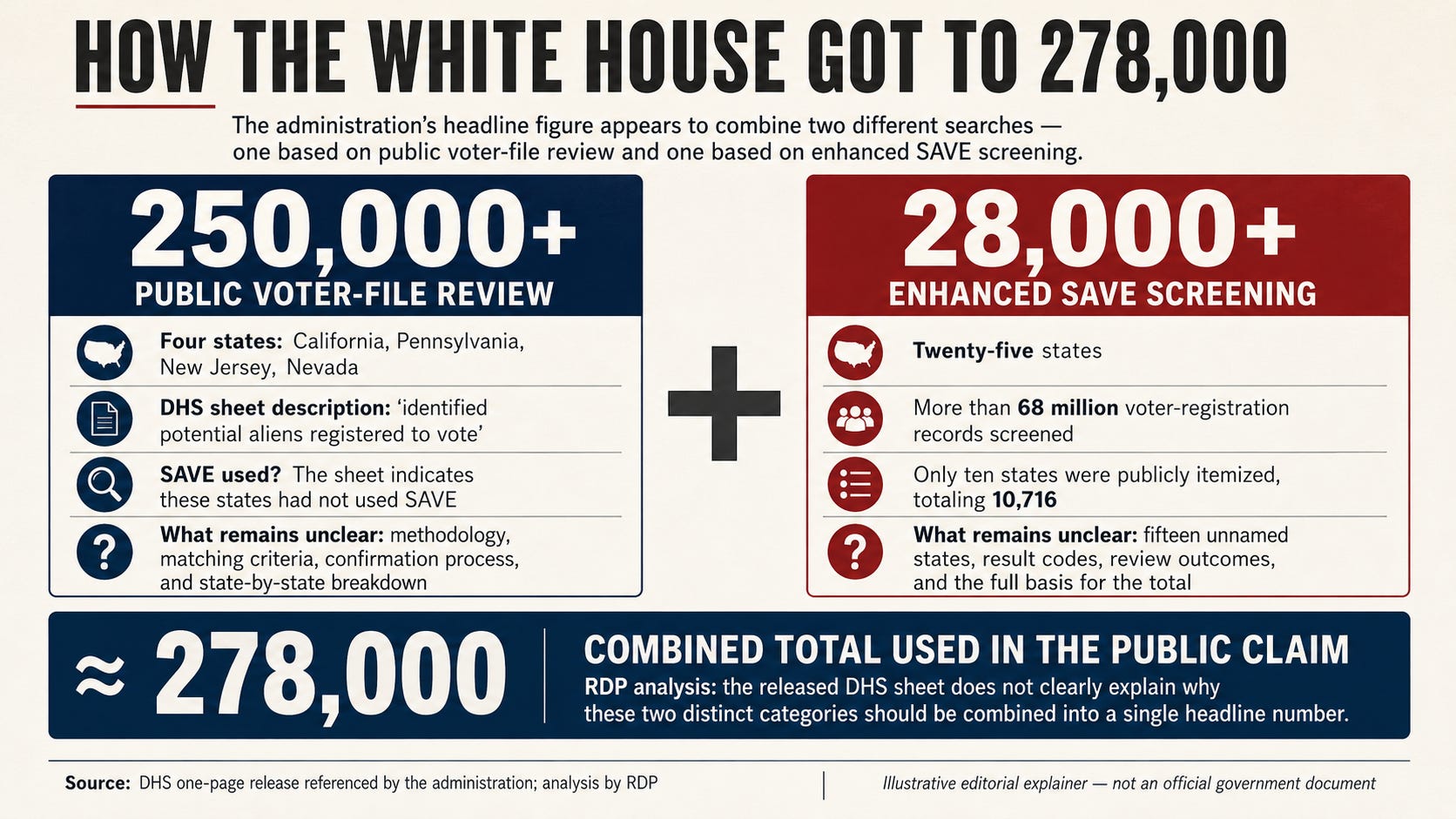
The sheet’s first figure is “over 250,000” noncitizens supposedly registered in California, Pennsylvania, New Jersey and Nevada, four states the document itself says had “not utilized the SAVE system.” That population came from a review of “public voter files.”
The sheet does not say what those files were matched against, what established noncitizenship, whether any match was confirmed or reviewed by a person, or how a wrongly flagged citizen could contest it.
Mullin acknowledged that DHS still needed additional records from those states to determine whether the people it had identified actually voted and where. The department might have to obtain that information through public-records requests, he said. That does not explain how DHS generated the 250,000 figure. It does show that the individualized review needed to move from a database flag to an enforceable finding was unfinished when the administration announced the number.
The sheet’s second figure is “over 28,000” noncitizens, drawn from the “enhanced SAVE system” — through which, it says, 25 states processed more than 68 million registration records as of June 22, 2026.
Here the document discloses a little more: a table headed “Proactive SAVE User States,” with deceased and noncitizen counts for ten states. The “noncitizen” column sums to 10,716, roughly 38 percent of the claimed 28,000. The document labels the table “sample data.” Fifteen of the 25 states go unnamed, and the balance is assigned to no state at all.
SAVE returns result codes that distinguish a confirmed match from a case needing further checking. The release discloses none of them, and never says how many of the 28,000 were tentative matches rather than settled findings.
Add 250,000 and 28,000 and you get 278,000. That sum is our arithmetic. The sheet doesn't tell the reader that the President’s headline number stitches together a database-screening program and a separate review of public files in states that, by the document’s own account, never used the SAVE program.
The government’s own language is inconsistent. The one-pager’s headline says the registrants “ARE ILLEGALLY REGISTERED.” Mullin, a day later, called them “potential.” Trump’s number carried no qualifier at all. These are official statements. They are not independently validated findings, and the distance between those two things is the whole story.
A Flag Is Not a Finding
A registration is not a vote. Nothing in the release shows that any of these registrants cast a ballot. A database match is not a legal determination of ineligibility; it means two records resemble each other, subject to a review the release does not describe.
The government knows the difference, because by its own account the confirming work is not finished. DHS was “going through these files one by one,” Mullin said, to determine for each person “did they vote? And… where do they vote at?” That is the description of a review still under way, offered as the basis for a number already presented to the nation as fact.
The distance between an initial flag and a confirmed finding can be large. As RDP previously documented from Iowa records and related litigation, Iowa’s own 2024 review initially flagged 2,176 registered voters as potential noncitizens; at least 88 percent turned out to be citizens.
That was a state review conducted outside SAVE, not a SAVE error rate, but it is a concrete measure of how far a flag can sit from a finding, and it is exactly the kind of secondary-review data the July release omits.
From Benefits Checks to Voter-Roll Screening
The distinction matters because SAVE was not designed to screen entire voter rolls.
The Systematic Alien Verification for Entitlements system is decades old. For most of its existence, agencies used it for case-by-case status checks in benefits and licensing decisions. An agency could ask whether a particular noncitizen held an immigration status that made the person eligible. Its transaction engine—the Verification Information System, or VIS, which also supports E-Verify—was built around that narrower function.
The 2025 changes altered both the scale and the population being searched. Bulk upload allowed states to submit entire lists at once. Searches using partial Social Security numbers allowed the system to reach beyond immigration-specific identifiers and query citizens as well as noncitizens.
The scale is documented. In a sworn declaration now in the appellate record, a senior USCIS official stated that 27 states had registered for SAVE voter verification by April 1, 2026, and that the system logged 59.7 million voter-verification queries during the preceding 15 months.
A case-by-case eligibility system was now processing voter records by the tens of millions. But scale alone does not show how state voter files reached the system. On that question, DOJ has now spoken in court.
The Pipeline is Now on the Record
The question is no longer whether DOJ intended to connect the voter files it collected from states to SAVE. DOJ said so in court.
In a March 26 hearing, DOJ’s acting Voting Section chief, Eric Neff, told a Rhode Island court, “we are certainly going to be proceeding with running this, our intention is to run this against DHS’s SAVE database.” He cautioned that steps remained before the government could claim full Privacy Act compliance. That's intent, not a completed handoff. But the intent did not stay a stray courtroom line.
In April, as Democracy Docket reported, Minnesota told a federal court that DOJ’s counsel had “confirmed that DOJ will in fact provide the list to DHS.” On May 12, DOJ’s Office of Legal Counsel issued an opinion titled “Authority to Obtain and Share Statewide Voter Roll Data,” supplying the administration’s legal theory for exactly that.
The new DHS sheet adds an official line of its own: DHS “will support the Department of Justice’s review of voter files obtained pursuant to their enforcement authority.” Those records establish the plan, the administration’s claimed legal authority and DHS’s promised participation. They do not establish that every state file completed that route. Iowa shows why that distinction matters.
Iowa appears in the record through two separate data channels. In the first, Iowa handed its statewide voter file to the Justice Department.
As RDP reported in May, Secretary of State Paul Pate said the state was “legally obligated to comply with the request,” and Iowa’s own public records show the transfer was completed through DOJ’s secure JEFS portal in March 2026, a staffer’s email confirming “the data transfer is complete.”
In the second channel, Iowa’s Department of Inspections, Appeals, and Licensing has been a direct SAVE user for professional licensing. Its interim director, Aaron Baack, swore on July 1 that Iowa began submitting cases in December 2025 and had submitted “more than 8,150,” with more than 350 licenses stalled when DHS disabled Social Security number verification the day after the D.C. court ruling.
Those licensing cases are not the voter file. And Iowa is no bystander in the litigation: its attorney general, Brenna Bird, is lead counsel on a four-state amicus brief filed in the D.C. Circuit on July 9, arguing to keep the screening system running.
The remaining Iowa question is specific: what happened after the voter file reached DOJ? The public record does not show whether DOJ sent it to DHS, whether any Iowa voter record entered SAVE, what matching rules or result codes were used, or whether anyone was flagged. The Iowa-to-DOJ transfer is documented. The downstream transaction record is not.
RDP has asked DIAL, the Attorney General’s Office, the Secretary of State’s Office and Iowa HHS which personal identifiers belonging to Iowans were sent to DHS. We have been asking for months. No state agency has provided a substantive answer.
The documented trail stops there. The state-by-state transaction ledger—and the validation data needed to measure false positives—has not been produced.
The same system was already under conflicting federal court orders when Trump delivered the speech. On June 22, Judge Sparkle Sooknanan of the federal district court in Washington vacated the 2025 SAVE changes. On July 7, a federal judge in Florida ordered DHS to restore two features for Florida, Ohio, Iowa and Indiana, and DHS created a workaround days later. The D.C. plaintiffs are seeking enforcement of the vacatur, while the four states are supporting continued operation of the system. The conflict remains unresolved.
The Law Congress Has Not Passed
Against that unresolved legal conflict, Trump asked Congress to give the disputed system an express statutory foundation. The vehicle he endorsed was the SAVE America Act—H.R. 7296, with a Senate companion, S. 3752.
Introduced on January 30, 2026, it has not passed the House and has not been marked up, contrary to claims after the speech that the House had already passed it. The bill that did pass the House, 220–208 in April 2025, is a different and narrower measure, H.R. 22, which has sat in the Senate since with no further action.
H.R. 7296 would convert the disputed machinery into law. It requires documentary proof of citizenship to register and photo identification to vote, in person and absentee, and writes SAVE into statute.
It orders federal agencies holding relevant information to hand it to a state election official within 24 hours of a request, batches included, and directs federal departments to share that information with one another to answer such requests.
The administrative changes enabling bulk screening and interagency data sharing were vacated as unlawfully implemented. H.R. 7296 would give much of that architecture an express statutory basis.
The bill contains no general restriction limiting mail voting to illness, disability, military service or travel, despite that promise appearing on the White House’s SAVE America page and in the address.
The SAVE America Act was not written in response to the June ruling; it was introduced nearly five months before the vacatur. The speech did not create the bill. It repurposed it.
The Expansion Did Not Begin With This Speech
Restoring Democracy’s Promise has treated SAVE as infrastructure for more than a year—following it from a benefits database into licensing, voter‑roll screening, inter‑agency data‑sharing and litigation.
We were on this beat before Trump made “SAVE America” the centerpiece of his speeches, reporting on DOJ’s SAVE MOU, Iowa’s voter‑file hand‑off, the federal court that vacated Trump’s revamped voter‑screening system, and the four‑state workaround DHS built in response.
The July 16 release adds another stage. The administration is asking Congress to make population-scale voter screening permanent while withholding the methodology, result codes and state-level records needed to test its central claim.
Trump gave the public a number. His administration did not provide the work behind it.
RDP will continue following the litigation, records requests and federal-state data exchanges as one connected investigation.
Restoring Democracy’s Promise has covered this beat since 2025. Subscribe to follow the litigation, the records requests and the data exchanges as they develop.
Further Reporting
SAVE: The Benefits Database Now Monitoring Every Licensed Iowan — and Every Driver, December 10, 2025
The 26-State Pattern: DOJ's "Confidential" SAVE MOU to Federalize Voter Rolls, December 31, 2025
The Department of Governance by Algorithm: How DOGE Built Cleta Mitchell’s Dream Machine, January 20, 2026
The SAVE America Act: From Voter Verification to Identity Infrastructure, February 18, 2026
Iowa Handed Over the Voter Data — The Legal Blueprint Was Already There, May 7, 2026
A Court Struck Down Trump's Voter-Screening System. Iowa Had Already Signed On Twice., June 25, 2026
DHS Built a Four-State SAVE Workaround After a Judge Struck Down the 2025 System, July 11, 2026